wayground logo

Free Printable Worksheets

Font size

S
M
L
XL
Worksheets

SOLAR SYSTEM AND EARTH SYSTEM quiz 2

Total questions: 85

Worksheet time: 1hrs 5mins

Name
Class
Date
1.
The law of universal gravitation is credited to whom?
a)
Einstein
b)
Galileo
c)
Darwin
d)
Newton
2.
Where would you have to travel to reduce your weight but not lose any mass?
a)
The moon
b)
The Sun
c)
Jupiter
d)
Saturn
3.
What model is where the earth is in the middle of our universe?
a)
Heliocentric Model
b)
Geocentric Model
c)
Moon phases
d)
Tidal Phases
4.
How long does it take the earth to make 1 revolution
a)
One year
b)
One day
c)
One hour
d)
One minute
5.
What Model is where the sun is the center of the universe?
a)
Geocentric
b)
Heliocentric
c)
Earth's rotations
d)
Earth's planets
6.
This image shows the:
a)
Geocentric Solar System
b)
Heliocentric Solar System
7.
Which planet in our solar system will have the fastest orbital  speed?
a)
Venus 
b)
Earth 
c)
Saturn 
d)
Mercury 
8.
Which statement is true about gas giants
a)
Gas giants formed close to the Sun and contain deep, gaseous atmospheres. 
b)
Gas giants have gaseous cores and rocky surfaces because the planets are far from the Sun
c)
Gas giants contain no rock or metals because the planets are too cold for these materials to condense. 
d)
Gas giants contain ices because these planets formed far enough from the Sun that these materials could condense. 
9.
How are Jupiter and Saturn similar? 
a)
They have the same density 
b)
They are close to the Sun
c)
They have many satellites.
d)
Made of mostly carbon dioxide. 
10.
Much of the surface of Mars is dry and dusty.  What weather conditions do winds on Mars most likely create on Mars?
a)
Rainstorm
b)
Hailstorm
c)
Dust storm
d)
Snow storm 
11.
Which of these tools enabled Galileo to study parts of the universe that had never been seen?
a)
Compass
b)
Geomtery 
c)
Mathematics
d)
Telescope
12.
Early historical models of the solar system were geocentric. Which of these phrases describes a geocentric solar system?
a)
the sun as a reference point
b)
existing in a star system
c)
Earth as a reference point
d)
circular, orbital path of travel
13.

About how long does it take for the moon to complete it's cycle?

a)

2 weeks

b)

365 days

c)

one month

d)

one week

14.
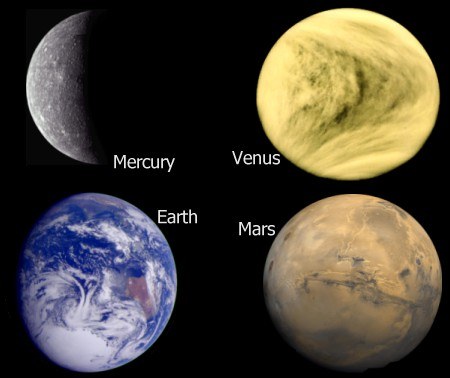
Mercury, Venus, Earth, and Mars are called.....?
a)
Jovian Planets
b)
Awesome Sauce Planets
c)
Gas Giants
d)
Inner Planets
15.
Which planet is the hottest?
a)
Earth
b)
Neptune
c)
Mercury
d)
Venus
16.
What do we call Jupiter, Saturn, Uranus and Neptune?
a)
Outer Planets
b)
Terrestrial Planets
c)
Inner Planets
d)
Oort Cloud
17.
What is the only planet known to contain life?
a)
Mars
b)
Earth
c)
Neptune
d)
Uranus
18.
What is one factor that makes life on Earth possible?
a)
Water
b)
High gravity
c)
Elliptical Orbit
d)
Hydrogen
19.
Which planet is now characterized as a dwarf planet?
a)
Neptune
b)
Pluto
c)
Miss Best
d)
Coca-cola
20.
Which is the largest object in our solar system?
a)
Sun
b)
Jupiter
c)
Earth
d)
Pluto
21.
Which is the second closest planet to the sun?
a)
Earth
b)
Saturn
c)
Venus
d)
Mercury
22.
Which planet is seventh from the sun?
a)
Saturn
b)
Earth
c)
Venus
d)
Uranus
23.

How many moons does Earth have?

a)

1

b)

2

c)

3

d)

4

24.

It's a big star that give us light.

a)

SUN

b)

MERCURY

c)

MARS

d)

VENUS

25.

This planet has rings.

a)

SATURN

b)

MERCURY

c)

MARS

d)

VENUS

26.

The biggest planet is...

a)

JUPITER

b)

EARTH

c)

MARS

d)

VENUS

27.

How many planets does the solar system have?

a)

1

b)

9

c)

5

d)

8

28.
What is the sun?
a)
a star
b)
a comet
c)
a planet
d)
an asteroid
29.

do the inner planets have rings

a)

yes

b)

no

30.

Quiz question!!! what is the coldest planet

a)

pluto

b)

neptune

c)

macrury

d)

saturn

31.

how long does it take for earth to spin on its axis once

a)

365 days

b)

25 hours

c)

24 days

d)

24 hours

32.

what is the order of outer planets

a)

Jupiter, neptune, uranus, and saturn

b)

jupiter, saturn, neptune, and uranus

c)

earth, venus, mars, and the sun

d)

Jupiter, saturn, Uranus, Neptune

33.

what separates the inner planers and the outer planets

a)

comets

b)

the asteroid belt

c)

there is nothing that does that

d)

the suns heat

34.

does the sun have a core

a)

yes

b)

no

35.
A ball of ice and dust with a tail of gas and dust pointing away from the sun.
a)
Asteroid
b)
Comet
c)
Moon
d)
Meteor
36.
A small object that appears as a streak of light as it enters earth's atmosphere.
a)
Asteroid
b)
Comet
c)
Moon
d)
Meteor
37.
A natural satellite of a planet.
a)
Asteroid
b)
Comet
c)
Moon
d)
Meteor
38.
Earth and the other planets closest to the Sun are made mostly of _______
a)
gas
b)
metal
c)
water
d)
rock
39.
One full orbit of an object around another object is called a ________.
a)
axis
b)
rotation
c)
revolution
d)
satellite
40.
Where is the asteroid belt found?
a)
between earth and mars
b)
Between Uranus and Neptune
c)
Between Mercury and Venus
d)
Between Mars and Jupiter
41.
Select the order from smallest to largest.
a)
Sun, Milky Way, solar system, universe
b)
Sun, Milky Way, universe, solar system
c)
Sun, solar system, Milky Way, universe
d)
Sun, solar system, universe, Milky Way
42.
Day and night is caused by the _____________ of earth on its axis.
a)
revolution
b)
orbit
c)
rotation
43.

One of the main differences between the outer and inner planets is __________.

a)

The inner planets all have water

b)

the inner planets are much bigger than the outer planets

c)

the outer planets are more moons

d)

the inner planets have rings, and the outer planets don't

44.

How long ago was our solar system formed?

a)

10 million years ago

b)

4.6 million years ago

c)

4.6 billion years ago

d)

2 billion years ago

45.

The theory that explains the formation of the solar system is called ____.

a)

Big Nebulis Theory

b)

Solar Nebular Theory

c)

Big Bang Theory

d)

Big Nebulan Theory

46.

Why is Venus Hot?

a)

Because It’s Orange and red

b)

Because it’s the same size as earth

c)

Because it’s clouds are hot

d)

Because it has a thick atmosphere

47.

What Is something unique to Uranus from the other planets?

a)

It’s spins on it’s side

b)

It’s upside down

c)

It’s tiny

d)

It orbits over the sun And under the sun

48.

What Is something on Neptune’s that’s deadly?

a)

The spinning

b)

The white on neptune

c)

none of the above

d)

Poisonous Gasses

49.

The moon get's it light from the

a)

Earth

b)

Sun

c)

Solar System

50.
The cycle of the moon lasts about a _.
a)
day
b)
year
c)
week
d)
month
51.
What is the name of the thin layer of solid rock that makes up the outermost part of Earth?
a)
core
b)
crust
c)
mantle
d)
biosphere
52.
All water on Earth is recycled through ____.
a)
the water cycle
b)
pockets of nitrogen
c)
exhaled gas
d)
dead organic material
53.
All living things on earth are part of the....
a)
Biosphere
b)
Geosphere
c)
Hydrosphere
d)
Cryosphere
54.
The Geosphere is...
a)
All liquid water on Earth
b)
A 100km thick layer of gases
c)
frozen water on earth
d)
Earths entire solid body 
55.
All frozen water on Earth is...
a)
Hydrosphere
b)
Geosphere
c)
Cryosphere
d)
Atmosphere
56.
Geo = 
a)
Earth
b)
Sphere
c)
Life
d)
Water
57.
Hydro = 
a)
Sphere
b)
Earth
c)
Life
d)
Water
58.
The Earth is composed of a complex set of cycles, parts and processes that all work together as a
a)
Planet
b)
Unit
c)
System
59.
Something that happens in a system like a volcanic eruption or factory fire is known as a(n)
a)
catastrophe
b)
disaster
c)
event
d)
hazard
60.
When carbon dioxide dissolves from the air into the ocean -the interaction is between
a)
the atmosphere and atmosphere
b)
the atmosphere and hydrosphere
c)
the atmosphere and geosphere
d)
the atmosphere and biosphere
61.
What is Earth's function?
a)
controls the distribution of minerals, rocks and soils and generates natural hazards that shape the land and impact humans
b)
a recycling planet powered by the flow of solar energy to support a network of life.
c)
sustains various life forms and plays an important role in ecosystems and regulating heat on earth.
d)
sustains life forms on the surface of the earth, absorbs and interacts with harmful  solar rays.It protects the earth from natural and human-caused space debris.
62.
What is the geosphere's function?
a)
controls the distribution of minerals, rocks and soils and generates natural hazards that shape the land and impact humans
b)
a recycling planet powered by the flow of solar energy to support a network of life.
c)
sustains various life forms and plays an important role in ecosystems and regulating heat on earth.
d)
sustains life forms on the surface of the earth, absorbs and interacts with harmful  solar rays.It protects the earth from natural and human-caused space debris.
63.
What is the hydrosphere's function?
a)
a recycling planet powered by the flow of solar energy to support a network of life.
b)
sustains various life forms and plays an important role in ecosystems and regulating heat on earth.
c)
sustains life forms on the surface of the earth, absorbs and interacts with harmful  solar rays.It protects the earth from natural and human-caused space debris.
d)
controls the distribution of minerals, rocks and soils and generates natural hazards that shape the land and impact humans
64.
What is the atmosphere's function?
a)
a recycling planet powered by the flow of solar energy to support a network of life.
b)
sustains various life forms and plays an important role in ecosystems and regulating heat on earth.
c)
sustains life forms on the surface of the earth, absorbs and interacts with harmful  solar rays.It protects the earth from natural and human-caused space debris.
d)
controls the distribution of minerals, rocks and soils and generates natural hazards that shape the land and impact humans
65.
How do the geosphere and the hydrosphere interact? 
a)
The geosphere stores parts of the hydrosphere.
b)
The geosphere erodes (shapes) the hydrosphere.
c)
The hydrosphere stores parts of the geosphere.
66.
How do the geosphere and the biosphere interact? 
a)
Soil contains living parts.
b)
Bacteria is in the air.
c)
Water rains onto the geosphere.
67.
How do the geosphere and the biosphere interact? 
a)
Fossil fuels in the geosphere used to be living.
b)
Bacteria is in the air.
c)
Water rains onto the geosphere.
68.
How do the geosphere and the atmosphere interact?
a)
Air contains water.
b)
Volcanic ash can enter the atmosphere.
c)
Living things need air to survive.
69.
How do the biosphere and the atmosphere interact?
a)
Air contains water.
b)
Volcanic ash can enter the atmosphere.
c)
Living things need air to survive.
70.
How do the biosphere and the hydrosphere interact? 
a)
Air contains water.
b)
Volcanic ash can enter the atmosphere.
c)
Living things need water to survive.
d)
These two spheres do not interact.
71.
How do the atmosphere and the hydrosphere interact? (Choose all that apply.)
a)
Air contains water.
b)
Volcanic ash can enter the atmosphere.
c)
Living things need water to survive.
d)
These two spheres do not interact.
72.
How was this landform created?
a)
Wind eroded the rock
b)
Water weathered the rock
c)
Ice eroded the rock
d)
The pieces of rock are moving away from each other.
73.
Which of the earth spheres are interacting when evaporation occurs between the ocean and air?
a)
biosphere and atmosphere
b)
geosphere and biosphere
c)
atmosphere and hydrosphere
d)
biosphere and geosphere
74.
A student is making a model of how the biosphere and atmosphere interact. Which model shows this?
a)
A model of animals eating plants.
b)
A model of animals drinking water.
c)
A model of animals decaying in the ground.
d)
A model of plants giving off carbon dioxide.
75.
How does the water cycle show how the hydrosphere and the atmosphere interact?
a)
Plants soak up water from the ground. 
b)
Air evaporates to form water clouds.
c)
Water filters through the soil into the ground water.
d)
Heat and wind causes water in the pond to evaporate into thin air.
76.
What is true about earth's water?
a)
Most of the fresh water is in glaciers.
b)
Most of the fresh water is in oceans.
c)
Most of the fresh water is in ground water.
d)
Most of the fresh water is mixed with salt water.
77.

A group of components (parts) that work together is a...

a)

Sphere

b)

System

c)

Habitat

d)

Cycle

78.

____________ is the outermost system which is an invisible layer of gases that surround the planet.

a)

biosphere

b)

hydrosphere

c)

geosphere

d)

atmosphere

79.

What is the atmosphere made of?

a)

Nitrogen, Oxygen, and Trace gases

b)

Nitrogen, Oxygen, and Helium

c)

Hydrogen, Oxygen, and Trace gases

d)

Nitrogen and Oxygen

80.

Which of the following is NOT a layer of the atmosphere?

a)

Troposphere

b)

Mesosphere

c)

Biosphere

d)

Stratosphere

81.

Which layer of the atmosphere do we live in?

a)

Troposphere

b)

Stratosphere

c)

Mesosphere

d)

Exosphere

82.

Where is most of Earth's freshwater located?

a)

Oceans

b)

Lakes

c)

Glaciers and Ice Caps

d)

Groundwater

83.

Which part of the geosphere is liquid?

a)

Crust

b)

Mantle

c)

Outer Core

d)

Inner Core

84.

97% of the water on earth exists as

a)

Saltwater

b)

Lakes and Rivers

c)

Groundwater

d)

Water Vapor

85.

Earth is divided into five different spheres. Which statement is true about the interaction between two of these spheres?

a)

Weather is an interaction between the hydrosphere and the geosphere.

b)

A plant receiving water from precipitation is an interaction between the biosphere and the hydrosphere.

c)

An ice cap providing shelter for an arctic animal is an interaction between the biosphere and the hydrosphere.

d)

The formation of the Grand Canyon is an example of an interaction between the geosphere and the atmosphere.