Wayground logo

Free Printable Worksheets

Font size

S
M
L
XL
Worksheets

Genes !

Total questions: 29

Worksheet time: 3575secs

Name
Class
Date
1.
The traits of an organism are passed to its offspring on small coded strands of DNA material called
a)
meiosis
b)
recessive traits
c)
genes
d)
heredity
2.

HOMOZYGOUS = RR rr

a)

same

b)

different

3.

HETEROZYGOUS = Rr

a)

same

b)

different

4.

Where in the cell is DNA found?

a)

Nucleus

b)

Cytoplasm

c)

Chloroplast

d)

Cell Membrane

5.
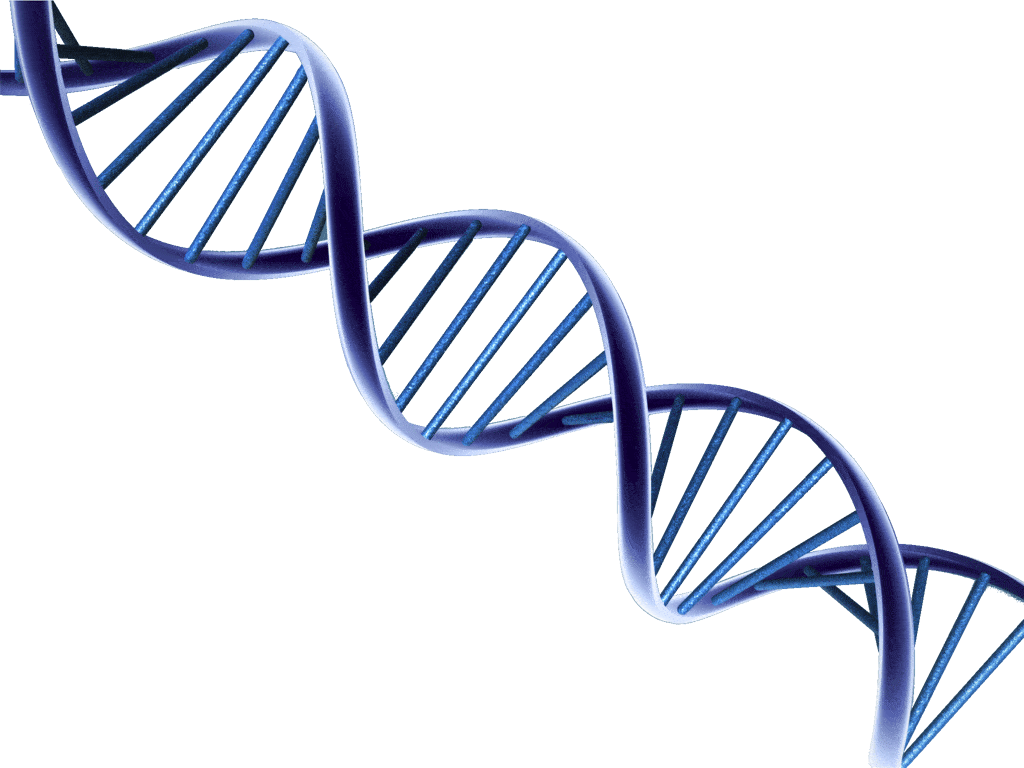
The drawing shows the structure of what molecule?
a)
A DNA molecule
b)
A lipid molecule
c)
A carbohydrate molecule
d)
A protein molecule
6.

What does DNA stand for?

a)

Deoxyribonucleic acid

b)

Denitrogenous acid

c)

Deribonucleic acid

d)

Diribonucleic acid

7.

Which of the following best describes the shape of a DNA molecule?

a)

double helix

b)

contains ribose

c)

made of amino acids

d)

contains Uracil

8.

What are sections of DNA called?

a)

DNA

b)

Genes

c)

Chromosomes

d)

Nucleus

9.

A gene determines a __________ such as eye or hair color.

a)

nucleus

b)

DNA

c)

chromosome

d)

Trait

10.

How many pairs of chromosomes do humans have?

a)

21

b)

22

c)

23

d)

24

11.

The cell division that produces gametes (egg & sperm).

a)

binary fission

b)

mitosis

c)

homologous pairing

d)

meiosis

12.
Each one of the boxes on the Punnett Square represents what probability of an offsprings' genotype?
a)
25%
b)
1%
c)
10%
d)
0%
13.
Are recessive traits shown with capital or lowercase letters? 
a)
Capital
b)
Lowercase
14.
The physical appearance or the way a gene looks is known as it's....
a)
genotype
b)
allele
c)
gene
d)
phenotype
15.
An allele or gene that always shows is
a)
recessive
b)
dominant
c)
hidden
d)
present
16.

Rosalind Franklin is known for

a)

knowing that adenine always pairs with thymine

b)

coming up with the double helix shape of DNA

c)

X ray diffraction of DNA in spiral form

d)

her work with pea plants and traits

17.
Which sequence of complementary DNA bases would pair with this partial strand
ATG TGA CAG?
a)
ATG TGA CAG
b)
TAC ACT GTC
c)
GTA AGT GAC
d)
CAT TCA CTG
18.
Which of the following best describes a DNA molecule?
a)
double helix
b)
contains ribose
c)
made of amino acids
d)
contains uracil
19.
What determines the code, or information, of a DNA molecule?
a)
the shape (structure) of the nitrogen bases
b)
the order (sequence) of the nitrogen bases
c)
the color of the nitrogen bases
d)
the frequency (number) of nitrogen bases
20.
Which 2 molecules form the sides (backbone) of the DNA ladder?
a)
deoxyribose sugar and adenine
b)
deoxyribose sugar and a hydrogen bond
c)
deoxyribose sugar and the nucleus
d)
deoxyribose sugar and phosphate
21.
The drawing shows the structure of what molecule?
a)
A DNA molecule
b)
A lipid molecule
c)
A carbohydrate molecule
d)
A protein molecule
22.
Heterozygous is when...
a)
the alleles are the same
b)
the alleles are different
c)
the alleles are absent
d)
the alleles are present
23.
T - tall and t = short
In the punnett square below, what belongs in the missing square
a)
tt
b)
Tt
c)
Bb
d)
TT
24.
B = brown fur  b = white fur
In the punnett square, what is the probability for white fur? 
a)
0%
b)
25%
c)
50%
d)
75%
25.
In the punnett square shown, what must the genotype of the missing parent be?
a)
BB
b)
Bb
c)
bb
d)
Tt
26.
Which element is found in period 3 group 2?
a)
Sodium (Na)
b)
Magnesium (Mg)
c)
Yttrium (Y)
d)
Boron (B)
27.
Vertical (up and down) columns in the periodic table are called _________ of elements and have similar properties. 
a)
groups
b)
periods
28.
_________are not good conductors of heat or electricity.
a)
Metals
b)
Metalloids
c)
Nonmetals
29.
The horizontal (left to right) rows on the periodic table are known as
a)
periods.
b)
atoms.
c)
groups or families.
d)
valence electrons.