wayground logo

Free Printable Worksheets

Font size

S
M
L
XL
Worksheets

Atoms and the Periodic Table

Total questions: 40

Worksheet time: 46mins

Name
Class
Date
1.

Which of the following is the correct symbol for sodium?

a)

S

b)

Na

c)

So

d)

N

2.

The atomic number of Beryllium is 4. Its mass number is 9. How many neutrons does an atom of Beryllium have in its nucleus?

a)

4

b)

4.0122

c)

5

d)

6

3.

The atomic number of an element is the number of _______ it has.

a)

protons

b)

neutrons

c)

electrons

d)

protons and neutrons

4.

The mass number of an element is the amount of _________ it has.

a)

protons

b)

protons and neutrons

c)

electrons

d)

neutrons

5.

The periodic table is organized into columns called _______ and rows called ______.

a)

groups and periods

b)

periods and groups

c)

categories and periods

d)

categories and groups

6.

Which element would you expect to be located in group 2 of the periodic table?

a)

Lithium

b)

Carbon

c)

Sulfur

d)

Beryllium

7.

Which of the following subatomic particles is negatively charged?

a)

neutron

b)

proton

c)

electron

d)

megatron

8.

Which particle does not have a charge?

a)

neutron

b)

proton

c)

electron

d)

megatron

9.

Which particle has a positive charge?

a)

neutron

b)

electron

c)

proton

d)

megatron

10.

An atomic nucleus has a _________ charge.

a)

positive

b)

negative

c)

neutral

d)

non

11.

Which of the following best describes the three general groups of elements?

a)

solids, liquids, gas

b)

metals, nonmetals, gases

c)

metals, nonmetals, metalloids

d)

metals, metalloids, synthetics

12.

An ionized atom of Sodium has 11 protons and 10 electrons. What is its atomic charge?

a)

+11

b)

+1

c)

-1

d)

-10

13.

Rows on the periodic table are called...

a)

groups

b)

periods

c)

families

d)

shells

14.

Columns on the periodic table are called...

a)

periods

b)

groups or families

c)

valence

d)

energy levels

15.

Rows on the periodic table correspond to the number of ________ in an atom.

a)

neutrons

b)

protons

c)

electrons

d)

energy levels

16.

Which element has 2 valence electrons?

a)

H

b)

Ca

c)

Na

d)

C

17.

Which element has 3 energy levels with electrons?

a)

Al

b)

C

c)

K

d)

I

18.
Bohr found that when atoms absorb precise amounts of energy (quanta), the electron(s) will
a)
move to another atom.
b)
fall into the nucleus.
c)
move to higher energy levels.
d)
go to ground state.
19.
How many electrons can reside in the third energy level?
a)
8
b)
18
c)
10
d)
6
20.
Why are noble gases stable elements?
a)
Their energy levels are filled.
b)
Their nucleus is not charged.
c)
They do not use d sub-levels.
d)
They always have balloons.
21.
What is the name of this element?
a)
Helium
b)
Hydrogen
c)
Argon
d)
Silver
22.
What is the name of this element?
a)
Lithium
b)
Boron
c)
Carbon
d)
Neon
23.
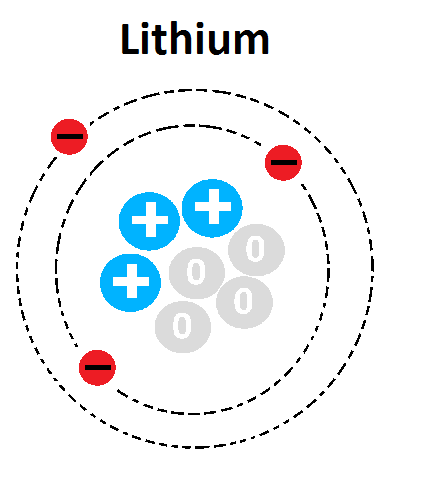
What is the mass number of this atom?
a)
1
b)
3
c)
4
d)
7
24.
What is the atomic number of this atom?
a)
2
b)
4
c)
6
d)
none of the above
25.
What's a valence electron?
a)
electrons in the second energy level
b)
electrons in the outermost energy level
c)
the atomic number
d)
electrons in the first level
26.
How many valence electrons?
a)
2
b)
3
c)
5
d)
10
27.

The innermost energy level has a maximum of how many electrons?

a)

1

b)

2

c)

6

d)

8

28.

What group does this element belong to?

a)

1

b)

2

c)

17

d)

18

29.

Which Bohr model represents Neon?

a)
b)
c)
d)
30.
How many neutrons does the isotope of lithium have?
a)
8
b)
3
c)
4
d)
5
31.
What quantities vary between isotopes of an element?
a)
protons, electrons, and atomic mass
b)
protons, electrons, and atomic number
c)
neutrons and electrons
d)
neutrons and atomic mass
32.
Four isotopes of lead include lead-204, lead-206, lead-207, and lead-208.  The average atomic mass of lead is 207.2.  Which isotope of lead is likely to be the most abundant.
a)
204
b)
206
c)
207
d)
208
33.
An atom is electrically neutral when
a)
protons and neutrons are the same
b)
protons and electrons are the same
c)
neutrons and electrons are the same
d)
neutrons balance the protons and electrons
34.
What is the name of the pictured isotope?
a)
Chlorine-Schmorine
b)
Chlorine-17
c)
Chlorine-35
d)
Chlorine-18
35.

Potassium-39 has how many neutrons?

a)

19

b)

18

c)

20

d)

21

36.
He developed the planetary model of the atom.
a)
Rutherford
b)
Bohr
c)
Chadwick
d)
Dalton
37.
James Chadwick discovered the ________.
a)
proton
b)
neutron
c)
electron
d)
nucleus
38.
What did Thomson discover?
a)
electron
b)
proton
c)
neutron
d)
electron cloud
39.

He claimed that matter was made of small, hard particles that he called “atomos.”

a)

Democritis

b)

Dalton

c)

Moseley

d)

Einstein

40.
The scientist responsible for "discovering" the nucleus is:
a)
Bohr
b)
Rutherford
c)
Schroedinger
d)
Einstein