wayground logo

Free Printable Worksheets

Font size

S
M
L
XL
Worksheets

Review standards 1,2,3, & 6.

Total questions: 31

Worksheet time: 46mins

Name
Class
Date
1.

Label the part of the microscope. What is part A?

a)

eyepiece lens

b)

eyepiece tube

c)

turret

d)

objective lens

2.

Label the part of the microscope. What is part D?

a)

body

b)

foot

c)

objective lens

d)

turret

3.

When carrying a microscope, place one hand on the ________ and one on the _________.

a)

focus knob

b)

body/arm

c)

stage

d)

foot/base

4.

The __________________ reflects light into the microscope.

a)

mirror

b)

stage clips

c)

field

d)

focus knob

5.

What is the processes that organisms use to maintain a stable internal environment?

a)

Heredity

b)

Metabolism

c)

Homeostasis

d)

Cell

6.

Characteristics that are passed down from parents to offspring is known as what?

a)

Heredity

b)

Homeostasis

c)

ATP

d)

Metabolism

7.

Which of the following is NOT a characteristic of all living things?

a)

Move around.

b)

Use energy.

c)

Respond to surrounding environment

d)

Grow, develop, and reproduce

8.

A _____ is a tiny, nonliving particle that enters and reproduces inside a living cell.

a)

Fungi

b)

Protist

c)

Virus

d)

Bacteria

9.

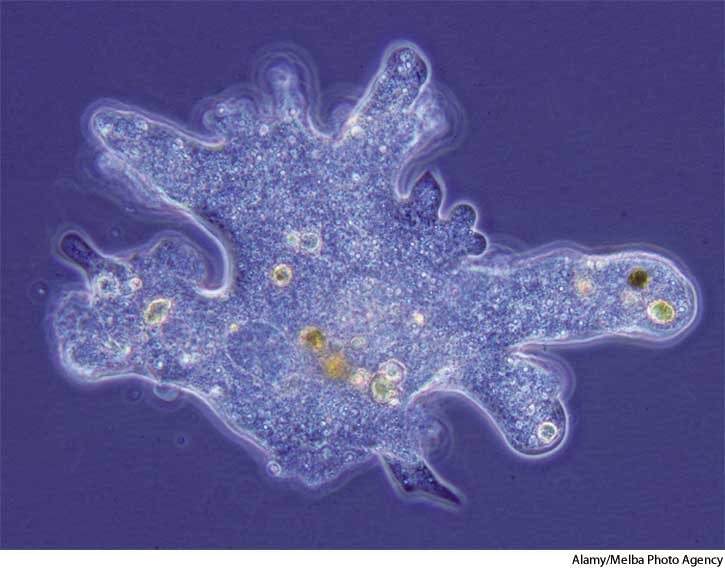
Is it a living or a non-living thing?

a)

Living thing

b)

Non-living thing

10.

Do you think chalk is a living thing or non living thing?

a)

living thing

b)

non living thing

c)

I am not sure.

11.

Rocks are everywhere in the park.

a)

Living

b)

Nonliving

c)

I am not sure.

12.
An Amoeba is a unicellular, animal-like protist that lives in ponds and streams. According to cell theory, where did this cell come from?
a)
another pre-existing amoeba cell.
b)
energy from sun that allowed the protist to reproduce.
c)
a multicellular organism.
d)
the nonliving environment.
13.
Robert Hooke, Anton van Leeuwenhoek, Theodor Schwann, Rudolf Virchow, and Matthias Schliden were all responsible for what theory?
a)
The Theory of Gravity
b)
The Theory of Relativity
c)
The Cell Theory
d)
The Theory of Continental Drift
14.
What tool do you use to view the cells?
a)
metric ruler
b)
centrifuge
c)
microscope
d)
telescope
15.
Which of the following is NOT a cell theory.
a)
All non-living things are made of cells
b)
All cells come from pre-existing cells
c)
Cells are the basic unit of structure and function of all living things
16.
What is the basic structural and functional unit of all living things? 
a)
atom
b)
cell
c)
molecule
d)
human
17.
An organism made of one cell is called
a)
unicellular organism
b)
multicellular organism
18.
Which of the following scientists was the first to observe bacteria under a microscope?
a)
Anton van Leuwenhoek
b)
Matthais Schleiden
c)
Robert Hooke
d)
Theodor Schwann
19.
Which is NOT part of the Cell Theory
a)
New cells are produced from existing cells
b)
All living things are composed of cells
c)
Only eukaryotic cells have a nucleus
d)
Cells are the basic unit of structure & function in living things
20.
DNA is free floating, not in a nucleus
a)
Prokaryote
b)
Eukaryote
21.
Typically are multicellular
a)
Eukaryote
b)
Prokaryote
22.
Only contain structures like ribosomes, cytoplasm, cell wall, flagella, and DNA
a)
Prokaryote
b)
Eukaryote
23.
Made up of one cell
a)
Prokaryote
b)
Eukaryote
24.
DNA is double stranded (in a double-helix shape)
a)
Prokaryote
b)
Eukaryote
25.
A group of similar types of cells that work together to do a specific job is called a/an _____.
a)
tissue
b)
organ
c)
stem cell
d)
organ system
26.
Which is true of unicellular organisms?
a)
they lack cells
b)
they all are eukaryotic
c)
they lack cell differentiation
27.
What is the correct order of organization
a)
tissues-cells-organs-organ systems-organism
b)
cell-tissue-organs-organ systems-organism
c)
organism-cells-tissues-organ systems-organism
d)
tissues-cells-organs-organ sytems-organism
28.
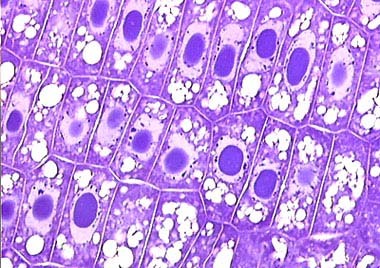
This is a example of ........
a)
cell
b)
tissue
c)
organ 
d)
organ system
29.
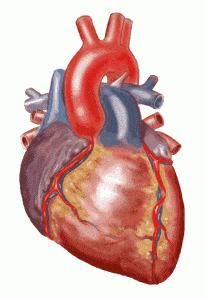
This is a example of ........
a)
cell
b)
organ system
c)
organ
d)
tissue
30.
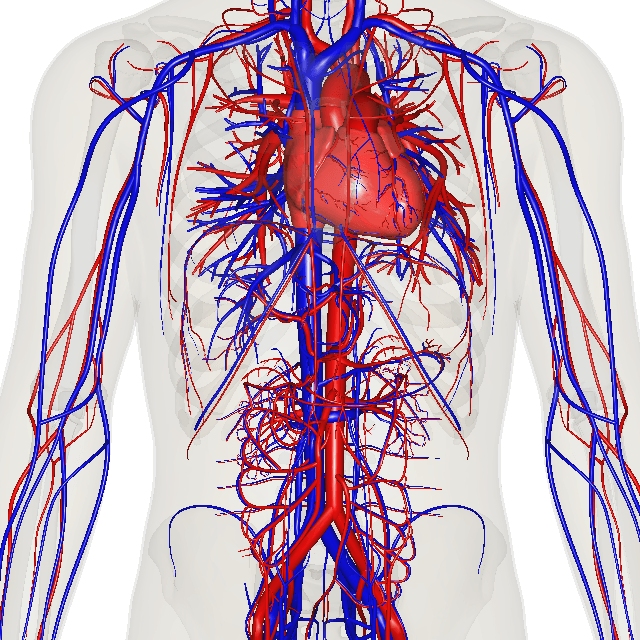
This is a example of ........
a)
organ
b)
organ system
c)
tissue
d)
cell
31.
When many organ systems work together it can form...
a)
a cell
b)
an organ
c)
an organ system
d)
an organism