
NEW
Font size
 Worksheets
Cells Unit Review
Total questions: 34
Worksheet time: 8hrs 25mins
Which statement is true according to the cell theory regarding plant and protista cells?
Both plants and protista can produce new cells, but only protista can take in nutrients.
Plants can take in nutrients, but only protista can produce new cells.
Both plants and protista are unable to produce new cells or take in nutrients.
Both plants and protista can take in nutrients and produce new cells.
Avery is observing a cell under a microscope. Which process describes the cell engulfing (or eating) a large particle?
exocytosis
division
endocytosis
reproduction
What is one primary purpose of cellular reproduction in organisms?
To repair damaged tissues.
To eliminate waste products.
To maintain homeostasis.
To increase the number of cells.
What is the primary function of chloroplasts in plant cells?
Chloroplasts are used to synthesize proteins in plant cells.
Chloroplasts convert sunlight into glucose (sugar/food) in plant cells.
Chloroplasts generate ATP in plant cells.
Chloroplasts are responsible for DNA synthesis in plant cells.
Sophia and Benjamin are studying how cells from different organisms are all able to function. They discover that cells
are genetically identical.
can use energy.
contain the same organelles.
undergo metamorphosis.
During a biology class, Isla and Ethan are discussing how cells produce energy to survive. What process are they talking about?
cellular respiration
cellular specialization
cellular differentiation
cellular transport
During a biology class, Olivia was asked where the cell membrane is located in the plant cell. What should she answer?
on the outer most part of the plant cell
In between the cell wall and the inside of the cell.
floating around in the cytoplasm
there is no cell membrane, only a cell wall
Abigail is learning about cellular processes in her biology class. She wonders, the process of exocytosis in a single cell is most similar to
waste removal through the excretory system in a multicellular organism.
the protective external barrier (skin) of the integumentary system in a multicellular organism.
the transport of molecules through the circulatory system in a multicellular organism.
food transport through the digestive system in a multicellular organism.
What role does mitosis play in skin repair?
Mitosis allows skin cells to multiply and replace damaged cells.
Mitosis causes skin cells to shrink and disappear.
Mitosis helps skin cells to produce more ATP.
Mitosis prevents skin cells from dividing.
Which organelle is responsible for energy production in both plant and animal cells?
nucleus
ribosome
mitochondria
Golgi apparatus
Which component is shared by both eukaryotic animal cells and prokaryotic bacteria cells?
cell membrane
ribosomes
chloroplasts
nucleus
During a biology class, Anika and Liam were discussing cell structures. What structures do animal and plant cells both have?
nuclei and mitochondria
cell walls and chromosomes
chloroplast and mitochondria
large vacuole and ribosomes
During a biology class, Daniel was asked where cellular respiration occurs. What should he answer?
chloroplast
ribosomes
nucleus
mitochondria
What is the basic unit of all living organisms?
tissue
cell
organ
molecule
Which substances are released as a result of photosynthesis?
oxygen and ATP
carbon dioxide and sugar (glucose)
water and oxygen
oxygen and sugar (glucose)
Which of the following is a byproduct of cellular respiration in mitochondria?
carbon dioxide, water, ATP (energy)
glucose, oxygen, ATP
oxygen, water, glucose
ATP, water, oxygen
During a biology class, Evelyn asked why a muscle cell would have more mitochondria in them?
A muscle cell requires more energy (ATP) and that is produced in the mitochondria.
A muscle cell does not have more mitochondria in it.
A muscle cell has more mitochondria to produce more sugars.
A muscle cell has more mitochondria to create more proteins in muscle tissue.
Which of the following are essential for cellular respiration in animal cells?
oxygen and glucose to produce ATP during cellular respiration.
water and sunlight to generate energy during photosynthesis
carbon dioxide and water to create glucose during photosynthesis
oxygen and carbon dioxide to produce ATP during cellular respiration
Which organelle is responsible for managing the activities of a eukaryotic cell?
the cell membrane
the nucleus
the ribosome
the vacuole
Liam is conducting an experiment on plant cells. What would happen if the plant cells didn't receive the proper nutrients that they need?
It will no longer be able to grow or divide.
It will grow but will no longer be able to divide.
It will begin to grow more quickly
It will begin to divide more quickly.
What is the result of the cell cycle and mitosis?
4 genetically different cells
2 identical daughter cells
new organelles
reproductive cells
In which part of the cell does DNA replication occur before Mitosis begins?
mitochondria
endoplasmic reticulum
nucleus
cytoplasm
Which cell structure facilitates the movement of materials inside the cell?
cell membrane
cytoplasm
Golgi apparatus
nucleus
James is studying biology and learns that all of life's processes are necessary in order for an organism to maintain ___________.
evolution
metabolism
homeostasis
adaptation
What is the role of the Golgi apparatus in a cell?
To synthesize lipids
To modify and package proteins
To generate ATP
To replicate DNA
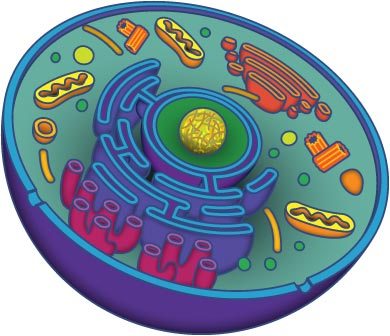
The basic unit of life in all organisms is...
cells
tissues
organs
systems
Abigail is studying biology and comes across a statement. Which of the following is NOT a cell theory?
All non-living things are made of cells
All cells come from pre-existing cells
Cells are the basic unit of structure and function of all living things
Which process allows water to pass through a semipermeable membrane?
diffusion
filtration
osmosis
facilitated diffusion

Aiden is looking at a diagram of a cell under a microscope. What part of the cell cycle is pictured?
interphase
mitosis
cytokinesis
meiosis
Which organelle is responsible for producing energy in both plant and animal cells?
Nucleus
Mitochondria
Golgi Apparatus
Endoplasmic Reticulum
What is the primary function of ribosomes in a cell?
To synthesize proteins
To store genetic information
To produce energy
To transport materials
Which type of cell lacks a nucleus?
Eukaryotic cell
Prokaryotic cell
Animal cell
Plant cell
Which process is responsible for the movement of molecules from an area of higher concentration to an area of lower concentration?
Osmosis
Active transport
Diffusion
Endocytosis

