
 Worksheets
Exogenic Processes
Total questions: 30
Worksheet time: 20mins
It is responsible for shaping the Earth's surface and forming the geologic features that are seen on the surface of Earth.
(a)
What are the two types of Weathering?
(a)
It occurs when the oxygen dissolved in water will oxidize some materials.
Oxygen
Carbonation
Oxidation
Biological Action
The physical breakdown/chemical alteration of rocks at or near the Earth's surface are referred to as (a) .
It is a large, moving mass of ice where they are found in many parts of the world, especially in the poles or in high mountains.
Valley Erosion
Flood Plain
Glacial Till
Glacier
It is formed when a stream reaches a flat area called piedmont or gently sloping plain.
Delta
Flood Plain
Alluvial Fan
Leeves
It is the slow movement of regolith down a slope, as observed in bent trees and fences.
Creep
Earthflows
Solifluction flows
Debris flows
Wind blown sand hitting a rock and slowly wearing it away is an example of ___________________.
Chemical Weathering
Chemical Erosion
Mechanical Erosion
Physical Weathering
Oxidation can cause some rocks to _________
rust
melt
turn green
change shape
Seeing a tree growing out of a rock would cause
erosion
landslide
physical weathering
chemical weathering
Which of the following is an example of
chemical weathering?
The dissolving of limestone by acid rain.
A rock broken into chunks after being carried by rapidly flowing water.
Pulverized rock resulting from a landslide.
Splits in a rock due to tree roots.
Form as a result of flood deposits on the banks of channel
Delta
Icelandic Alluvial Fan
Leevees
Glacier
These are deposits of coarse materials in the shape of hills or ridges.
Loess
Cliff
Moraines
Sand dunes
(a) is the transport of weathered sediments by agents of erosion and transported to different places.
What are the agents of erosion?
Water
Wind
Ice
Fire
When rock is broken down and disintegrated without any chemical alterations, the process in operation is
physical weathering.
chemical weathering.
hydrolysis.
erosion.
The fact that water expands as much as 9% of its volume as it freezes is the basis of
oxidization.
exfoliation.
salt crystal growth.
frost wedging.
________ occurs as rock surfaces heated by the Sun during the day expand slightly, and then contract with nighttime cooling.
Exfoliation
Thermal expansion
Frost wedging
Salt-crystal growth
When rock is broken down and disintegrated in the presence of water and with chemical alterations to the rock, the process in operation is
physical weathering.
chemical weathering.
mass movement.
biological weathering.
When rainwater attacks formations of limestone, the minerals dissolve and wash away with the mildly acid rainwater. This is an example of
oxidation.
crystallization.
frost action.
carbonation.
In which mass movement do rock fragments fall freely through the air?
rockslide
rockfall
slump
earthflow
What is the downslope movement of soil and weathered rock resulting from the force of gravity?
Mass Movement
Landslide
Mudflow
Slump
What is the slow, steady, downhill flow of loose, weathered Earth materials, especially soils?
Slump
Landslide
Mudflow
Creep
What are swiftly moving mixtures of mud and water?
Slump
Landslide
Mudflow
Creep
What is a mudflow that occurs in volcanic regions?
Earth Flow
Lahar
Mudflow
Creep
What is a landslide that occurs when a sheet of rock moves downhill on a sliding surface?
Avalanche
Landslide
Rockslide
Slump
What increases the amount of wind erosion?
Limited amounts of rain
Increased amount of rain
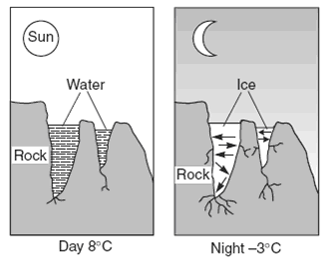
Which statement best explains why this process results in weathering?

