wayground logo

Free Printable Worksheets

Font size

S
M
L
XL
Worksheets

Characteristics of Life, body systems and feedback loops

Total questions: 56

Worksheet time: 48mins

Name
Class
Date
1.
An organism made of one cell is called
a)
unicellular
b)
multicellular
2.
The smallest unit of life is a(n)
a)
atom
b)
cell
c)
snail
3.
Multicellular means
a)
made of many cells
b)
made of one kind of cell
c)
made of only one cell
4.
What does reproduce mean?
a)
They grow - get larger
b)
They are living things
c)
Organisms make other organisms
5.
Living things respond to heat, light, and sound.  This means they respond to:
a)
stimuli/ environment
b)
suction
c)
Dr. Suess
d)
digestion
6.
During ___________ conditions inside our body are kept stable (the same)
a)
homeopathic
b)
Homo sapian
c)
homeostasis
d)
homologous
7.
Plants get energy from the sun while animals get energy from
a)
condensation
b)
eating food
c)
photosynthesis
d)
sleeping
8.
All of the following are characteristics of all living things EXCEPT
a)
Respond to stimulus
b)
Grow and develop
c)
maintain homeostasis
d)
Movement
9.
All living things are composed of cells. 
a)
True
b)
False
10.
When you step out into the cold, your body shivers in order to keep its temperature at 98.6F.
a)
All living things use energy
b)
All living things contain cells
c)
All living things maintain homeostasis
d)
All living things grow
11.
Green plants produce their own food through the process of photosynthesis.
a)
All living things use energy
b)
All living things contain cells
c)
All living things maintain homeostasis
d)
All living things grow
12.
A baby song bird hatches from its egg with both parent songbirds watching.
a)
All living things reproduce
b)
All living things maintain homeostasis
c)
All living things use energy
d)
All living things grow
13.
A pill bug (roly poly) eats a carrot.
a)
All living things contain cells
b)
All living things use energy
c)
All living things maintain homeostasis
d)
All living things grow
14.
A camel has eyelashes that work to keep the dust and sand out of its eyes.
a)
All living things adapt to their environment
b)
All living things grow
c)
All living things have cells
d)
All living things use energy
15.
A caterpillar hibernates in a cocoon and emerges as a butterfly.
a)
All living things adapt to their environment
b)
All living things use energy
c)
All living things respond to their environment
d)
All living things grow
16.
A tulip opens in the morning at sunrise and closes in the evening at sunset.
a)
All living things have cells
b)
All living things use energy
c)
All living things respond to their environment
d)
All living things grow
17.
A cat is an organism that has a respiratory system that contains lungs and a trachea.
a)
All living things contain cells
b)
All living things maintain homeostasis
c)
All living things have different levels of organization
d)
All living things grow
18.
A sea worm drops its tail and the tail becomes a new worm.
a)
All living things contain cells
b)
All living things grow
c)
All living things have different levels of organization
d)
All living things reproduce
19.
An adult hydra is producing its offspring through budding.
a)
All living things use energy
b)
All living things reproduce
c)
All living things contain cells
d)
All living things grow
20.
The roots of a plant grow towards a source of ground water.
a)
All living things use energy
b)
All living things reproduce
c)
All living things respond to their environment
d)
All living things grow
21.

Which of the following is an example of homeostasis?

a)

adapting to your environment

b)

maintaining an appropriate respiration rate

c)

the sum of all of your chemical reactions

d)

being composed of more than one cell

22.

Which of the following is a stimulus?

a)

removing your hand from a hot stove

b)

swinging a bat at a baseball

c)

screaming when something scares you

d)

a ball moving from the pitching mound to home plate towards a batter

23.

Which of the following is a response?

a)

a flashlight shined into the eye

b)

a rubber band popping your hand

c)

your pupils constricting when exposed to bright light

d)

blood glucose levels drop significantly

24.

The sum of all the chemical reactions in your body?

a)

organization

b)

metabolism

c)

homeostasis

d)

evolution

25.

Which of the following is NOT an example of an adaptation?

a)

birds migrating during the winter months

b)

the total sum of all the chemical reactions in your body

c)

humans evolving the ability to digest lactose (sugar in milk)

d)

the ability of dolphins to communicate in aquatic environments

26.

Which of the following is asexual reproduction?

a)

two sets of genetic information; unique offspring

b)

one set of genetic information; identical offspring

27.

Which of the following is sexual reproduction?

a)

two sets of genetic information; unique offspring

b)

one set of genetic information; identical offspring

28.

Streptococcus, a round cell, is the bacteria that causes strep throat.


Which characteristic of life does this refer to?

a)

Living things need energy

b)

Living things are composed of one or more cells

c)

Living things respond to their environment

d)

Living things grow and reproduce

e)

Living things maintain a stable internal environment

29.

"Germ-eating" macrophages take in and destroy germs.


Which characteristic of life does this refer to?

a)

Living things need energy

b)

Living things are composed of one or more cells

c)

Living things respond to their environment

d)

Living things grow and reproduce

e)

Living things maintain a stable internal environment

30.
The main purpose of the ____________ system is to break food particles into pieces that can be used.
a)
circulatory
b)
respiratory
c)
digestive
d)
skeletal
31.
What is responsible for delivering oxygen and removing carbon dioxide from the body?
a)
cell nucleus
b)
excretory system
c)
nervous tissue
d)
respiratory system
32.
The __________ system directs the body to inner and outer changes.
a)
digestive
b)
circulatory
c)
nervous
d)
skeletal
33.
When tissues come together, they form ___________.
a)
cells
b)
atoms
c)
organs
d)
systems
34.
In multicellular organisms, tissues are comprised of _______.
a)
organs
b)
systems
c)
cells
d)
blood
35.
Which of the following body systems work together for support, protection, and movement?
a)
respiratory and cardiovascular
b)
skeletal and muscular
c)
skeletal and integumentary
d)
digestive and respiratory
36.
This system protects the body's organs, provides support for the body.
a)
Nervous System
b)
Skeletal System
c)
Respiratory System
37.
What body system removes the waste from your body? 
a)
Circulatory
b)
Excretory
c)
Digestive
d)
Respiratory
38.
What system receives oxygen and gets rid of carbon dioxide?
a)
Heart
b)
Muscular System
c)
Veins 
d)
Respiratory System
39.
The main purpose of the _______ system is to ensure the continuation of the species.
a)
respiratory
b)
reproductive
c)
circulatory
d)
endocrine
40.
The main purpose of the ________ system is to produce hormones for the body.
a)
excretory
b)
digestive
c)
reproductive
d)
endocrine
41.
What system is the body's way of fighting off pathogens that would make it sick?
a)
Excretory
b)
Immune
c)
Digestive
d)
Endocrine
42.

What is the point of a feedback loop?

a)

To provide the body with more energy

b)

To provide the body with more food

c)

To make sure the conditions in the body are always changing

d)

To make sure the conditions in the body remain stable

43.

A feedback loop best fits which characteristic of life?

a)

Cells

b)

Organization

c)

Homeostasis

d)

Adaptation

44.

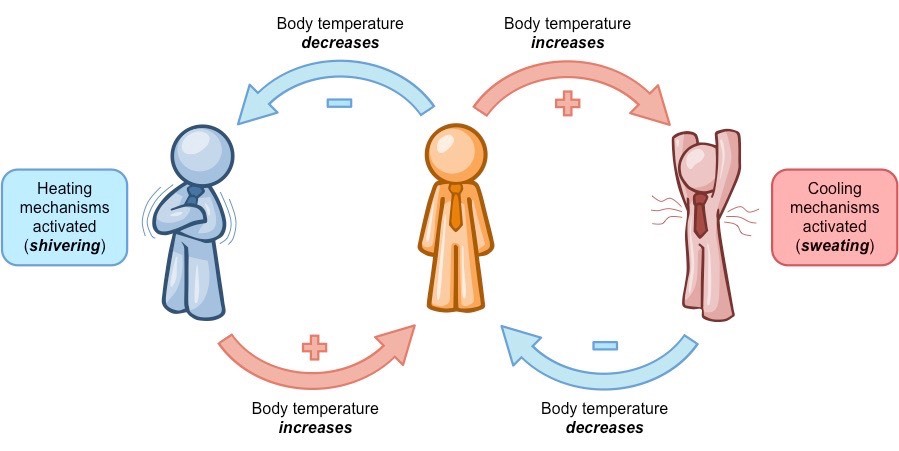
In this body temperature feedback loop, predict what would happen if cooling mechanisms were NOT activated?

a)

The body would not warm up.

b)

The body would not cool down.

c)

Your body would get colder and colder.

d)

Your body would release lots of heat.

45.

According to the feedback loop, what does high blood sugar promote?

a)

Insulin Release

b)

Glucagon Release

c)

Insulin Uptake

d)

Glycogen Uptake

46.

What happens if stretch receptors are activated in the uterus?

a)

Oxytocin will cause uterine muscles to relax

b)

Contractions will get weaker

c)

The baby will be born later than normal

d)

The brain will signal for the release of oxytocin

47.

What is the difference between what will happen if their is too much Glucose or too little Glucose? SELECT ALL THAT APPLY

a)

With too much Glucose, Insulin is released. With too little Glucose, Glucagon is released.

b)

With too much Glucose, the pancreas produces insulin. With too little Glucose, the pancreas produces glucagon.

c)

With too much Glucose, Glucagon is released. With too little Glucose, Insulin is released.

d)

There is no difference.

48.
Failure to maintain homeostasis could result in:
a)
lack of internal balance
b)
eventual death
c)
difficulty carrying on metabolism 
d)
all three
49.
The two types of feedback systems that help organisms maintain homeostasis are:
a)
positive and negative 
b)
receptor and effector
c)
static and dynamic
d)
minor and major
50.
Maintaining body temperature is an example of a:
a)
negative feedback loop
b)
positive feedback loop
51.
The process of childbirth is an example of:
a)
negative feedback loop
b)
positive feedback loop
52.
The "cause" for something to happen is the
a)
response
b)
effect
c)
stimulus
d)
homeostasis
53.
The "effect" of a given stimulus is the...
a)
response
b)
stimulus
c)
cause
d)
result
54.
When you get cut, your skin cells release hormones that signal platelets to come and stop the bleeding. Platelets then release more hormones that signal even more platelets to help stop bleeding. The hormone signals continue until the cut is closed.
a)
Positive Feedback Response
b)
Negative Feedback Loop 
55.
Rapid growth during puberty causes your body to release more and more growth hormones. As you grow, more and more growth hormones are released until puberty is reached, and then the hormones stop.
a)
Positive Feedback Response
b)
Negative Feedback Loop 
56.
If the calcium in your blood decreases below homeostasis levels, a gland in the brain will sense the decrease and send a chemical message to your bones. Your bones will release calcium into the blood, bringing blood calcium levels back up.
a)
Positive Feedback Response
b)
Negative Feedback Loop