
 Worksheets
Ch 3 Review Round 2- Angle Pairs & Parallel Lines
Total questions: 66
Worksheet time: 33mins
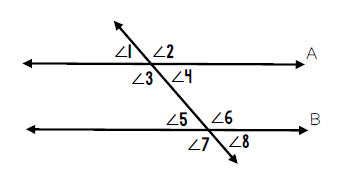
If the two lines shown are // and m∠7 = 115°, find the measure of ∠2.
115°
65°
180°
Cannot be determined
If the two lines shown are // and m∠5 = 63°, find the measure of ∠3.
63°
117°
180°
Cannot be determined
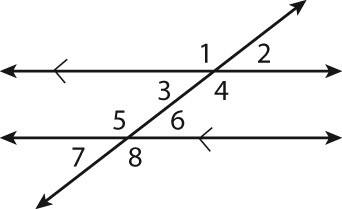

Angles 4 and 6 are...
supplementary
congruent
What is the complement angle to 92°?
48°
88°
100°
Not possible

parallel lines
parallel planes
transversal
skew lines

parallel lines
parallel planes
transversal
skew lines
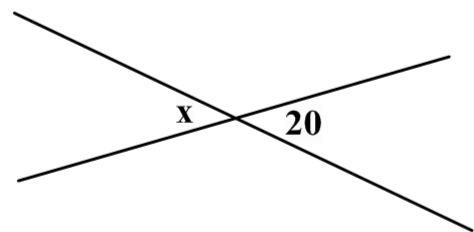
Solve for x.
20o
70o
160o
180o
If the two lines shown are // and m∠1 = 57°, find the measure of ∠6.
123°
57°
180°
Cannot be determined

If the two lines shown are // find angle L
∠L=51°
∠L=129°
∠L=180°
∠L=39°


Lines r and s are cut by a transversal. Which equation must be true to show r // s ?
3x + 14 = 143
3x + 14 + 143 = 180
3x + 14 - 143 = 180
3x - 14 = 143

The two lines shown are parallel. Which equation must be true?
120 + 6y = 180
120 + 6y = 90
120 = 6y
120 - 6y = 180
The two lines shown are parallel. Solve for y.
y = 20
y = 120
y = 60
y = 10
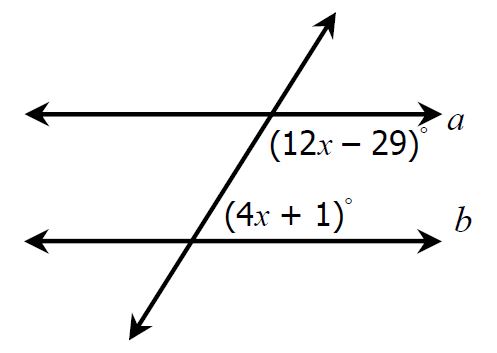


If these angles are congruent, the lines are parallel b/c the angles are _?_
Alternate Interior
Consecutive Interior
Corresponding
Cannot be proved parallel

If the angle pair shown can be used to show the lines are parallel, name the kind of angles they are. If they can't be used to show the lines are //, answer "cannot be proved parallel"
Corresponding
Alternate Interior
Linear Pair
Cannot be proved parallel

If the angle pair shown can be used to show the lines are parallel, name the kind of angles they are. If they can't be used to show the lines are //, answer "cannot be proved parallel"
Alternate Interior
Corresponding
Vertical
Cannot be proved parallel

If the angle pair shown can be used to show the lines are parallel, name the kind of angles they are. If they can't be used to show the lines are //, answer "cannot be proved parallel"
Alternate Interior
Corresponding
Alternate Exterior
Cannot be proved parallel

Which of the following would NOT be a valid name for the angle shown
∠ABC
∠A
∠BAC
∠CAB

What do the red arcs mean in the diagram?
∠JFK≅∠HJK
m∠FJH=m∠HKJ
m∠FJH=m∠HJK
m∠KJH=2(m∠KJF)

∠1 and ∠3 are an example of ...
vertical angles
supplementary angles
a linear pair
complementary angles


Answer the question using only the angles whose measures are shown.
No
Yes, corresponding angles are congruent
Yes, consecutive interior angles are congruent
Yes, Alternate interior angles are congruent

What is the value of x?
4
7
11
10

Answer the question using only the angles whose measures are shown.
No
Yes, corresponding angles are congruent
Yes, consecutive interior angles are congruent
Yes, Alternate exterior angles are congruent

Answer the question using only the angles whose measures are shown.
No
Yes, Corresponding angles are congruent
Yes, Alternate Interior angles are congruent
Yes, Alternate Exterior angles are congruent

Answer the question using only the angles whose measures are indicated.
No
Yes, Corresponding angles are congruent
Yes, Alternate Interior angles are congruent
Yes, Alternate Exterior angles are congruent

Answer the question using only the angles whose measures are indicated.
No
Yes, Corresponding angles are congruent
Yes, Alternate Interior angles are congruent
Yes, Alternate Exterior angles are congruent

Answer the question using only the angles whose measures are indicated.
No
Yes, Corresponding angles are congruent
Yes, Alternate Interior angles are congruent
Yes, Alternate Exterior angles are congruent
Yes, Vertical angles are congruent.

Answer the question using only the angles whose measures are indicated.
No
Yes, Consecutive Interior angles are supplementary
Yes, Alternate Interior angles are congruent
Yes, Alternate Exterior angles are congruent

Answer the question using only the angles whose measures are indicated.
No
Yes, Consecutive Interior angles are supplementary
Yes, Consecutive Interior angles are congruent
Yes, Alternate Exterior angles are congruent

If CA are ≅ then the lines forming them are //
If // lines form CA, then the CA are ≅
If // lines form CIA, then CIA are supplementary
If AIA are ≅ , then the lines forming them are //

If // lines form CIA, then the CIA are supplementary
If two lines form CIA that are supplementary, then the lines are //
If two lines form ≅ AIA , then the lines are //
If two lines form ≅ CA, then the lines are //

Yes, vertical angles are congruent
No, ≅ vertical angles are not enough to prove lines parallel
Yes, corresponding angles are congruent
Yes, alternate interior angles are congruent

Yes, corresponding angles are congruent
Yes, alternate exterior angles are congruent
Yes, alternate interior angles are congruent
No, those angles have no relationship

100° - If Consecutive Interior Angles are congruent then the lines are //
80° - If Consecutive Interior Angles are supplementary then the lines are //

126° - If Corresponding Angles are congruent then the lines are //
54° - If Corresponding Angles are supplementary, then the lines are //
126° - If Alternate Interior Angles are congruent then the lines are //
54° - If same side interior angles are supplementary then the lines are //

71° - If Alternate Exterior Angles are congruent then the lines are //
109° - If Alternate Exterior Angles are supplementary then the lines are //
71° - If Alternate Interior Angles are congruent then the lines are //
109° - If Same Side Interior angles are supplementary then the lines are //

97° - Alternate Exterior Angles are congruent
83° - Alternate Exterior Angles are supplementary
97° - Corresponding Angles are congruent

Which equation can be used to answer the question? (Do not solve it)
4 + 22x = 36x + 2
4 + 22x + 36x + 2 = 180
4 + 22x + 36x + 2 = 90
(4 + 22x) - (36x + 2) = 180
x = 7
x = 3
x = 1/7
x = 9

Which equation can be used to find the value of x in the figure? (Do not solve it)
(10x + 10) + 70 = 180
10x + 10 = 70
10x + 10 = 110
x = 6
x = 10
x = 30
x = 5

Which equation can be used to answer the question? (Do not solve it)
17x + 3 = 75
17x + 3 + 75 = 90
17x + 3 - 75 = 180
17x + 3 + 75 = 180
x = 72/17
x = 12
x = 6
x = 4.2

Which equation can be used to answer the question? (Do not solve it)
(-2 + 9x) + 70 = 180
(- 2 + 9x) + 70 = 90
-2 + 9x = 70
(-2 + 9x) - 70 - 180
x = 8
x = 68/9
x = 12.4
x = -3

Identify a pair of AIA formed by lines m, n and transversal p.
∠4 and ∠6
∠4 and ∠5
∠4 and ∠13
∠4 and ∠9
Identify a pair of AIA formed by lines p, q and transversal n.
∠3 and ∠6
∠11 and ∠14
∠6 and ∠15
∠4 and ∠9

m∥n because Alternate Exterior angles are congruent
m∥n because Alternate Interior angles are congruent
p∥q because Alternate Interior angles are congruent
Neither pair of lines is parallel

m∥n because Alternate Exterior angles are congruent
p∥q because Alternate Exterior angles are congruent
p∥q because Corresponding angles are congruent
Neither pair of lines is parallel

m∥n because Corresponding angles are congruent
m∥n because Consecutive Interior angles are congruent
p∥q because Corresponding angles are congruent
Neither pair of lines is parallel

m∥n because Alternate Interior angles are congruent
p∥q because Alternate Interior angles are congruent
m∥n because Consecutive Interior angles are congruent
Neither pair of lines is parallel

