Wayground logo

Free Printable Worksheets

Font size

S
M
L
XL
Worksheets

C1 C2 C3

Total questions: 40

Worksheet time: 30mins

Name
Class
Date
1.

An unknown gas can be collected using the apparatus shown.


Based on the diagram only, what can your infer about the physical property of this gas?

a)

It is denser that air.

b)

It is insoluble in water.

c)

It is less dense than air.

d)

It is soluble in water.

2.
The diagram shows the apparatus for separating soil and water. What are the labelled parts?
a)
A = distillate, B = filtrate
b)
A = filtrate, B = residue
c)
A = residue, B = filtrate
d)
A = residue, B = distillate
3.

To separate a mixture of salt and water what separation method is used?

a)

Filtration

b)

Distillation

c)

Chromatography

d)

Evaporation to dryness

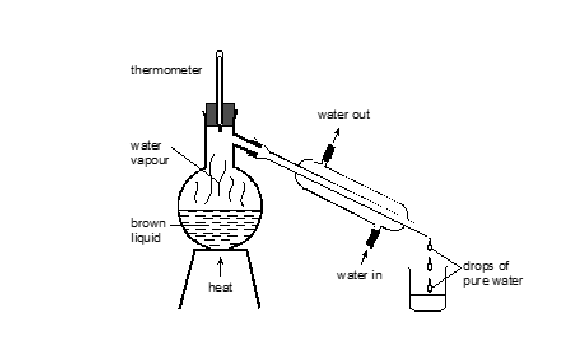
4.

Which separation technique uses the apparatus shown in the diagram?

a)

filtration

b)

evaporation

c)

distillation

d)

chromatography

5.
What is the boiling point of water?
a)
0oC
b)
100oC
c)
80oC
d)
95oC
6.
Water and alcohol are easily separated by distillation because of their
a)
different densities
b)
different boiling points
c)
different colours
d)
different melting points
7.

Which of the following pairs of substances may best be separated through through fractional distillation

a)

sand and soil

b)

water and soil

c)

salt and sand

d)

water and alcohol

8.
A solution that contains a large amount of solute is best described as 
a)
unsaturated
b)
concentrated
c)
dilute
d)
weak
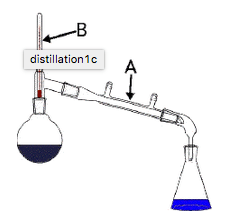
9.
In the distillation apparatus shown, what are the parts labelled A and B?
a)
A = funnel, B = thermometer
b)
A = thermometer, B = funnel
c)
A = condenser, B = flask
d)
A = condenser, B = thermometer
10.

Dyes in water soluble markers may be separated by means of

a)

Simple distillation

b)

Crystallisation

c)

Chromatography

d)

Filtration

11.

Which property indicates that a solid is pure?

a)

It burns completely in oxygen, leaving no residue.

b)

It has a fixed melting point.

c)

It has a fixed volume.

d)

It is soluble in water.

12.
Filtration can be used to separate...
a)
an insoluble solid from a solution
b)
a soluble solid from a solution
c)
a dissolved solid from a solution
13.
Look at the apparatus setup. It cannot be used to separate which of the following mixtures? 
a)
Marble chips from oil 
b)
Alcohol and water
c)
Chalk from sugar solution
d)
Sand and sea water
14.

In an experiment, a student needs to measure out 36.50 cm3 of a solution. Which piece of apparatus would measure this volume most accurately?

a)

beaker

b)

burette

c)

measuring cylinder

d)

pipette

15.

A liquid ester used to flavour food is believed to be impure. What would be the best way of testing its purity?

a)

filter it

b)

measure its boiling point

c)

use paper chromatography

d)

evaporation to dryness

16.

A mixture contains two substances. What property must be the two substances have for them to be separated by paper chromatography?

a)

Both substances must be soluble in the chromatography solvent,

b)

Both substances must have low boiling point.

c)

Both substances must be coloured.

d)

Both substances must be solid at room condition.

17.

Which is the most suitable laboratory apparatus used to measure 78cm3 of distilled water?

a)

beaker

b)

measuring cylinder

c)

gas syringe

d)

pipette

18.

What method is used to obtain copper(II) sulfate crystals from its solution?

a)

Crystallisation

b)

Evaporation to dryness

c)

Paper chromatography

d)

Fractional distillation

19.

The laboratory apparatus used to collect 15.0 cm3 of oxygen gas from a chemical reaction.

a)

gas syringe

b)

condenser

c)

pipette

d)

burette

20.

What is the method suitable to obtain pure water from seawater.

a)

Simple distillation

b)

Fractional distillation

c)

Filtration

d)

Evaporation to dryness

21.

Subatomic particles with a negative charge

a)

Electrons

b)

Neutrons

c)

Protons

d)

Quarks

22.
subatomic particles found on the outermost shell & responsible for the atom's reactivity
a)
neutrons
b)
valence electrons
c)
isotopes
d)
ions
23.
Subatomic particles with a positive charge
a)
neutrons
b)
atomic mass
c)
protons
d)
isotopes
24.
Measure mainly of the nuclear particles: protons + neutrons
a)
Subatomic Particles
b)
Atomic Number
c)
Atomic Mass
d)
Gluons
25.
Value representing the number of protons in an element
a)
Atomic Mass
b)
Mass Number
c)
Valence Electrons
d)
Atomic Number
26.
Subatomic particles that are neutral in charge
a)
Neutrons
b)
Protons
c)
Nucleus 
d)
Electrons
27.
Atoms of the same element with a different number of neutrons
a)
Ion
b)
Gluons
c)
Isotope
d)
Quarks
28.
A charged atom
a)
Ion
b)
Isotope
c)
Electron Cloud
d)
Quark
29.
The smallest particle of an element that shows all the properties of that element.
a)
Subatomic Particles
b)
Atom
c)
Quarks
d)
Gluons
30.
Where electrons are likely to be found as they travel around the nucleus
a)
Nucleus
b)
Electron Cloud
c)
Within a Proton
d)
Within a Neutron
31.
A tiny but very dense, positively charged portion of the atom that holds most of the atomic mass
a)
Electron Shells
b)
Orbitals
c)
Electron Cloud
d)
Nucleus
32.
Arrangement of elements organized by atomic number
a)
Electron Cloud 
b)
Periodic Table 
c)
Electron Configuration
d)
None of these
33.
Discovered the nucleus of the atom through the Gold Foil Experiment
a)
Rutherford
b)
Chadwick
c)
Thomson
d)
Dalton
34.
Proposed the Modern Electron Cloud Model of the atom
a)
Schrodinger & Heisenberg
b)
Dalton
c)
Chadwick
d)
Rutherford
35.
Discovered the electron within the atom
a)
Thomson
b)
Chadwick 
c)
Schrodinger & Heisenberg
d)
Dalton
36.
Created the Planetary Model of the atom
a)
Bohr
b)
Dalton
c)
Rutherford
d)
Chadwick
37.
Discovered the neutron within the atom
a)
Democritus
b)
Thomson
c)
Rutherford
d)
Chadwick
38.
Believed that atoms of the same element are identical to each other
a)
Bohr
b)
Rutherford
c)
Dalton
d)
Thomson
39.
Calculation used to find the number of neutrons in an atom
a)
Atomic Mass - Atomic Number
b)
Atomic Number - Atomic Mass
c)
Atomic Mass - Electrons
d)
none of these
40.
The only element with no neutrons in its nucleus.
a)
Oxygen
b)
Helium 
c)
Hydrogen
d)
Lithium