
 Worksheets
FORM 4 PHYSICS
Total questions: 50
Worksheet time: 1hrs 10mins

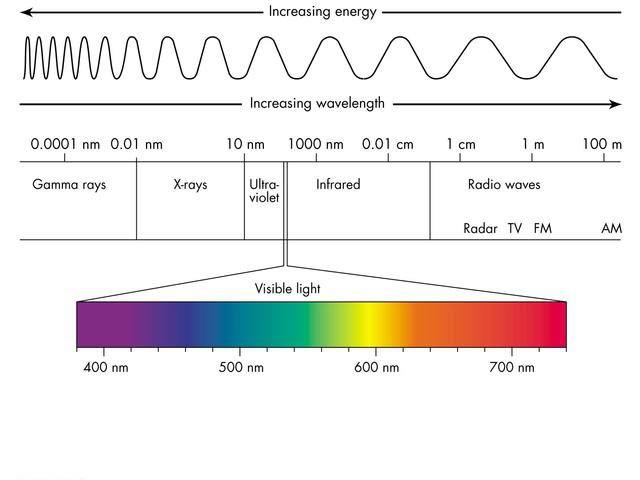
What is the correct order of the visible light spectrum starting with the longer wavelength?
Red, yellow, orange, blue, violet, indigo
Violet, indigo, blue, green, yellow, orange, red
Green, yellow, blue, indigo, red, orange
Red, orange, yellow, green, blue, indigo, violet

Scientists observed a celestial object emitting waves with a frequency of 1.41 x 10⁸ Hz. What type of telescope did the scientists have to use to view this object?
Radio wave
Microwave
X-ray
Ultraviolet wave
The frequency of an x-ray is --
1.41 x 10⁻¹⁰ Hz
1.41 x 10¹⁸ Hz
1.41 x 10¹⁰ Hz
1.41 x 10⁻¹⁸ Hz


Black holes emit tremendous amounts of energy which result in astronomers using many different means of technology to gather information. Instruments such as the GALEX satellite and Spitzer Space Telescope use different parts of the electromagnetic spectrum to gather data about these strange celestial objects. To view black holes, the GALEX typically operates at a frequency of about 1.3 X 10¹⁵ Hz while the Spitzer Space Telescope operates at 2.2 X 10¹² Hz.
Which two portions of the electromagnetic spectrum are astronomers using to detect information about black holes?
Ultraviolet and X-Ray
Gamma Ray and X-Ray
Ultraviolet and Infrared
Infrared and Radio
Which of the following transmits information using microwaves?


Archimedes' Principal states that the buoyant force of an object is equal to the weight of the fluid it displaces.
True
False
An object will sink in water if it...
is more dense than water
is less dense than water
has the same density as water
In iceberg floats in the ocean. The ice must be ________ than the liquid water.
less dense
more dense
Choose the correct match.
Wooden board => float
Scissors => float
Ballons => sink
Ping pong ball => sink

What is this?
paper
paper clip
paper boat
When do objects weigh the most?
Completely out of water
partially submerged in water
completely submerged in water
Would a Rock be More or Less Dense?
More
Less
Both
I don't even know
The density of water is 1 g/cm3. If an object has a density of 0.9 g/cm3, will it float or sink?
float
sink
Archimedes' Principal says that the buoyant force of an object is equal to
the weight of the fluid it is in/on.
the mass of the fluid it is in/on.
the weight of the fluid it displaces.
the volume of the fluid it displaces.
When a piece of metal is placed on water, it sinks. But when the same piece of metal is placed on a block of wood, both are found to float. Explain this observation.
Metal is denser than water. Metal and the piece of wood have a general density (combined density) more than that of water and floats just below the surface.
Metal is denser than water hence sinks. Metal and the piece of wood have a general density (combined density) less than that of water and floats just below the surface.
Metal is denser than water. Metal and the piece of wood have a general density (combined density) less than that of water and floats just below the surface.
Metal is denser than water. Metal and the piece of wood have a general density (combined density) less than that of water and sinks just below the surface.
State Achimede's principle
when a body is wholly or partially immersed it experiences upthrust force equal to the weight of the liquid displaced
when a body is wholly or partially immersed it experiences upthrust equal to the weight of the fluid displaced
when a body is wholly or partially immersed it experiences an upward force equal to the weight of the water displaced
upward force is equal to weight of the body
State the law of floatation
A body displaces its own mass of the liquid in which it floats
A body displaces its own volume of the liquid in which it floats
A body displaces its own weight of the liquid in which it floats
A body displaces its own density of the liquid in which it floats
State the law of floatation
A body displaces its own mass of the liquid in which it floats
A body displaces its own volume of the liquid in which it floats
A body displaces its own weight of the liquid in which it floats
A body displaces its own density of the liquid in which it floats
What is the SI unit of relative density
Kg/m3
Kgm-2
M3/kg
None of the above
The density of water is 1 g/cm3. If an object has a density of 0.9 g/cm3, will it float or sink?
float
sink
Neutral buoyancy results in an object
floating.
sinking.
being wet.
being suspended. (neither sinking nor floating)
Weight is the measure of
gravity on an object.
a push or a pull on an object.
the mass of an object.
the momentum of an object.
Which principle states that the buoyant force is equal to the weight of the displaced water?
Archimedes Principle
Arthur Principle
Archaeology Principle
If you buy sunglasses in a store, you can be sure that they are polarized when one pair of sunglasses is placed in front of another and rotated in the plane of the body and
the light passing through the sunglasses will be blocked at two positions due to refraction of light.
the light passing through the sunglasses will be blocked at two positions due to reflection of light.
the light passing through the sunglasses will be blocked at two positions due to the polarization of light.
the light passing through the sunglasses will be blocked at two positions due to the bending of light waves.
Explain in terms of distance and the speed of light why it is currently very unlikely that humans will visit planets that circle stars other than our Sun.
The spacecrafts used for travel are very heavy and thus very slow.
Spacecrafts do not have a constant source of energy to run them.
If a spacecraft could attain a maximum speed equal to that of light, it would still be too slow to cover astronomical distances.
Spacecrafts can attain a maximum speed equal to that of light, but it is difficult to locate planets around stars.
Calculate the wavelength of light that has a frequency of 5.2 x 10¹²/s.
5.8 x 10 -5 m
5.8 x 10 -7 m
5.19 x 10 14 m
1.56 x 10 23 m
If an AM radio station broadcasts at
9.95 x 10⁵ Hz, what is the wavelength of this radiation?
6.59 x 10⁻²⁸ m
1.01 x 10⁻⁶ m
3.32 x 10⁻³ m
301.5075 m
When you go out to sun, ultraviolet light rays give you your tan. What is the wavelength of this light if it has a frequency of
7.74 X 10¹⁴ Hz?
3.88 x 10⁻⁷ m
3.26 x 10⁻² m
2.58 x 10⁶ m
2.32 x 10²³ m
IRAS, the Infrared Astronomy Satellite launched by NASA in 1983, had a detector that measured infrared or heat radiation from different regions of space. What is the frequency of infrared light that has a wavelength of
1.10 X 10⁻⁶ m?
3.67 x 10⁻¹⁵ Hz
3.67 x 10⁻³ Hz
2.73 x 10² Hz
2.73 x 10¹⁴ Hz
A particular light source gives off light waves with a measured wavelength of
2.0 x 10⁻⁷ m. What is the frequency of the light source?
6.67 x 10⁻¹⁵ Hz
6.0 x 10¹¹ Hz
1.5 x 10¹⁵ Hz
not enough information to answer
The density of water is 1 g/cm3. If an object has a density of 0.9 g/cm3, will it float or sink?
float
sink


Wavelength= 1.2 m
Frequency= 210 hertz

