
Font size
 Worksheets
Unit 2 Plate Tectonics
Total questions: 35
Worksheet time: 19mins
The movement of matter due to differences in density; the transfer of energy due to the movement of matter
plate tectonics
convergent boundary
convection
divergent boundary
The process by which new oceanic lithosphere (sea floor) forms when magma rises to Earth's surface at mid-ocean ridges a solidifies (hardens) as older, existing sea floor moves away from the ridge.
sea-floor spreading
transform boundary
plate tectonics
convection
The Boundary between tectonic plates that are colliding.
mid ocean ridges
plate tectonics
convergent boundary
divergent boundary
The theory that Earth's outer layer is made up of large moving pieces called tectonic plates; the theory explains how plates interact and how those interactions relate to processes such as earthquakes and mountain building.
mid ocean ridges
plate tectonics
divergent boundary
convection theory
The boundary between tectonic plates that are sliding past each other horizontally.
divergent boundary
convergent boundary
transform boundary
plate tectonics
The boundary between tectonic plates that are moving away from each other.
divergent boundary
convergent boundary
transform boundary
plate tectonics
This type of plate boundary is most often associate with earthquake
transform
divergent
convergent
The Great Rift Valley in Africa occurs on land at this plate boundary
divergent boundary
transform boundary
convergent boundary
The Himalayan mountains and Mt. Everest can be found at this plate boundary.
convergent boundary
divergent boundary
transform boundary

convergent boundary
divergent boundary
transform boundary

convergent boundary
divergent boundary
transform boundary

convergent boundary
divergent boundary
transform boundary
The San Andreas fault in California is on this type of plate boundary
convergent boundary
divergent boundary
transform boundary
Mid-ocean ridge and sea-floor spreading happen at this plate boundary
convergent boundary
transform boundary
divergent boundary
What is magma?
hot fluid or semifluid material below or within the earth's crust from which lava and other igneous rock is formed on cooling.
hot molten or semifluid rock erupted from a volcano or fissure, or solid rock resulting from cooling of this
Something that is, ya know, like really big.
Donald Trump's campaign slogan.
The zone of earthquakes and volcanoes surrounding the Pacific Ocean.
Three Ring Circus
Ring of Fire
Devil's Rim
Round House of Horror
German Scientists that first theorized about the past existence of a super continent called Pangea.
Alfred Wegener
Alfred Hitchcock
Albert Einstein
August Oppenheimer
Large ocean eave created by undersea earthquakes or volcanic eruptions
algiers
tsi tsi
tsunami
hawewe ("wave" in hawaiian)
Two continental plates meeting at a convergent boundary create what type of landform?
costal volcanoes
rift valleys
mid-ocean ridges
folded mountains
What two landforms are created by the convergence of an ocean plate with a continental plate?
trench & coastal volcano
trench & island arc
folded mountain & mid-ocean ridge
folded mountain & rift valley

What landforms would be created at this plate boundary? (pick 2)
trench
coastal volcano
volcanic islands
folded mountains
Where does subduction occur?
trenches
volcanoes
divergent boundaries
fault lines

Where do earthquakes AND volcanoes occur?
along plate boundaries
hot spots
only convergent boundaries
only subduction zones

Using the image shown above, in which location is Igneous rock found in the rock cycle?
A
B
C
Not shown

Using the image shown, in which location is Sedimentary rock found in the rock cycle?
A
B
C
Not Shown
The Appalachian Mountains in north Georgia were formed when tectonic plates collided nearly 480 million years ago. They have weathered and eroded since they formed. The Himalayan mountains of Asia are steep and jagged because they are young and still forming where plates are colliding. The physical appearance of mountains tells much about their age because:
Old mountains are rounded and weathered rather than jagged and steep.
Old mountains are steep and jagged rather than rounded and weathered.
Only new mountains have peaks and valleys
Only old mountains are taller than the land around them

At which locations would you most likely find mafic minerals?
A & C
A & B
B & D
C & D
Areas of volcanism away from plate boundaries are called:
calderas
hot spots
fissures
cones
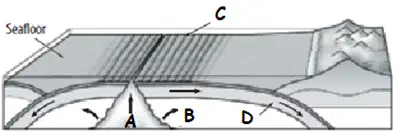
New seafloor moves away from the ridge, cools, moving outward in both directions
A
B
C
D
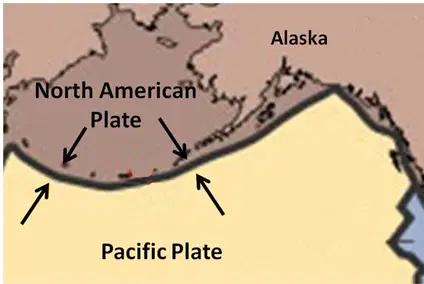
Oceanic crust is sliding beneath the Aleutian Islands in the North Pacific Ocean, forming the Aleutian Trench shown in the picture to the right. What type of plate boundary is involved in forming this trench?
a. convergent plate boundary between the Pacific Plate and the Juan de Fuca Plate
b. convergent plate boundary between the Pacific Plate and the North American Plate
c. divergent plate boundary between the Pacific Plate and the North American Plate
d. divergent plate boundary between the Pacific Plate and the Juan de Fuca Plate
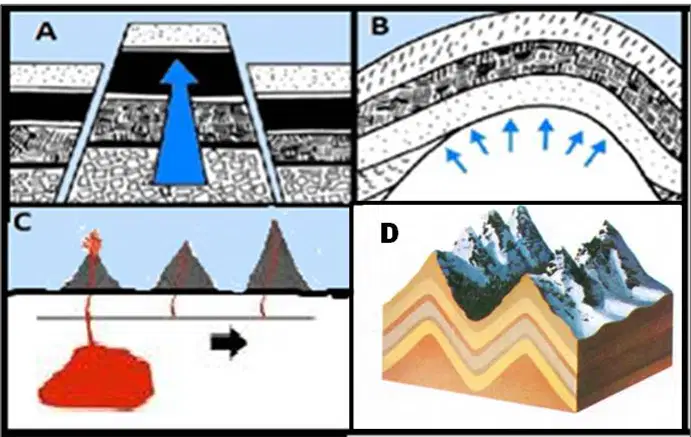
Identify the Four types of mountains in order A-D in the images at the left
Folded-Block-Volcanic-Dome
Block-Dome-Volcanic-Folded
Volcanic-Folded-Block-Dome
Dome-Folded-Block-Volcanic
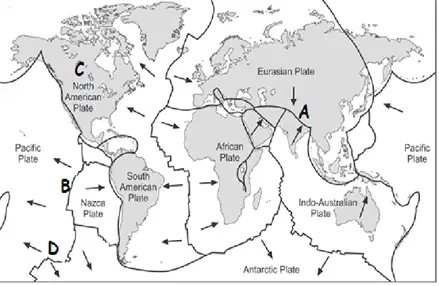
High, non-volcanic mountains are forming at location A on the map. What process is causing these mountains to form?
One continental plate is colliding with an oceanic plate which is slipping under the continental one
Two continental plates are colliding
Two oceanic plates are colliding
One continental plate is colliding with an oceanic plate which is slipping under the oceanic one.
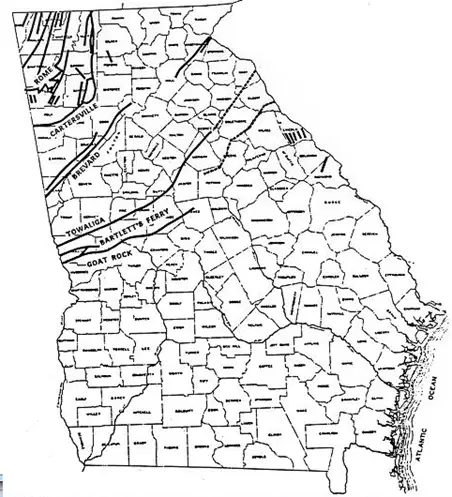
The map to the left shows the location of ancient, CONVERGENT faults in Georgia. If these were DIVERGENT faults instead, what type of landform would most likely be present?
a. Rift Valley
b. Mountains
c. Ocean Trenches
Moraines
Rift Valley
Mountains
Ocean Trenches
Moraines
Drag the labels to the correct the locations on the diagram.
convergent boundary
Mid-ocean Ridge
slab pull
trench
divergent boundary
Which of the following is an effect of plate tectonics?
Formation of rivers
Creation of mountain ranges
Changes in weather patterns
Erosion of soil

