wayground logo

Free Printable Worksheets

NEW

Font size

S
M
L
XL
Worksheets

IB Matter and Change Review Part 1

Total questions: 66

Worksheet time: 34mins

Name
Class
Date
1.
From 30 degrees to 55 degrees, what state of matter is the substance?
a)
Solid
b)
Liquid
c)
Gas
d)
Plasma
2.
What is increasing as time increases?
a)
state of matter
b)
boiling point
c)
melting point
d)
kinetic energy
3.
The combination of pressure and temperature where all three states of matter will exist at the same time
a)
triple point
b)
temperature point
c)
pressure point
d)
the point of three states
4.
Evaporation is when liquid particles absorb enough energy to leave the 
a)
surface
b)
bottom
c)
center
d)
liquid throughout
5.
Sublimation is
a)
when solid turns into gas
b)
when gas turns into plasma
c)
when liquid turns into gas
d)
when gas turns into solid
6.
Fluid states are
a)
solid and gas
b)
liquid and gas
c)
solid and liquid
d)
solid, liquid and gas
7.
What state of matter is segment 5?
a)
Solid
b)
Liquid
c)
Gas
d)
Plasma
8.
The Kelvin temperature scale is based on
a)
potential energy
b)
kinetic energy
c)
Kelvins
d)
water
9.
The only state that will change volume with pressure changes is
a)
a solid
b)
a liquid
c)
a gas
d)
no states of matter
10.
What state of matter does the picture best describe?
a)
Solid
b)
Liquid
c)
Gas
11.
Which State of Matter does the diagram best represent?
a)
Solid
b)
Liquid
c)
Gas
12.
This picture represents: 
a)
Element
b)
Compound
c)
Mixture of Elements
d)
Mixture of Compounds
13.
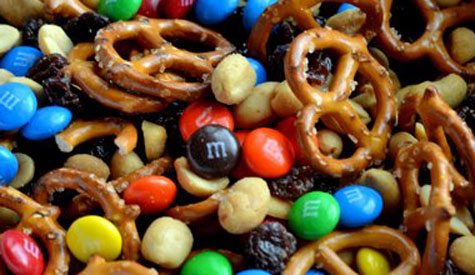
What type of mixture is this?
a)
homogenous mixture
b)
chemical
c)
heterogeneous mixture 
d)
solid mix
14.
A substance with two or more elements that are combined in a fixed proportion
a)
colloid
b)
compound
c)
element
d)
solution
15.
A substance in which all the atoms are the same
a)
colloid
b)
homogeneous mixture
c)
solution
d)
element
16.
A mixture that contains two or more substances blended evenly throughout
a)
heterogeneous mixture
b)
homogeneous mixture
c)
suspension
d)
colloid
17.
Which of the following is an element?
a)
Sugar
b)
Salt
c)
Water
d)
Oxygen
18.
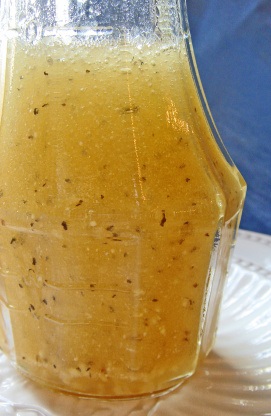
Italian Salad Dressing is a . . .
a)
heterogeneous mixture
b)
homogeneous mixture
c)
Pure Substance
d)
Compound
19.
If you change a substance into a new substance...
a)
Partial Change
b)
Physical Change
c)
Chemical Change
d)
Freezing
20.
Changing the phase, size or shape of something....
a)
Chemical change
b)
Physical Change
c)
Suspension
d)
Colloid
21.
This picture represents: 
a)
Element
b)
Compound
c)
Mixture of Elements
d)
Mixture of Compounds
22.
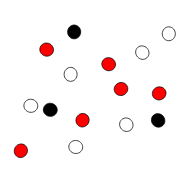
Which of the following statements correctly explains the difference between the two mixtures in the diagram below?
a)
Mixture 1 is homogeneous because the different particles are unevenly distributed.
b)
Mixture 1 is heterogeneous because the different particles are evenly distributed.
c)
Mixture 2 is homogeneous because the different particles are unevenly distributed. 
d)
Mixture 2 is homogeneous because the different particles are evenly distributed.
23.
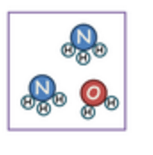
This picture represents: 
a)
Element
b)
Compound
c)
Mixture of Elements
d)
Mixture of Compounds
24.
Which one of these pictures represents a pure substance? 
a)
1 and 2
b)
1 and 3
c)
2 and 3
d)
1, 2 and 3
25.

Classify the matter pictured

a)

Element

b)

Compound

c)

Mixture of elements

d)

Mixture of compounds

e)

Mixture of elements and compounds

26.

Classify the matter pictured

a)

Element

b)

Compound

c)

Mixture of elements

d)

Mixture of compounds

e)

Mixture of elements and compounds

27.
Salt dissolved in water.  
What method would you use to separate this mixture so that you can get the salt AND the water?
a)
sorting by hand
b)
distillation
c)
chromatography
28.
Which technique is shown the diagram below
a)
seiving
b)
filtration
c)
decanting
d)
crystallization
29.
Which one of the following is NOT an example of a separation technique?
a)
all of them
b)
fishing net
c)
surgical mask
d)
 tea strainer
30.
Dyes in water soluble markers may be separated by means of
a)
Distillation
b)
Decanting
c)
Chromatography
d)
Centrifuge
31.
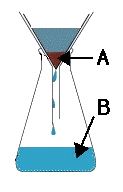
The diagram shows the apparatus for separating soil and water. What are the labelled parts?
a)
A = distillate, B = filtrate
b)
A = filtrate, B = residue
c)
A = residue, B = filtrate
d)
A = residue, B = distillate
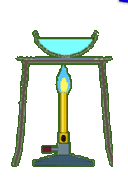
32.
Which one of the following is the name for separation technique in the picture below
a)
distillation
b)
dissolving
c)
evaporation
d)
decanting
33.

A solid produced by a chemical reaction.

a)

slush

b)

gel

c)

aqueous solution

d)

precipitate

34.
In physical changes, substances might change in __________ but not in __________.
a)
appearance, composition
b)
volume, state of matter
c)
texture, color
d)
weight, mass
35.
Which of the following is an example of a physical change?
a)
sugar and oxygen reacting to produce water and carbon dioxide
b)
honey dissolving in tea
c)
a raw egg being cooked
d)
metal rusting after being left out in the rain
36.
A physical change can sometimes result in a color change. Which of the following situations show this?
a)
Milk turns yellow when it spoils.
b)
Dough becomes darker when it is baked into cake.
c)
A red candy dissolves and turns water pink.
d)
A match turns black when it is burned.
37.
A copper penny turning greenish after a few years is an example of ...
a)
Chemical Change
b)
Physical Change
38.
Bubbles form when two or more substances are combined ...
a)
Chemical Change
b)
Physical Change
39.
An explosion occurs ...
a)
Chemical Change
b)
Physical Change
40.
A change in the size, shape, or state of matter.
a)
chemical change
b)
physical change
41.

Choose the best description below for the image

a)

physical change

b)

chemical change

42.

Choose the best description below for the image

a)

physical change

b)

chemical change

43.

Choose the best description below for the image

a)

physical change

b)

chemical change

44.

Choose the best description below for the image

a)

physical change

b)

chemical change

45.

Choose the best description below for the image

a)

physical change

b)

chemical change

46.

Choose the best description below for the image

a)

physical change

b)

chemical change

47.

The image is best described as

a)

Chemical Change

b)

Physical Change

48.

Blue color: Chemical or Physical Property

a)
Chemical Property
b)
Physical Property
49.
Density: Chemical or Physical Property
a)
Chemical Property
b)
Physical Property
50.
Flammability (burns): Chemical or Physical Property
a)
Chemical Property
b)
Physical Property
51.

Reacts with acid: Chemical or Physical Property

a)
Chemical Property
b)
Physical Property
52.
Brittleness: Chemical or Physical Property
a)
Chemical Property
b)
Physical Property
53.

Sour taste: Chemical or Physical Property

a)
Chemical Property
b)
Physical Property
54.

Melting point: Chemical or Physical Property

a)
Chemical Property
b)
Physical Property
55.

TRUE or FALSE: In order to change the state of matter, you need increase or decrease the energy (heat).

a)

TRUE

b)

FALSE

56.

TRUE or FALSE: The particles in solids move around a lot and spread out.

a)

TRUE

b)

FALSE

57.

Phase change from liquid to gas is called:

a)

Freezing

b)

Condensation

c)

Vaporization

d)

Sublimation

58.

Phase change from solid to gas is called:

a)

Freezing

b)

Condensation

c)

Vaporization

d)

Sublimation

59.

Phase change from liquid to solid is called:

a)

Melting

b)

Freezing

c)

Deposition

d)

Condensation

60.

Phase change from gas to liquid is called:

a)

Melting

b)

Freezing

c)

Deposition

d)

Condensation

61.

Phase change from gas to solid is called:

a)

Sublimation

b)

Freezing

c)

Deposition

d)

Vaporization

62.

Which of the following statements is NOT true about gases?

a)

Gases do not have fixed shape or volume

b)

Gas particles do not move much, but vibrate

c)

Gas particles have a lot of free space

d)

Unlike solids, gases can be compressed

63.

Which of the following statements is true about liquids?

a)

Particles do not move around much, but vibrate

b)

Particles have a lot of free space and spread out

c)

Liquids have fixed shape & volume

d)

Particles are less closely packed than solids

64.

Which of the following statements is true about solids?

a)

Particles do not move around much, but vibrate

b)

Particles have a lot of free space and spread out

c)

Solids have fixed shape but not volume.

d)

Particles are less closely packed than gas.

65.

Look at the picture. Which state of matter is in beaker C?

a)

Solid

b)

Liquid

c)

Gas

d)

Blue thingys

66.

Look at the picture. Which state of matter is in beaker A?

a)

Solid

b)

Liquid

c)

Gas

d)

Blue thingys