wayground logo

Free Printable Worksheets

NEW

Font size

S
M
L
XL
Worksheets

1st Six Weeks Test Review Chem

Total questions: 41

Worksheet time: 33mins

Name
Class
Date
1.

An ice cream cone melts in a kid's hand while walking outside on a hot summer day. What is this an example of?

a)

Physical property

b)

Chemical property

c)

Physical change

d)

Chemical change

2.

A silver ring gets tarnished (becomes dull) as a result of being exposed to air and moisture. What is this an example of?

a)

Physical property

b)

Chemical property

c)

Physical change

d)

Chemical change

3.

Water boils at 100˚C. What is this an example of?

a)

Physical property

b)

Chemical property

c)

Physical change

d)

Chemical change

4.

Benzene is a compound that is highly flammable. What is this an example of?

a)

Physical property

b)

Chemical property

c)

Physical change

d)

Chemical change

5.

Which set of properties, intensive or extensive, are based on the size of a sample?

a)

intensive

b)

extensive

6.

What kind of physical property is this? Color

a)

intensive

b)

extensive

7.

What kind of physical property is this? Temperature

a)

intensive

b)

extensive

8.

What kind of physical property is this? Number of Atoms

a)

intensive

b)

extensive

9.

___________ are the smallest unit of an element that maintains the properties of that element.

a)

Atoms

b)

Elements

c)

Compounds

d)

Mixtures

10.

An _______________ is made up of one or more of the same kind of atom chemically combined.

a)

atom

b)

element

c)

molecule

d)

compound

11.

A ______________ is made up of different kinds of atoms chemically combined.

a)

element

b)

compound

c)

mixture

d)

molecule

12.

A ______________ mixture is one that does not have a uniform composition.

a)

heterogeneous

b)

homogenous

c)

pure substance

13.

A _________________ mixture is one where the substances are evenly spread throughout.

a)

heterogeneous

b)

homogeneous

c)

pure substance

14.
John Dalton stated:
a)
elements are made of atoms
b)
atoms of a given element are identical
c)
atoms cannot be subdivided, created, nor destroyed
d)
all of the above
15.
The scientist responsible for "discovering" the nucleus is:
a)
Bohr
b)
Rutherford
c)
Schroedinger
d)
Einstein
16.
He developed the planetary model of the atom.
a)
Rutherford
b)
Bohr
c)
Chadwick
d)
Dalton
17.
What did Thomson discover?
a)
electron
b)
proton
c)
neutron
d)
electron cloud
18.
What is the atomic number?
a)
the number of protons
b)
the number of protons and neutrons
c)
the number of neutrons
d)
the number of protons and electrons
19.
What is the mass number defined as?
a)
the number of protons
b)
the number of protons and neutrons
c)
the number of neutrons
d)
the number of protons and electrons
20.

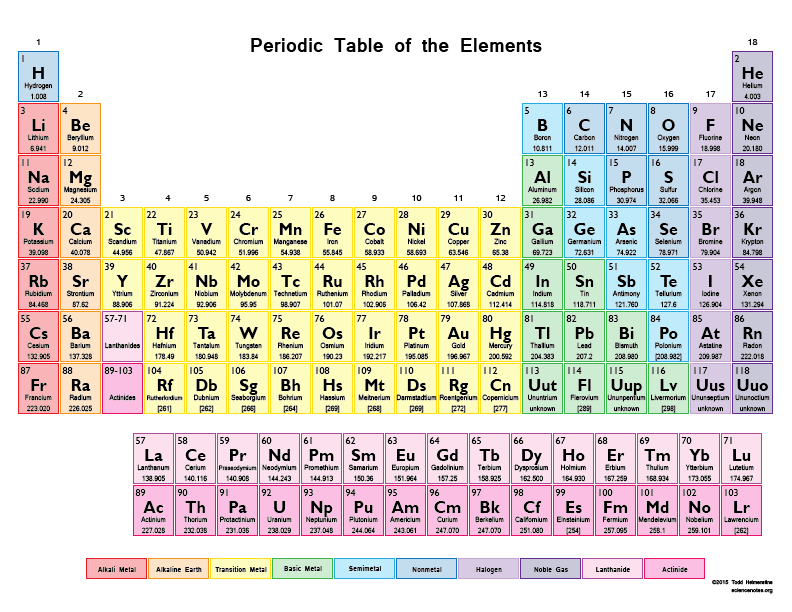
What is the atomic number of Barium, Ba? (enlarge the periodic table)

a)

20

b)

38

c)

56

d)

88

21.

An element has the mass number 12 and atomic number 6. The number of neutrons in it is:

a)

6

b)

10

c)

4

d)

8

22.
Ions are: 
a)
atoms with a positive or negative charge
b)
atoms with no charge
c)
atoms with ONLY a positive charge
d)
atoms with ONLY a negative charge
23.
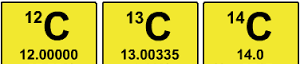
What do these isotopes of carbon all have in common?
a)
neutrons & mass number
b)
atomic number and neutrons
c)
atomic number and electrons
d)
protons, atomic number, and mass number
24.
How many neutrons does the isotope of lithium have?
a)
8
b)
3
c)
4
d)
5
25.
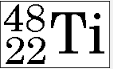
How many protons does this isotope of titanium have?
a)
48
b)
22
c)
26
d)
70
26.
24.1% of all the isotopes of a an element have a mass of 75.23 amu, 48.7% have a mass of 74.61 amu, and 27.2% have a mass of 75.20 amu.
What is the average mass of this element?
a)
74.92 amu
b)
24.97 amu
c)
75.01 amu
d)
74.51 amu
27.
Calcium has three different isotopes. One has a mass of 35.00 amu; another has a mass of 41.00 amu; and another has a mass of 40.00 amu. Which isotope is the most abundant of the three?
a)
40.00 amu
b)
41.00 amu
c)
35.00 amu
d)
impossible to tell
28.
An element with 4.35% have a mass of 49.9461 amu, 83.79% have amass of 51.9405 amu, 9.50% have a mass of 52.9407 amu, and 2.36% have a mass of 53.9389amu.
a)
51.99 amu
b)
52.19 amu
c)
53.45 amu
d)
17.33 amu
29.
4.35% of all X atoms have a mass of 39.946 amu. 83.79% have a mass of 41.941 amu, 9.50% have a mass of 42.941 amu, and 2.36% have a mass of 43.939 amu. What is the average atomic mass of atom X?
a)
41.97 amu
b)
42.19 amu
c)
10.43 amu
d)
40.04 amu
30.
As the wavelength of a wave increases, which is also true?
a)
The energy of the wave will increase.
b)
The speed of the wave will increase.
c)
The frequency of the wave will decrease.
d)
Planck's constant will decrease.
31.
Which set correctly lists the types of electromagnetic radiation in order, from least to most energetic?
a)
ultraviolet, visible, infrared, microwave
b)
infrared, microwave, ultraviolet, x-rays
c)
ultraviolet, visible violet, visible red, infrared
d)
radio, microwave, ultraviolet, gamma
32.
Radio station A broadcasts a signal with a frequency of 98.7 MHz, and radio station B broadcasts a signal with a frequency of 100.3 MHz.  What can be said about the relationship of signal A to signal B?
a)
Signal A and signal B have the same energy.
b)
Signal A has more energy than signal B.
c)
Signal A has a shorter wavelength than signal B.
d)
Signal A has a longer wavelength than signal B.
33.
The energy of violet light is approximately twice that of red light.  How do the wavelengths of violet and red light compare?
a)
​​The wavelength of violet light is sometimes greater than and sometimes less than that of red light.
b)
The wavelength of violet light is the same as that of red light.
c)
The wavelength of violet light is approximately twice that of red light.
d)
The wavelength of violet light is approximately half that of red light.
34.
How many electrons should Oxygen have around its Lewis dot model?
a)
5
b)
6
c)
7
d)
8
35.
This is the correct dot diagram for sodium (Na)
a)
true
b)
false
36.
This is the correct dot diagram for nitrogen (N)
a)
true
b)
false
37.
What atom matches this electron configuration?
1s22s22p63s23p64s23d10
a)
Zinc
b)
Copper
c)
Nickel
d)
Germanium
38.
What electron configuration matches an oxygen atom?
a)
1s22s22p63s2, 3p64s23d104p5
b)
1s22s22p4
c)
1s22s22p6
d)
1s22s22p63s23p64s23d1
39.
What is the electron configuration of Sulfur  using noble gas method
a)
[Ne]3s1
b)
[Ne]3s23p3
c)
[Ne]3s23p4
40.
The electron configuration of an atom is 1s22s22p6.  The number of electrons in the atom is 
a)
3
b)
6
c)
8
d)
10
41.

What atom matches this electron configuration?

[Xe] 6s24f145d9

a)

Mercury

b)

Gold

c)

Platinum

d)

Thallium