
 Worksheets
04. Fluid Principles and Gas Laws (conceptual)
Total questions: 25
Worksheet time: 19mins
A unit of pressure is called a
bernoulli
pascal
pound
meter
One application of Pascal's principle is
a hydraulic car lift
the flight of an airplane
a speedboat's bottom slapping against the waves
the buoyancy shown by ducks and other waterfowl
Which of the following is true of the buoyant force?
it acts in the downward direction
it acts with the force of gravity
it acts in the upward direction
ti makes an object feel heavier
What scientific rule states that the buoyant force on an object is equal to the weight of the fluid displaced by the object?
Archimedes' principle
Pascal's principle
Bernoulli's principle
Newton's third law of motion
A ship stays afloat as long as the buoyant force is
less than the ship's weight
equal to the ship's weight
less than the ship's speed
greater than the ship's speed
The mass per unit volume of a substance is its
density
buoyancy
weight
fluid pressure

This principle says that an increase in pressure on a confined fluid is transmitted equally to all parts of the fluid.
Newton's Principle
Bernoulli's Principle
Archimedes' Principle
Pascal's Principle

This principle states that the faster a fluid moves, the less pressure the fluid exerts.
Bernoulli's Principle
Newton's Principle
Pascal's Principle
Archimedes' Principle
Which states of matter are fluid?
solid
liquid
gas
liquid and gas
A student inflates a balloon with helium then places it in the freezer. The student should expect
the balloon's volume to increase
the balloon's volume to decrease
the balloon's moles to increase
the balloon's moles to decrease
If a hairspray can is heated, what can be expected of the pressure of the gas inside the can?
The pressure will increase
The pressure will decrease
The pressure will remain constant
The pressure will equalize
Which of the following would increase the (gas) pressure of a system?
Increase the temperature of the sample
Pump in more gas particles
Decrease the volume of the container
Each of these is correct
Charles' Law explains...
that if the pressure increases, the volume decreases
that if the pressure increases, the temperature increases
that if the temperature increases, the volume increases
that if the pressure goes decreases, the volume decreases
Directly proportional means as one value increases ..
the other stays the same
the other increases as well
the other decereases
the other goes to zero
Temperature describes the ___ of particles.
volume
mass
motion
conductivity
Increasing the temperature on an aerosol can is dangerous because the gas inside will
Increase the pressure
Decrease the pressure
Increase the volume
Decrease the volume
The random molecular motion of a substance is greatest when the substance is
a solid
a liquid
a gas
molecular motion is constant
If you blow up a balloon and then place it in the freezer, according to Charles's Law it will
explode
get smaller
get larger
freeze

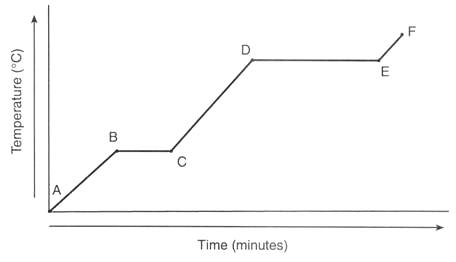

The melting point of the sample is
-60 ºC
-100 ºC
60 ºC
100 ºC
The freezing point would equal
the melting point
the boiling point
the condensation point
absolute zero
What do we call the the amount of force exerted on a certain area?
fluid
pressure
buoyant
force
What is the formula for pressure?
P=A/F
P=FA
P=F/A
P=M/V

