
 Worksheets
EP015 Assessment 6 : Circular Motion
Total questions: 26
Worksheet time: 26mins
When an object moves in a uniform circular motion, the magnitude of its velocity, v ………, …… the direction of the velocity, v ……………. with time.
remains constant, and, remains constant
remains constant, but, continually changing
continually changing, but, remains constant
continually changing, and, continually changing
Period, T refers to the time taken for an object to make ………………..
10 complete revolutions.
2 complete revolutions.
1 complete revolution.
1/2 complete revolution.
The SI unit for period is ….
millisecond.
second.
minute.
hour.
The dimension of period is …
M
L
T
s
Frequency, f refers to the number of revolutions made by an object for every ………...
1 milisecond
1 second
1 minute
1 hour
The SI unit for frequency is ….
Watt
Joule
Hertz
Newton
The dimension of period is …
M-1
L-1
T-1
s-1
Centripetal acceleration is produced due to the change of …..
the magnitude of angular velocity.
the direction of angular velocity.
the magnitude of velocity.
the direction of velocity.
What is the direction of the centripetal acceleration?
Parallel to the circular path.
Perpendicular to the circular path.
Towards the centre of circular path.
Outwards the centre of circular path.
The SI unit of centripetal acceleration is ….
ms-2
ms-1
rad s-2
rad ms-1
The dimension of centripetal acceleration is ….
ML-2
MT-1
LT-2
LT-1
The magnitude of the centripetal acceleration of an object is depending on ….
i. the mass of the object.
ii. the radius of the circular path.
iii. the velocity of the object.
i and ii
ii and iii
i and iii
all factors.
What is the direction of the centripetal force?
Parallel to the circular path.
Perpendicular to the circular path.
Towards the centre of circular path.
Outwards the centre of circular path.
The SI unit of centripetal force is ….
kgms-2
kgms-1
kg rad s-2
kg rad ms-1
The dimension of centripetal force is ….
ML-2
MLT-1
MLT-2
LT-1
The magnitude of the centripetal force exerted on an object is depending on ….
i. the mass of the object.
ii. the radius of the circular path.
iii. the velocity of the object.
i and ii
ii and iii
i and iii
all factors.

An object is attached to one end of a string. The object revolves in a horizontal circle which makes an angle θ with thw vertical line. Determine the force that contributes the centripetal force.
W
T
T cos θ
T sinθ

A car rounds a curve of radius r with velocity v. What force that prevents the car from sliding out of the curve?
Normal force
Friction
Weight of the car
Thrust force of the car

A satellite is orbiting around the Earth with orbital speed, v. What force that contribute centripetal force on the satellite?
Drag force of the satellite.
Thrust force of the satellite.
Gravitational force upon the Earth.
Gravitational force upon the satellite.

A rider on a Ferris wheel moves in a vertical circle of radius r at constant speed v. Determine the force that contribute the centripetal force at the top of the circle ?
mg - N
N - mg
mg + N
mg
A rider on a Ferris wheel moves in a vertical circle of radius r at constant speed v. Determine the force that contribute the centripetal force at the bottom of the circle ?
mg - N
N - mg
mg + N
mg

A small remote control car moves at a constant speed v in a vertical circle inside a hollow metal cylinder of radius r. Determine the force that contribute the centripetal force at the top of the circle.
mg
mg - N
mg + N
N - mg

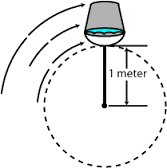
You swing a bucket of water attached to a string in a circle above your head. What keeps the water in the bucket?
Friction
Normal Force
Gravitial Potential Energy
Velocity

