wayground logo

Free Printable Worksheets

NEW

Font size

S
M
L
XL
Worksheets

Ancient India and China

Total questions: 38

Worksheet time: 23mins

Name
Class
Date
1.
What is the name of the writing system of ancient India?
a)
cuneiform
b)
hieroglyphics
c)
sanskrit
d)
calligraphy
2.
Where did all of these civilizations develop?
● Mesopotamia
● Egypt
● China
● India
a)
in river valleys
b)
in the mountian range
c)
in the coastal region 
d)
in the rain forest region
3.
The Himalayan Mountains acted as a barrier for India. How did this impact the people in India?
a)
Helped protect them from invasions but also separated them from the outside world.
b)
Helped improve communication and spread new ideas with Asia and Europe
c)
Helped build relationships with the government and military.
d)
Helped make traveling easier to trade with the rest of Asia.
4.
Reincarnation
a)
The process of recycling
b)
The process of rebirth
c)
The process of decomposition
d)
The process of farming
5.
Buddhism originated in which country?
a)
China
b)
Korea
c)
Thailand
d)
India
6.
Who founded Buddhism?
a)
Siddhartha Gautama
b)
The Brahman
c)
Ramayana
d)
Mahabharata
7.
Buddhists believe that you must give up what to get rid of suffering?
a)
your job
b)
all your money
c)
all your worldly desires
d)
your family
8.
Which of the following religions believe in reincarnation and is found predominately in India?
a)
Islam
b)
Christianity
c)
Confucianism
d)
Hinduism 
9.
For what purpose would a Shang leader most likely use an oracle bone made from a turtle shell?
a)
to serve as a ceremonial meal
b)
to make music for his family
c)
to send messages to the nobles
d)
to ask for advice from ancestors
10.
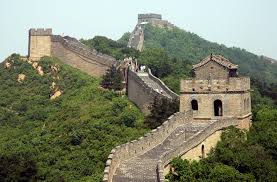
What is the purpose of the structure pictured here?
a)
It is a temple
b)
To protect China's northern border
c)
To protect China's Southern border
d)
To protect China from India 
11.
What religion was spread to China on the Silk Road?
a)
Christianity
b)
Buddhism
c)
Islam
d)
Hinduism
12.
How did the Silk Road effect China?
a)
China became wealthy
b)
China ended farmed
c)
China started a war
d)
China stopped trading
13.
Chinese farmers built this with stone and sand; pilled rubble in order to keep out invaders
a)
rudder
b)
Great Wall
c)
Huang He
d)
ideograph
14.
Trade route that stretched from western China to southern Asia
a)
filial piety
b)
Silk Road
c)
Great Wall
d)
Anyang
15.
A symbol in a writing system based on pictures
a)
ideograph
b)
pictograph
c)
bureaucracy
d)
currency
16.
Which river is in China?
a)
Green
b)
Mississippi
c)
Yellow
d)
Himilaya
17.
Pick a Chinese invention.
a)
School
b)
Paper
c)
Flag
d)
Crackers
18.
What is the central idea of Daoism
a)
Duty to community
b)
Living in harmony with nature
c)
Enforcing laws with harsh punishments
d)
Humans are naturally evil
19.
Confucius a very famous ____________, in Ancient China
a)
emperor
b)
philosopher
c)
army leader
d)
god
20.
Along what river did China's earliest civilizations develop?
a)
Huang He (Yellow)
b)
Indus
c)
Yangtze
d)
Nile
21.
A philosophy based on respect for elders and authority. 
a)
Daoism
b)
Legalism
c)
Confucianism
d)
Qin
22.
What were oracle bones used for?
a)
Cooking
b)
Telling stories
c)
Building the Great Wall of China
d)
Asking for advice from the gods
23.
Chinese philosophy based on the teachings of Laozi; taught that people should turn to nature and give up their worldly concerns
a)
Daoism
b)
Legalism
c)
Confucianism
d)
Zhou
24.
The responsibility children have to respect, obey, and care for their parents is
a)
pictograph
b)
cultural diffusion
c)
ideograph
d)
filial piety
25.

Which of these is a Hindu belief?

a)

Anyone can achieve nirvana

b)

A person's status in life is a result of how they lived their previous life.

c)

An individual does not have a soul.

d)

Demonic forces try to keep people from living good lives.

26.

Which of these is a Buddhist belief?

a)

Conquer your enemies for glory

b)

Desire is the cause of suffering.

c)

The cow is a sacred animal.

d)

The right ceremonies and rituals will result in enlightenment.

27.

Buddhism was founded by

a)

Ghandi

b)

Alexander

c)

Siddartha

28.

This Indian ruler converted to Buddhism after witnessing the carnage of a great battle.

a)

Chandra Gupta

b)

Ashoka

c)

Alexander

d)

Ramses

29.

The one word that would best describe Ashoka's reign would be....

a)

militaristic

b)

peaceful

c)

tyranny

d)

oppressive

30.

Buddhism appealed to a wider of people because

a)

Buddhists believed in many gods

b)

Buddha traveled to many places

c)

Buddhism treated all people equally

d)

Buddhist poetry was so good

31.

This Chinese practice stated that the ruling leader/dynasty would stay in power, as long as they had the blessings of the gods. This was called the...

a)

Mandate of Heaven

b)

Permission of Heaven

c)

Trials of Heaven

d)

Heavenly Order

32.

Which group of people moved from Europe into Southern Asia (India), forcing out all other groups of people already living there?

a)

Aryans

b)

Nigerians

c)

Muslims

d)

Hindus

33.

Which of the following was NOT an important river valley in India & China?

a)

Nile River

b)

Ganges River

c)

Yellow/Huang He River

d)

Indus River

34.
Who founded Buddhism?
a)
Siddhartha Gautama
b)
The Brahman
c)
Ramayana
d)
Mahabharata
35.
Line of rulers from the same family
a)
Legalism
b)
long Chinese line
c)
filial piety
d)
dynasty
36.
The Indus Valley Civilization was one of the first civilizations in the world.  What two cities were at the center of this civilization?
a)
Hormuz and Rome
b)
Mohenjo Daro and Harappa
c)
Indus and Brahmaputra
d)
Ganges and Indus
37.

What group conquered India in 1500 B.C. and set up the caste system?

a)

Mongols

b)

Hindus

c)

Aryans

d)

British

38.

During the Golden Age of the Gupta dynasty, Indian mathematicians contributed...

a)

algebra, addition & multiplication

b)

365-day calendar, fractions, hieroglyphics

c)

arabic numeric system, zero, & infinity

d)

algebra, alphabet, chemistry