wayground logo

Free Printable Worksheets

Font size

S
M
L
XL
Worksheets

Science In Action

Total questions: 40

Worksheet time: 40mins

Name
Class
Date
1.
A possible explanation to a problem that has not yet been tested. 
a)
data
b)
theory
c)
hypothesis
d)
fact
2.
What step does every scientific experiment begin with?
a)
hypothesis
b)
question/problem
c)
procedures
d)
conclusion
3.
The summary at the end of an experiment that explains the results. 
a)
conclusion
b)
procedures
c)
materials
d)
responding variable
4.
A series of steps used by scientists to solve a problem or answer a question. 
a)
scientific method
b)
recipe
c)
data collection
d)
metric system
5.
This part of the experiment serves as a basis of comparison; the one variable being tested has been omitted. 
a)
experimental group
b)
control group
c)
data
d)
variables
6.
An experiment is performed on plants to see how different liquids affect plant growth. Each plant in the experiment is given a different liquid; water, apple juice, or milk. Each plant has the same amount of soil, sunlight, and listens to the same music. In this investigation, the independent variable is ...
a)
The type of plant
b)
The amount of sunlight
c)
The type of music
d)
The type of liquid
7.
A student wants to test the effects of type of exercise on heart rate.  What is the dependent variable?
a)
heart rate
b)
type of exercise
c)
amount of exercise
d)
time of day exercise occurs
8.
On what axis should the independent variable always be?
a)
X
b)
Y
9.
An experiment is performed on plants to see how different liquids affect plant growth. Each plant in the experiment is given a different liquid; water, apple juice, or milk. Each plant has the same amount of soil, sunlight, and listens to the same music. In this investigation, what are the controlled variables?
a)
Type of plant, amount of music, and sunlight
b)
Water, apple juice, milk
c)
Plant growth
10.
Squidward found new reeds to tryout for his clarinet.  He used an APPLAUSOMETER to measure applause after playing  Under the Sea with each reed.  The results were put in the table.
What was the independent variable?
a)
The Song
b)
The Reed
c)
The Applause
11.
Squidward found new reeds to tryout for his clarinet.  He used an APPLAUSOMETER to measure applause after playing  Under the Sea with each reed.  The results were put in the table.
What was the dependent variable?
a)
The Song
b)
The Reed
c)
The Applause
12.

Which two of these can be observations about a gorilla?

a)

The gorilla wants a bigger banana.

b)

The gorilla has 5 fingers on his right hand.

c)

The gorilla is hungry.

d)

The gorilla has dark brown hair.

13.

Which of these choices are inferences about the picture.

a)

The gorilla wants a bigger banana.

b)

The gorilla has two eyes.

c)

The gorilla will be hungry after he eats that banana.

14.

How are the skills of inferring and predicting alike? How are they different?

a)

Both involve making observations, but predictions are about what will happen and inferences are about what has happened.

b)

Only inferring involves making observations, but predictions are about what will happen and inferences are about what has happened.

c)

Only predicting involves making observations, but observations are about what will happen and inferences are about what has happened.

d)

There is nothing similar or different about the two. That is what makes them unique.

15.
Your teacher has asked you to explain the difference between quantitative and qualitative observations. Which statement is correct?
a)
Quantitative observations use numbers, qualitative uses the senses.
b)
Quantitative observations use the senses, qualitative uses numbers.
c)
Quantitative observations use measurement, qualitative uses numbers.
d)
Quantitative observations use colors, qualitative uses the senses.
16.
The leaves on the plant are turning brown.
a)
Qualitative
b)
Quantitative
c)
Both
d)
Neither
17.
There are 16 red marbles in the bag.
a)
Qualitative
b)
Quantitative
c)
Both
d)
Neither
18.
If your teacher asked you to make qualitative observations about the class’s pet hamster, which group of words might be used?
a)
A  mass of 3 kg, 11 cm long, age of 16 months
b)
A  mass of 3 kg, 11 cm long, cute
c)
A  long hair, white and brown colored, soft
d)
A  temperature, length, weight
19.

How are observations made?

a)

Only with your eyes.

b)

By trying to explain what you see.

c)

Using your 5 senses

d)

Just making a good guess.

20.
It occurs when a scientist's expectations change how the results are viewed
a)
Scientific law
b)
Scientific theory
c)
Bias
d)
Model
21.

An unconscious bias impacts the response you have to a person, belief or situation.

a)

True

b)

False

22.

Everyone has some type of bias, whether unconscious or cognitive.

a)

True

b)

False

23.
If you read a biased source, you might not get all of the information.
a)
True
b)
False
24.
At a middle school, the 7th graders will conduct a survey for where to go on a field trip. Which method will result in the least biased decision?
a)
to randomly ask 8th grade students who went on a field trip last year
b)
to randomly choose some 7th grade students to select a location
c)
to ask all 7th grade teachers and administrators for a location
d)
to ask the student council to choose a location
25.

Prejudice in favor of or against one thing, person, or group compared with another, usually in a way considered to be unfair is called

a)

Bias

b)

Disagreement

c)

Rude

d)

Agreement

26.
Which variable is found on the y-axis?
a)
Independent
b)
Manipulated
c)
Dependent
d)
Input
27.

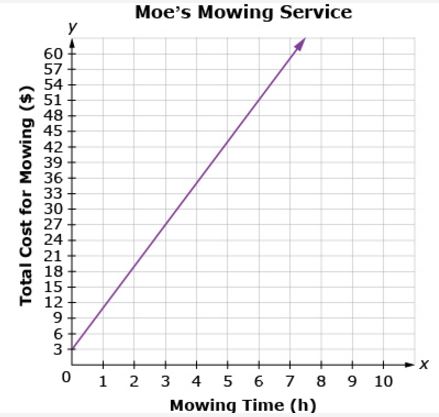
What type of graph is this?

a)

Bar Graph

b)

Line Graph

c)

Percentage Graph

d)

Data Table

28.
The variable that is being tested or changed
a)
independent variable
b)
dependent variable
c)
control variable
29.
The variable that is being measured
a)
independent variable
b)
dependent variable
c)
control variable
30.
What is the name of this graph?
a)
line plot
b)
line graph
c)
bar graph
d)
frequency table
31.

What is the main purpose of a line graph?

a)

to compare two things

b)

to show change over time

c)

to have an independent variable

d)

so you don't have to read words

32.
How much does it cost to have your lawn mowed for 2 hours?
a)
$16
b)
$17
c)
$18
d)
$19
33.
What is the independent variable?
a)
cost of mowing
b)
Moe's Mowing Service
c)
$18
d)
Mowing Time
34.

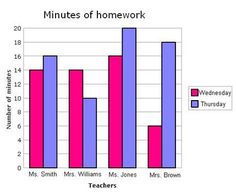
Which day had more minutes of homework?

a)

Wednesday

b)

Thursday

c)

Friday

d)

Tomorrow

35.
How many more people like purple than red?
a)
3
b)
5
c)
7
d)
9
36.

What is the dependent variable?

a)

nicest fruit

b)

number of people

c)

types of fruit

37.

Which type of graph is used to compare?

a)

line graph

b)

bar graph

c)

circle graph

38.

According to the data in the table, the students' favorite type of book is -

a)

mystery

b)

adventure

c)

science fiction

d)

biography

e)

other

39.

What question could this table answer?

a)

How much do pets cost?

b)

Why do students think dogs are the best pets?

c)

What kind of pets do our classmates have?

d)

Do you like having a pet at home?

40.

Using the table, how many students were asked about their favorite pet?

a)

5

b)

46

c)

42

d)

24