
 Worksheets
PreDIA 1_UNIT 1 SciTh_Water_MacroMol_Enzymes_2026
Total questions: 28
Worksheet time: 1hrs 24mins
Dr. Taylor wants to examine whether a new drug increases the maze-runningg performance of older rats. Dr. Smith teaches two groups of older rats to find a piece of tasty rat chow in the maze.
One group of rats is given the new drug while they are learning the maze.
The second group is not given the drug.
One week after having learned the maze he retests the rats and records how long it takes them to find the rat chow.
Based on Dr. Taylor’s experiment, what inference can be made about the effect of the new drug on the maze performance of older rats?
If the rats given the drug find the chow faster, it suggests the drug improves memory or learning ability.
If both groups of rats perform equally, the drug likely has no effect on maze performance.
If the rats given the drug perform worse, it may indicate the drug negatively affects memory or learning.
The experiment proves that the drug is the only factor that determines how rats learn mazes.

Bailey found thaaat when she dded a certain chemical to water, the pH would change. The results of her study are shown in the table and then converted into a graph.
Which of the following is a valid conclusion based on the results of Bailey's experiment?
Control chemcial always changes the pH to the same acid or base.
The pH of the water is not affected by the amount of chemical.
Adding more of the chemical will nevr change the pH to more acidic.
Adding more of the chemicial will change the pH but only to a certain point.

Small insects can walk across the surface of calm water. Their feet push the surface of the water down slightly, somewhat like a person walking across a trampoline, but they do not break the thin skin of water molecules on the surface. What is the best explanation for why this happens?
A florist places a bouquet of white carnations in water containing blue dye. After a time, the flowers turn blue. Similarly, trees absorb water and nutrients from the soil, resulting in the growth of the tree. What water property listed below occured to allow the plant to maintain water flow, turn blue and grow tatll?

The hydrogen bonds expanding
Solvency
Cohesion
Formation of ionic, covalent and hydrogen bonds between the hydrogen, oxygen, and nitrogen molecules
Many plants and animals can survive a cold winter even when the temperature drops below freezing., especially in aquatic environments. What unique property of water contributes to this effect?
Freezing water expands and becomes less dense, floats, thereby acting as an insulastor protecting the plants and animals below
Water forms hydrogen bonds and has a low boiling point, resulting in hot boiling water at the surface protecting the living things below by keeping the termperature more stable

What causes water to be polar?
The oxygen end is negative, hydrogen ends are positive
The hydrogen ends are negative, the oxygen end is positive
Both oxygen and hydrogen ends are positive
Both hydrogen and oxygen ends are negative
Florida, the “Sunshine State” is a big supplier of citrus. Although Florida has a hot-humid climate, the state occasionally experiences light freezes during the growing season. To protect the fruit, citrus growers will spray the fruit with water for protection. Which property of water helps to protect the fruit?
The adhesive property of water allows it to stick to the fruit
The cohesive property of water creates a film that reflects cold, reflects the heat less, and maintains a completely balanced environment
Due to high heat capcity, water temperature changed drastically
Due to high heat capacity, water resists temperature change and keeps the fruit at a constant temperature

Which of the following molecular structures functions to help build and repair tissues, regulate cell processes, and functions as an enzyme?
A
B
C
D

The following is a diagram of the product of protein synthesis, which means the 'making' of proteins. This protein is a polymer (a chain) of a specific molecule. The individual molecule labeled Z is most likely classified as --.
The difference between lipids and carbohydrates is
A. Carbohydrates are quickly broken down to be used as energy, while lipids take longer to be broken down to be used for energy
B. Carbohydrates are long term energy and lipids are short term energy
C. Lipids make proteins and carbohydrates make DNA & RNA
D. Carbohydrates are made of carbon, hydrogen, and oxygen and lipids are made of carbon, hydrogen, oxygen, and nitrogen
As food travels through the digestive system, it is exposed to a variety of pH levels. The stomach has a pH of 2 due to the presence of hydrochloride acid (HCl), and the small intestine has a pH ranging from 7 to 9. HCl converts pepsinogen into pepsin, an enzyme that digests proteins in the stomach. Which of the following most likely happens to pepsin as it enters the small intestine?
It denatures, losing the Active site, and becomes inactive.
It begins to replicate the Active Site, and then denature to become more active.
It's shape changes to engulf large proteins to gain their function.
It denatures & it's activity increases to digest more proteins.
The human body maintains a temperature of around 98.6 degrees at all times. Enzymes are involved in almost every chemical reaction in the body. Which of the following describes the connection between these two statements?
Enzymes function best at a specific temperature.
The body needs to be warm to prevent hypothermia.
The body is kept relatively warm to prevent too much enzyme action.
There is no connection between the two statements.
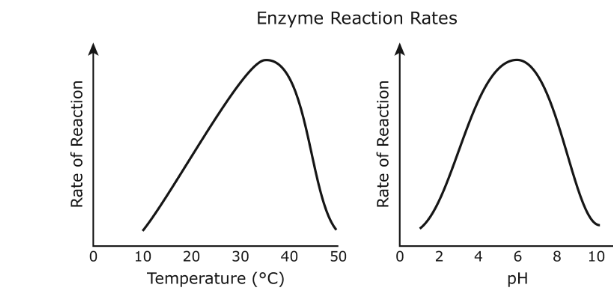
The graphs show the reaction rate for an enzyme across a range of temperatures and pH.
Based on these data, this enzyme functions best as what temperature and pH?
Temperature of 27oC and a pH of 4
Temperature of 37oC and a pH of 6
Temperature of 40oC and a pH of 8
Temperature of 50oC and a pH of 10
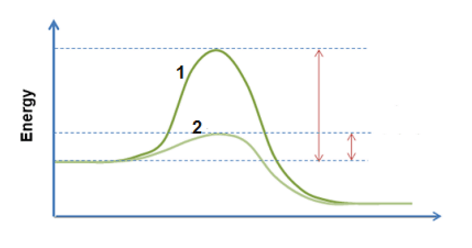
(A) Which line represents a catalyzed reaction; Which line represents an UNcatalyzed reaction?
(B) Which line uses more energy ; Which line uses less energy?
(A) Line 1 is catalyzed ; Line 2 is uncatalyzed
(B) Line 1 uses less energy ; Line 2 uses more energy
(A) Line 2 is catalyzed : Line 1 is uncatalyzed
(B) Line 1 uses more energy ; Line 2 uses less energy

Corey found that when he added a certain chemical to water, the water would heat up. He then performed an experiment in which he mixed different amounts of the chemical with water in a test tube and measured the temperature of the water. The results of his experiment are shown in the table below.
Which of these is a valid conclusion based on the results of Corey’s experiment?
The chemical always heats water to the same temperature
The temperature of the water is not affected by the amount of the chemical
Adding more of the chemical will always heat the water to a greater temperature
Adding more of the chemical will heat the water but only to a certain temperature
You are paddling out on your surfboard in the Inlet waiting for the right wave. Suddenly, you see a fin out of the corner of your eye and start paddling faster towards the shoreline. Your muscles keep a form of fast energy just for these emergencies. What macromolecule releases short term energy in your muscles?
Carbohydrates
Lipids
Proteins
Nucleic Acids
A common science experiment is to place a celery stalk into a glass of water and food coloring. After some time, the food coloring appears in the celery. What chemical principle is modeled by this experiment?
Water accounts for about 60 percent of the celery plant. The food coloring dissolves in the water in the celery and spreads throughout the plant only by surface tension.
The food coloring acts as a buffer, and the plant absorbs the food coloring in order to maintain a pH near 7.
The food coloring dissolves in the water in the glass. The water rises through vessels in the celery stem by capillary action, which involves cohesion & adhesion, thus carrying the dissolved food coloring along with it.
The food-coloring molecule carries a + charge, and it is attracted to oppositely charged molecules in the plant.
Lactase is an enzyme that breaks down lactose, a type of sugar found in milk. Lactase functions best between 21 degrees Celsius and 48 degrees Celsius, and at a pH between 2 and 7. Which of the following would happen to lactase and lactose if the temperature and pH fell far outside of these narrow ranges?
The lactose would be broken down in the same way, but it wouls gain an active site, just as it would when within the given range
The lactase would carry out the reverse reaction, synthesizing (making) lactose
The lactase would break apart lactose into very small molecules
The lactase would denature, lose its active site, and be unable to break down the lactose

A student studying reactions with enzymes uses the graph to form a conclusion. What is the best conclusion a
student can make based on the information on the graph?
The amount of activation energy is lower in reactions
without enzymes.
The amount of activation energy needed is greater in
reactions with enzymes.
A reaction with an enzyme lowers the activation energy needed.
As the reaction continues the amount of energy needed
increases.
An enzyme is a type of molecule that speeds up chemical reactions, which is referred to as a/an --- that raises OR lowers the Activation Energy...
Inhibitor ; Denature
Catalyst ; Lowers
Enzyme ; Lowers
Catalyst ; Raises
Water has many special properties that make it very unique. Some of the properties are high heat capacity, cohesive & adhesive behavior. Which of the following best explains why water has these properties and makes it so special?
Water is a weak acid and acts as a buffer
Water is polar and forms weak hydrogen bonds
Water molecules join together to form polymers
The atoms of a water molecule are held together by strong ionic bonds

Water makes up about 60% of the human body and is essential for the survival of all living things, animals as well as plants. Which unique property of water is most responsible for its importance in supporting life?
Water provides energy for cells to carry out respiration.
Water's polarity allows it to dissolve more substances than any other liquid .
Water prevents organisms from ever losing heat to their surroundings
Water only serves as a cushion for joints in animals.
Which sentence best states the importance of using control groups?
Control groups eliminate the need for statistical tests and simplify calculations
Control groups provide a method by which statistical variability can be reduced
Control groups eliminate the need for large sample sizes, reducing the number of measurements needed
Control groups allow comparison between subjects receiving a treatment and those receiving no treatment

The diagram illustrates the structure of glucose.
Which of the following describes how the body uses molecules like the onw shown?
Sugars form carbohydrates, which are linked together to form fats that store energy.
Carbohydrates are broken down into glucose, which is stored inside the body’s cells.
Sugars are broken down into proteins that become the building blocks of the body’s tissue.
Carbohydrates are broken down to release chemical energy that is used by the body’s cells
Lactase is an enzyme that breaks down lactose, a type of sugar found in milk. Lactase functions best between 21 degrees Celsius and 48 degrees Celsius, and at a pH between 2 and 7. Which of the following would happen to lactase and lactose if the temperature and pH fell far outside of these ranges?
The lactose would be broken down in the same way as within the given range
The lactase would carry out the reverse reaction, synthesizing (making) lactose
The lactase would break apart lactose into very small molecules
The lactase would denature and be unable to break down the lactose
How do coastal areas typically differ from inland regions?
They have more extreme temperatures due to humid air releasing heat as it rises, keeping tempertures at a constant level across the world.
They experience milder temperatures because the ocean absorbs the heat and releases it slowly at night keeping tempertures steady
They have less precipitation
They have stronger winds

All of the following are functions of proteins EXCEPT:
act as biological catalysts because an example are enzymes
store the genetic information of the cell
make up the structure of hair, nails, skin, bone, etc
are made up of monomers of amino acids

