
 Worksheets
Unit 1 Cell Structure and Function
Total questions: 25
Worksheet time: 25mins
Is this describing STRUCTURE or FUNCTION:
A straw is a long hollow tube.
STRUCTURE
FUNCTION
Is this describing STRUCTURE or FUNCTION:
A straw is used to consume or drink liquids.
STRUCTURE
FUNCTION

Is this describing STRUCTURE or FUNCTION:
Mitochondria contains a folded inner membrane
STRUCTURE
FUNCTION
Is this describing STRUCTURE or FUNCTION:
Mitochondria goes through respiration where food is converted into a usable energy.
STRUCTURE
FUNCTION

ORGANELLES:
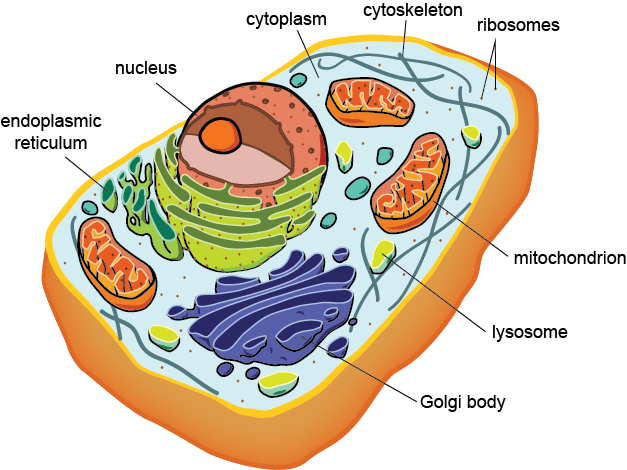
What is the FUNCTION of the purple rounded structure (#1)?
Provide structure/shape for the cell
Allow nutrients, water, and gases to enter and let wastes exit
Control the cell by using the DNA code inside of it.
Convert Energy from Food into energy for the cell.
ORGANELLES:
What is the purple round structure labeled #1 in the picture?
Mitochondria
Chloroplast
Cell Membrane
Nucleus

ORGANELLES:
The _____________ stores food, water, wastes, and other materials in both plant and animal cells.
Vacuole
Mitochondria
Nucleus
Cell Wall
Cell Membrane

ORGANELLES:
Thick gel-like fluid inside of the cell
Chloroplast
Cytoplasm
Mitochondria
Cell Membrane

ORGANELLES:
These organelles in plants capture light energy and store it in glucose molecules to be used as food. The cell's "money maker"!
Chloroplasts
Mitochondria
Nucleus
Vacuoles

ORGANELLES:
This is used as a model for what type of cell?
Plant
Animal
ORGANELLES:
A school’s cafeteria kitchen has a large, walk-in refrigerator where food is stored for lunch later in the week.
Which cell organelle has a function that is similar to the refrigerator?
Vacuole
Nucleus
Chloroplast
Mitochondria

ORGANELLES:
What cell parts does a plant cell have that are not found in an animal cell?
Cell Wall, Nucleus, Small vacuoles
Cell Wall , Chloroplast, Large Vacuoles
Cell membrane, Chloroplast, small vacuoles
Mitochondria , Cell membrane, Nucleus

ORGANELLES
I am the "brain" of the cell or the "control center" for everything happening within the cell because of my DNA.
I am a...
Vacuole
Nucleus
Chloroplast
Mitochondria

ORGANELLES
I decide what goes in and out of the cell. I am found in BOTH plant and animal cells. I am a...
Cell Wall
Cell Membrane
Cytoplasm
Nucleus

ORGANELLES:
I provide plant cells their rigid shape. I am the...
Chloroplast
Cytoplasm
Cell Membrane
Cell Wall

CELL THEORY:
According to cell theory, what do each of the following organisms have in common?
They can all reproduce by spontaneous generation
Each organism is able to photosynthesize.
Cells are the basic unit of structure for each organism
They are all made up of the same kinds of atoms.
CELL THEORY
Which of the following statements is not part of the cell theory?
Cells are the basic unit of structure and function in all living things.
All cells are produced from other cells.
Only animal cells are composed of cells.
All living things are composed of cells.

CELL THEORY
The invention of the ________ made it possible for scientists
to discover the cell.
Telescope
Microscope
Magnifying Glass
Binoculars
CELL THEORY:
A student observing a sample of cheek cells noticed that all of the cells were identical.
Why is this true?
They all come from the same location in the body.
All cells come from other cells through division.
They do not have a cell wall.
They have a chloroplast.
LEVELS OF ORGANIZATION:
Which one of the following represents the correct level of organization ranging from simplest to most complex?
Cells --> Tissues--> Organs--> Organ systems -->
Organisms
Tissues--> Organs--> Cells--> Organisms -->
Organ system
Cells--> Tissues--> Organ system--> Organisms-->
Organs
LEVELS OF ORGANIZATION:
Nesting dolls are a set of hollow, wooden toys that have the same shape. Smaller nesting dolls fit inside larger dolls so that all smaller dolls fit into the largest doll when completely assembled.
Students were asked to use nesting dolls to model the levels of organization from the smallest to largest structure.
Which model best demonstrates the levels of organization in plants and animals?


LEVELS OF ORGANIZATION:
All of the following are true EXCEPT —
skin is an organ made of epithelial tissue
cells make up tissues
each organ is made up of its own kind of tissue
tissues are made of cells
LEVELS OF ORGANIZATION:
Blood is mostly made of two types of cells.
Red blood cells carry oxygen to all parts of the body. White blood cells protect the body from disease using a variety of methods.
Blood is best classified as a/an —
Organ
Organ system
Tissue
Organism
LEVELS OF ORGANIZATION
Leaves are composed of vascular tissue.
Leaves are at the _______________ level.
Tissue
Organ
Organ System
Cell
LEVELS OF ORGANIZATION
Seeds are the offspring of mature plants.
If a seed germinates and survives, it will grow to become a mature plant.
A seed is considered to be a/an ...
Cell
Organ
Organ System
Organism

