wayground logo

Free Printable Worksheets

Font size

S
M
L
XL
Worksheets

Biology Review #1

Total questions: 50

Worksheet time: 50mins

Name
Class
Date
1.
Proteins are made of monomers called ___________
a)
Nucleotides
b)
Monosaccharides
c)
Amino Acids
d)
Glycerol and fatty acids
2.
DNA and RNA are examples of 
a)
Carbohydrates
b)
Lipids
c)
Proteins
d)
Nucleic Acids
3.
Nucleotides are monomers of
a)
Carbohydrates
b)
Lipids
c)
Proteins
d)
Nucleic Acids
4.
Monosaccharides are monomers of
a)
Carbohydrates
b)
Lipids
c)
Proteins
d)
Nucleic Acids
5.
Waxes, oils and fats are examples of
a)
Carbohydrates
b)
Lipids
c)
Proteins
d)
Nucleic Acids
6.
What is the function of nucleic acids?
a)
store genetic information
b)
store energy (long-term)
c)
store energy (short-term)
d)
build skin, hair, nails, muscles
7.
Which of the following organic compounds is the main source of energy for living things?
a)
carbohydrates
b)
lipids
c)
nucleic acids
d)
proteins
8.
Which macromolecule stores energy, insulates us, and makes up the cell membrane?
a)
lipids
b)
proteins
c)
carbohydrates
d)
nucleic acids
9.

Enzymes belong to which class of macromolecules?

a)

lipids

b)

carbohydrates

c)

proteins

d)

nucleic acids

10.
What is the purpose  of an enzyme?
a)
give permission for the reaction
b)
raise activation energy
c)
speed up reactions
d)
control how many reactions occur
11.
Where do substrates bind on an enzyme?
a)
voltage-gated channels
b)
surface receptor
c)
calcium channels
d)
active site
12.
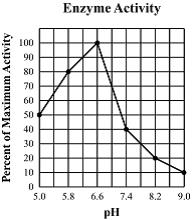
Which of the following conclusions can be drawn from this graph?
a)
The optimum pH of the enzyme is 6.6.
b)
The optimum pH of the enzyme is 5.8
c)
The enzyme’s activity increases as pH increases 5.0 to 9.0
d)
The enzyme’s activity is greater around pH of 8.0 .
13.
What makes an enzyme substrate specific?
a)
Size
b)
Shape
c)
Name
d)
Location it is found in
14.
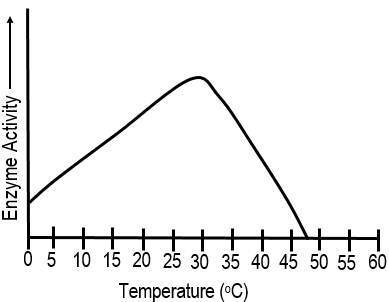
Based on the graph, what temperature does this enzyme work best? 
a)
15 C
b)
40 C
c)
30 C
d)
47 C
15.
An enzyme speeds up a chemical reaction in the cell but can only be used once.  True or False? 
a)
true
b)
false
16.
Which of these is most likely an enzyme?  
a)
Sucrose
b)
Galactose
c)
Fructose
d)
Amylase
17.
What is the activation energy?
a)
The energy of the products
b)
The energy of the reactants
c)
The minimum energy needed by the reactants to form the products.
d)
The energy lost in the reaction
18.
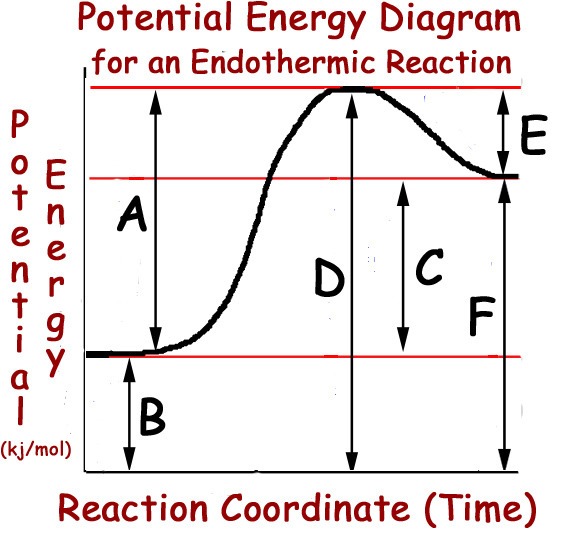
What letter represents the activation energy?
a)
A
b)
B
c)
C
d)
D
19.
Enzymes will make a reaction go _______ and use ______ energy.
a)
faster, less
b)
faster, more
c)
slower, less
d)
slower, more
20.
The graph shows how enzymes affect reactions in cells. Which statement best summarizes the information shown in the graph?
a)
Enzymes increase the energy of the reactants.
b)
Enzymes decrease the energy level of the products.
c)
Enzyme decrease the activation energy of the reaction.
d)
Enzymes reverse the direction of the reaction.
21.
The clear, jelly-like material in a cell that supports and protects the cell’s organelles.
a)
Cytoplasm
b)
Cell Membrane
c)
Nucleus
d)
Mitochondria
22.

The smallest unit of a living thing are

a)

atoms

b)

cells

c)

DNA

d)

organelles

23.

Which of the following is not under the Cell Theory?

a)

Cells are the basic unit of life

b)

All organisms are made up of cells

c)

Cells came from other cells

d)

A cell is an indestructible particle

24.

What surrounds all cells?

a)

A cell wall

b)

A cell membrane

c)

Cytoplasm

d)

DNA

25.

All cells contain...

a)

Ribosomes

b)

A nucleus

c)

DNA

d)

Endoplasmic Reticulum

26.

Why would an enzyme not work effectively at temperatures above its optimal temperature?

a)

The size of the substrate will change

b)

The shape of the substrate changes

c)

The shape of the active site changes

d)

The substrates move too fast.

27.

What is the saturation point in this graph?

a)

0.2

b)

0.3

c)

0.4

d)

0.5

28.

What is the point on a substrate concentration versus rate of reaction graph called when the graph levels off to become a straight line?

a)

Optimal substrate

b)

Optimal pH

c)

Optimal temperature

d)

Saturation Point

29.
What 3 letters do enzymes typically end in?
a)
-ose
b)
-ase
c)
-ese
d)
-tic
30.
Enzymes catalyze reactions by ___________ Activation Energy.
a)
Increasing
b)
Decreasing
31.
Letter D...
a)
active site
b)
enzyme
c)
substrate
d)
products
32.

Match the MACROMOLECULES and their MONOMERS.

Hint: Monomer = a single unit

a)

carbohydrate

1.

monosaccharide

b)

lipid

2.

fatty acid

c)

protein

3.

amino acid

d)

nucleic acid

4.

nucleotide

33.
An enzyme speeds up a chemical reaction in the cell but can only be used once.  True or False? 
a)
true
b)
false
34.
What is the function of an enzyme?
a)
enzymes break themselves into small pieces
b)
enzymes slow down chemical reactions
c)
enzymes speed up chemical reactions
d)
enzymes combine products to form reactants 
35.

How does an enzymes shape relate to its function?

a)

the shape of the enzyme has no relation to its function

b)

the enzyme is shaped specially for certain substrates to perform a specific reaction

c)

the enzyme shape acts as a receptor to certain products

d)

the enzyme shape can fit into specific substrates to cease a reaction

36.

Match the following macromolecules to their functions

a)

Carbohydrates

1.

Main source of quick energy

b)

Proteins

2.

Structure, support, act as enzymes, transport

c)

Lipids

3.

Long-term energy storage, insulation, makes up cell membrane

d)

Nucleic Acids

4.

Codes for our genetic code

37.

what is the smallest unit of an organism that is classified as living?

a)

an atom

b)

a molecule

c)

an organ

d)

a cell

38.
______________ are the basic unit of life.
a)
DNA
b)
RNA
c)
Cells
d)
Takis
39.

Which enzyme would you expect to find in bacteria growing in a hot environment?

a)

Enzyme X

b)

Enzyme Y

40.

Which enzyme has an optimum temperature of 40 degrees Celsius?

a)

Enzyme X

b)

Enzyme Y

41.
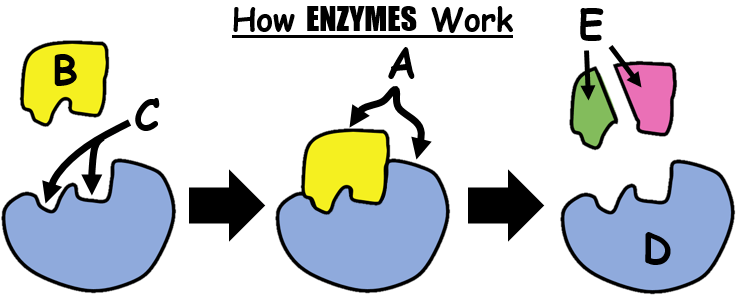
Question Image

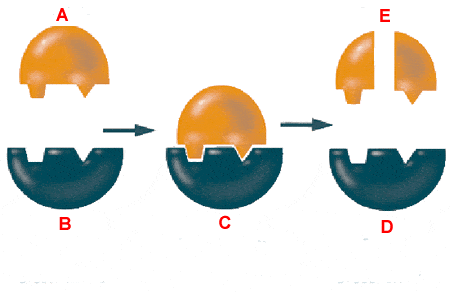
Using the diagram, match the following.

a)

A

1.

Substrate

b)

B

2.

Enzyme

c)

C

3.

Active Site

d)

D

4.

Product

e)

E

5.

Enzyme Substrate Complex

42.

Enzymes are important for the body because

a)

they increase the activation energy needed for a chemical reaction.

b)

keep the activation energy of a chemical reaction at a constant level.

c)

lower the activation energy needed for the chemical reaction.

d)

remove all of the activation energy needed for a chemical reaction.

43.

An enzyme is which type of macromolecule

a)

Carbohydrate

b)

Lipid

c)

Protein

d)

Nucleic acid

44.

Why is the “lock and key” analogy often used to describe enzyme function?

a)

Each enzyme is the same as its substrate.

b)

Each enzyme will fit with only one specific kind of substrate.

c)

Each enzyme can only be used once in a reaction and cannot be used again.

d)

Each enzyme has its own active site that will not fit with other active sites.

45.

Which biomolecule includes sugars, cellulose and starch?

a)
Lipids
b)
Proteins
c)
Carbohydrates
d)
Nucleic Acid
46.
Many monomers can be linked together to form ______________. 
a)
building blocks
b)
chemical reactions
c)
polymers
d)
energy
47.
Based on their role in the cell, enzymes can also be classified as –
a)
inhibitors
b)
catalysts
c)
sources of energy
d)
vitamins
48.
Sucrase has an optimum temperature of 37 C and an optimum pH of 6.2. What would happen if the pH changed to 3?
a)
Sucrase would continue to work the same
b)
The reaction sucrase catalyzes would speed up
c)
The reaction sucrase catalyzes would slow down
49.

___ are the elements and compounds that are created by a reaction.

a)

Products

b)

Reactants

c)

Molecules

d)

Ingredients

50.

What is the name for the mechanism of normal enzyme activity?

a)

lock and key

b)

jigsaw puzzle

c)

hammer and nail

d)

competitive inhibition