
 Worksheets
Year 10 Chemistry 1st half term
Total questions: 48
Worksheet time: 29mins
Name
Class
Date
1.
What subatomic particles would you find in the nucleus of an atom?
a)
Protons only
b)
Protons and Neutrons
c)
Neutrons and Electrons
d)
Protons and Electrons
2.
Which subatomic particles contribute the most to the mass of an atom?
a)
Protons, Neutrons, Electrons
b)
Protons only
c)
Protons and Electrons
d)
Protons and Neutrons
3.

What is the number of protons that the element in this image contain?
a)
14
b)
7
c)
15
d)
18
4.
If an atom has 12 positively charged subatomic particles, which of the following must it also have to be considered a neutral atom?
a)
12 neutrons
b)
12 electrons
c)
12 protons
d)
24 protons and neutrons
5.
An atom has 10 protons, 15 neutrons and 10 electrons what is its mass number.
a)
20
b)
10
c)
5
d)
25
6.
An element with a mass number of 11 and an atomic number of 5 has how many neutrons?
a)
11
b)
5
c)
6
d)
16
7.

Which letter represents a proton?
a)
A
b)
B
c)
C
d)
D
8.
Which letter represents a neutron?
a)
A
b)
B
c)
C
d)
D
9.
Which letter represents an electron?
a)
A
b)
B
c)
C
d)
D
10.

What is the atomic mass of the atom pictured?
a)
9
b)
10
c)
18
d)
19
11.
What is the atomic mass of the atom pictured?
a)
9
b)
10
c)
18
d)
19
12.
What is the atomic number of the atom pictured?
a)
9
b)
10
c)
18
d)
19
13.
Which scientist discovered the electron, which helped him develop a model of the atom?
a)
Niels Bohr
b)
John Dalton
c)
Ernst Rutherford
d)
J.J Thompson
14.
What is an atom mostly made up of?
a)
protons
b)
electrons
c)
empty space
d)
neutrons
15.

True or False - Protons and Neutrons have about the same mass.
a)
True - They have about the same mass
b)
False - They do not have about the same mass
16.

How many electron shells/levels does this atom have?
a)
1
b)
2
c)
3
d)
4
17.
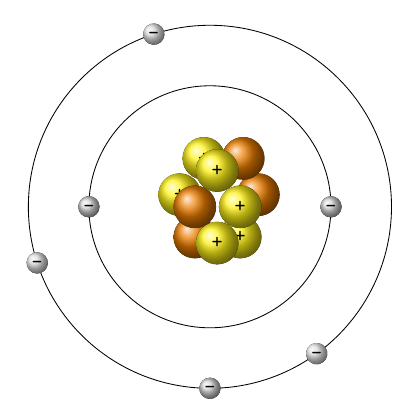
How many protons does this atom have?
a)
3
b)
6
c)
4
d)
2
18.

Which of these statements was made by John Dalton?
a)
A nucleus contains protons and neutrons
b)
Electrons orbit an atom
c)
Atoms combine in whole number ratios
d)
Atoms can be divided
19.

In Rutherford’s experiment, where would your expect the most alpha particles to strike the screen?
a)
1
b)
2
c)
3
20.

What is the electronic shell configuration of argon?
a)
2,8,8
b)
2,4,6,6
c)
2,8,10,2
d)
2,8,18,8,4
21.
Element X has an electronic configuration of 2,8,4. It is most likely to be..
a)
In Group 4
b)
In Period 4
c)
Have 4 nucleons
d)
have 4 protons
22.
Element X has an electronic configuration of 2,8,2. It is most likely to be...
a)
metal
b)
non metal
c)
impossible to say
23.
Ionic Bonding involves...
a)
The transfer of protons
b)
The transfer of nuetrons
c)
The transfer of electrons
d)
None Of the above
24.
What happens when the sodium atom loses an electron?
a)
It become negatively charged
b)
It become positively charged
c)
none
25.
What usually forms the negative ion?
a)
nonmetals
b)
metal
c)
none
26.
Covalent compounds
a)
Share electrons
b)
transfer electrons
c)
contain a sea of electrons
d)
conduct electricity
27.
What two types of atoms make a covalent bond?
a)
2 Nonmetals
b)
1 Nonmetal and 1 Metal
c)
2 Metals
d)
2 Noble Gases
28.
What happens when an atom loses an electron?
a)
Neutral (no charge)
b)
Positive charge
c)
Negative charge
29.
What happens when an atom gain an electron?
a)
Neutral(no charge)
b)
Positive charge
c)
Negative charge
30.
What charges attract?
a)
Opposite
b)
Same
31.
Predict the bond that will form between Be and F.
a)
Ionic
b)
Covalent
32.
Predict the bond that will form between Se and Cl.
a)
Ionic
b)
Covalent
33.
Predict the bond that will form between Sr and S.
a)
Ionic
b)
Covalent
34.
What is the number of valence electrons for Oxygen?
a)
8
b)
6
c)
2
d)
1
35.
What is the number of valence electrons for Beryillum?
a)
1
b)
4
c)
2
d)
7
36.
What is the number of valence electrons for Silicon?
a)
1
b)
2
c)
6
d)
4
37.

Is this equation balanced?
a)
yes
b)
no
c)
Not enough information
38.

Is this equation balanced?
a)
yes
b)
no
c)
Not enough information
39.
What is the name for CO?
a)
Copper Oxide
b)
Carbon monoxide
c)
monocarbon oxide
d)
Copper monoxide
40.
What is the name for MgH2?
a)
Magnesium hydride
b)
Magnesium dihydride
c)
Monomagnesium hydride
d)
Monomagnesium dihydride
41.
What is the formula for Silicon dioxide?
a)
SO
b)
SO2
c)
SiO
d)
SiO2
42.
Name the ionic compound, LiCl
a)
lithium chlorine
b)
lithium chloride
c)
lithium chlorate
d)
lithium monochloride
43.
Name the ionic compound, CaCO3
a)
calcium carbide
b)
calcium carbon trioxide
c)
calcium carbon oxide
d)
calcium carbonate
44.
H20 - name?
a)
hydrooxic acid
b)
hydroxic acid
c)
water
d)
hydrogen oxide
45.
Name the following compound:
CO2
a)
monocarbon dioxide
b)
carbon oxide
c)
carbon dioxide
d)
oxygen carbonide
46.
What is the name for AlBr3?
a)
aluminum bromide
b)
aluminum tribromide
c)
aluminum bromine
d)
monoaluminum tribromide
47.
Name this formula:
Al2O3
Al2O3
a)
Aluminum Oxide
b)
Aluminum Oxygen
c)
Antimony Oxide
d)
Aluminum (VII) Oxide
48.
Name the compound Na2O
a)
Sodium Oxide
b)
Sodium Dioxide
c)
Sodium Oxygen
d)
Natride Oxide
100 %

