wayground logo

Free Printable Worksheets

NEW

Font size

S
M
L
XL
Worksheets

1st 6 wks review

Total questions: 56

Worksheet time: 14hrs 0mins

Name
Class
Date
1.

Which of the following is not a cell but has the ability to reproduce within a living cell?

a)

A virus

b)

An alga

c)

A bacterium

d)

A yeast

2.

Viral activity is represented in the diagram below. Invading the host cell allows the virus to -

a)

Obtain nutrients

b)

Increase its size

c)

Synthesize needed oxygen

d)

Reproduce

3.

Why type of cycle is represented in the diagram?

a)

Lysogenic

b)

Mitosis

c)

Meiosis

d)

Lytic

4.

Some viruses enter cells and, rather than destroy the cell, they integrate their DNA into the host cell’s chromosome, becoming a provirus. Every cell that replicates has a copy of the virus and can be activated at any time. This describes which type of viral cycle?

a)

Lytic

b)

Lysogenic

c)

Bacteriophage

d)

Retrovirus

5.

A photograph of a virus is shown below. The projections on the surface of the virus allows the virus to?

a)

Most inside a host cell

b)

Control a host cell's DNA

c)

Attach to a host cell

d)

Signal other viruses to infect a host cell

6.

Three things are depicted below. Genetic material would best fit into which area?

a)

W

b)

X

c)

Y

d)

Z

7.

Viruses are able to infect cells because they share a common genetic code and are to use host cell enzymes to carry out protein synthesis. There are some structures which are unique to viruses and not found in cells. These include:

a)

I only

b)

II only

c)

I and II only

d)

II and III only

8.

The virus that causes AIDS is damaging to the body because it –

a)

Attacks specific red blood cells

b)

Causes an abnormally high insulin level

c)

Prevents the normal transmission of nerve impulses

d)

Targets cells that fight invaders

9.

HIV causes a person to develop AIDS. HIV remains active even after extensive treatment. Immunologists believe that HIV protects itself from attack by –

a)

Mixing with the chromosomes of host cells

b)

Consuming the nuclei of host cells

c)

Reproducing the mitochondria of host cells

d)

Fusing with the vacuoles of host cells

10.

Cold sores are caused by the herpes simplex virus type 1. A company that wants to develop antiviral drugs would study what?

a)

The mechanism used by the virus to infect cells

b)

How closely related the virus is to cold viruses

c)

The metabolism of the virus

d)

Meiosis in the virus

11.

In order to replicate itself, a virus must first –

a)

Absorb the nucleus of the host cell

b)

Steal the genetic material of the host cell

c)

Penetrate the cell membrane of a host cell

d)

Dilute the cytoplasm of a host cell

12.
What is the monomer of a Protein?
a)
Amino Acid 
b)
Fatty acid
c)
Monosaccharide
d)
Nucleotide
13.
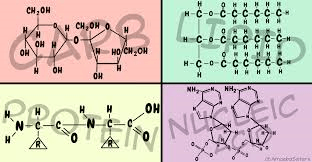
This is an example of which macromolecule?
a)
Carbohydrate
b)
Protein
c)
Lipid
d)
Nucleic Acid
14.

Which biomolecule is made of nucleotides and contains your DNA?

a)

Carbohydrate

b)

Lipids

c)

Protein

d)

Nucleic Acid

15.
What elements are common to all 4 biomolecules?
a)
Carbon, hydrogen, nitrogen
b)
Carbon, Nitrogen, Phosphorus
c)
Carbon, Hydrogen, Oxygen
d)
Carbon, Hydrogen, Phosphorus
16.
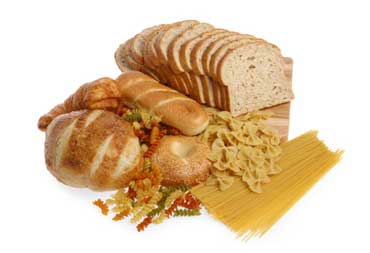
Which biomolecule is found in pasta and bread?
a)
Lipid
b)
Protein
c)
Nucleic Acid
d)
Carbohydrate
17.
Which biomolecule contains fats, oils, and waxes?
a)
Proteins
b)
Nucleic Acid
c)
Lipids
d)
Carbohydrate
18.
Glucose is an example of a
a)
Carbohydrate
b)
Lipid
c)
Protein
d)
Nucleic Acid
19.
What 3 letters do enzymes typically end in?
a)
-ose
b)
-ase
c)
-ese
d)
-tic
20.
Enzymes are considered to be 
a)
Lipids
b)
Carbohydrate
c)
Protein
d)
Nucleic Acid
21.
What is the purpose  of an enzyme?
a)
give permission for the reaction
b)
raise activation energy
c)
speed up reactions
d)
control how many reactions occur
22.
Where do substrates bind on an enzyme?
a)
voltage-gated channels
b)
surface receptor
c)
calcium channels
d)
active site
23.
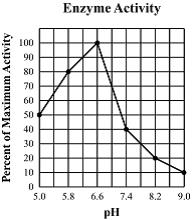
Which of the following conclusions can be drawn from this graph?
a)
The optimum pH of the enzyme is 6.6.
b)
The optimum pH of the enzyme is 5.8
c)
The enzyme’s activity increases as pH increases 5.0 to 9.0
d)
The enzyme’s activity is greater around pH of 8.0 .
24.
If you spill or break something during an experiment, what is the FIRST thing you should do?
a)
Tell the teacher.
b)
Clean it up. 
c)
Cover it with a paper towel.
d)
Leave it for someone else.
25.
The lab equipment seen in the image should be worn during a lab investigation when...
a)
using glassware.
b)
using chemicals.
c)
using heat/fire.
d)
using any of the above.
26.
Identify the piece of lab equipment seen in the image.
a)
Erlenmeyer Flask
b)
Graduated Cylinder
c)
Beaker
d)
Test Tube
27.
Identify the primary function of the lab equipment seen in the image.
a)
Transfer small amounts of liquid
b)
Transfer large amounts of liquid
c)
Measure liquid volume
d)
Mixing liquid chemicals
28.
True or False: If you see something dangerous taking place during a lab,you should immediately tell the teacher.
a)
True
b)
False
29.
Which of the following should NOT be worn during a lab investigation?
a)
Flip flops
b)
Loose, long hair
c)
Dangling jewelry
d)
All of the above
30.
A beaker is used to measure volume in which metric unit?
a)
Milliliters (mL)
b)
Grams (g)
c)
Meters (m)
d)
Kilograms (kg)
31.
Identify the piece of lab equipment seen in the image.
a)
Microviewer
b)
Dissecting Scope
c)
Microscope
d)
Electron Imager
32.
A thermometer is used to measure temperature in which metric unit?
a)
Fahrenheit (°F)
b)
Celcius (°C)
c)
Kilometers (km)
d)
Liters (L)
33.
A series of steps used by scientists to solve a problem or answer a question. 
a)
scientific method
b)
recipe
c)
data collection
d)
metric system
34.
Which is NOT a step in the scientific method?
a)
Make observation
b)
Form a theory
c)
Collect data
d)
Form a hypothesis
35.
A testable explanation to a problem that has not yet been tested. 
a)
data
b)
theory
c)
hypothesis
d)
fact
36.
Testing a hypothesis often involves a(n):
a)
answer
b)
experiment
c)
problem
d)
safety check
37.
This variable in an experiment is the one being changed by the scientist. 
a)
dependent variable
b)
independent variable
c)
data
d)
control group
38.
The summary at the end of an experiment that explains the results. 
a)
conclusion
b)
procedures
c)
materials
d)
responding variable
39.
The name of the information that you get from your experiment (you organize it into charts and graphs).
a)
observations
conclusion
b)
data
c)
variables
d)
hypothesis
40.
An experiment is performed on plants to see how different liquids affect plant growth. Each plant in the experiment is given a different liquid; water, apple juice, or milk. Each plant has the same amount of soil, sunlight, and listens to the same music. In this investigation, the independent variable is ...
a)
The type of plant
b)
The amount of sunlight
c)
The type of music
d)
The type of liquid
41.
Dependent variable means
a)
the scientist controls what to test
b)
educated guess
c)
ask a question
d)
what is being measured
42.
If you increase the amount of spinach you eat, then you will increase the iron in your blood. 
What's the dependent variable?
a)
increase the amount of iron in your blood
b)
spinach you eat
43.
If I ride my bike to school instead of walking, then I will get to school faster. What is the dependent variable?
a)
True
b)
How fast you get to school
c)
Riding a bike or walking
d)
False
44.
Will a construction paper air plane fly faster than an airplane made from notebook paper? Choose the best hypothesis.
a)
If I make a paper airplane from notebook paper, then it will fly faster than construction paper.
b)
Yes.
c)
No.
d)
I think the construction paper air plane will fly faster.
45.
If I study for my scientific method test, then I will have a better test score. What is the dependent variable?
a)
Scientific Method
b)
Studying
c)
Independent variable
d)
Test score
46.
If I read this question carefully, then I will answer it correctly. What is the independent variable?
a)
I hope so
b)
Yes
c)
Reading or not reading carefully
d)
Likelihood of a correct answer
47.
This is the group that we will compare our experimental group to. This group stays "normal."
a)
Control Group
b)
Experimental Group
c)
 Normal Group
d)
Weird Group
48.
This is the group that is affected by the independent variable or the group that is changed.
a)
Control Group
b)
Experimental Group
c)
Changed Group
d)
Cool Group
49.
After you write your conclusion, it is important to share your results with others. 
a)
True
b)
False 
50.
True or False: Your hypothesis can never be wrong.
a)
True
b)
False
51.

The basic building block of living things, made up of organelles.

a)

Tissue

b)

Organelle

c)

Cell

d)

Atom

52.

Groups of cells with similar functions.

a)

Organs

b)

Molecules

c)

Tissues

d)

Organelles

53.

Group of tissues with similar functions.

a)

Organelles

b)

Cells

c)

Tissues

d)

Organs

54.

Group of organs with similar functions.

a)

Organism

b)

Cell

c)

Organ

d)

System

55.

The smallest unit

of a compound consisting of two or more atoms

bonded together.

a)

Organelle

b)

Cell

c)

Molecule

d)

Atom

56.

The smallest unit that makes up the known elements.

a)

Molecule

b)

Organelle

c)

Cell

d)

Atom