
 Worksheets
Theater Production Quarter 1
Total questions: 66
Worksheet time: 33mins
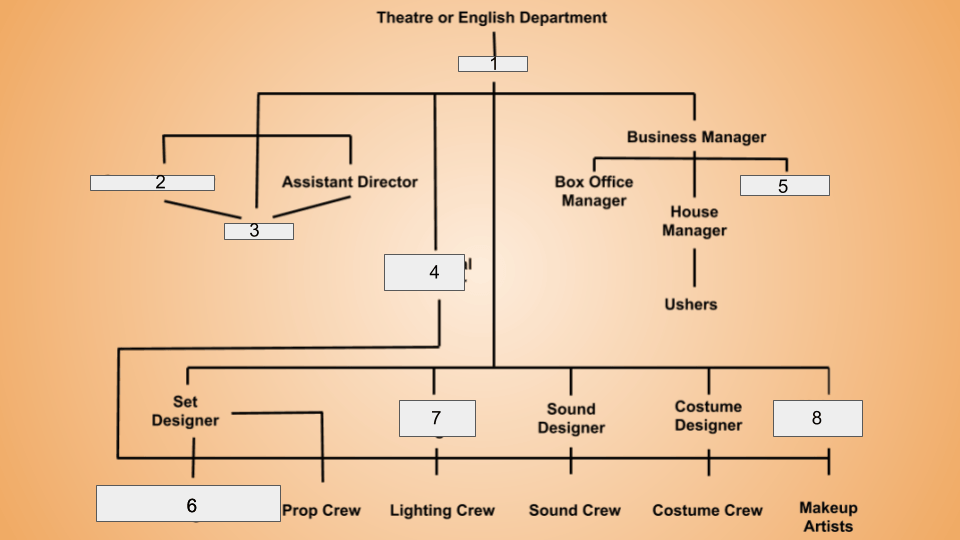
What role belongs in slot 1
Actor
Director
Technical Director
Stage Manager
What role belongs in slot 2
Actor
Director
Technical Director
Stage Manager
What role belongs in slot 3
Actor
Director
Technical Director
Stage Manager
What role belongs in slot 4
Actor
Director
Technical Director
Stage Manager
What role belongs in slot 5
Light Designer
Publicists
Makeup Designer
Shifting Crew
What role belongs in slot 6
Light Designer
Publicists
Makeup Designer
Shifting Crew
What role belongs in slot 7
Light Designer
Publicists
Makeup Designer
Shifting Crew
What role belongs in slot 8
Light Designer
Publicists
Makeup Designer
Shifting Crew
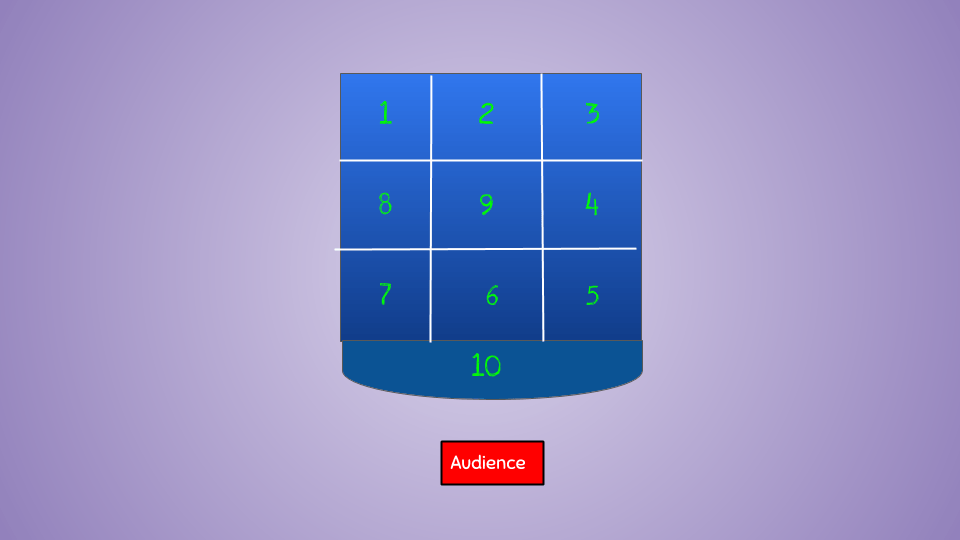
What is the Stage Direction indication for Area 1?
Up Stage Left
Up Stage Right
Down Stage Left
Down Stage Right
What is the Stage Direction indication for Area 3?
Up Stage Left
Up Stage Right
Down Stage Left
Down Stage Right
What is the Stage Direction indication for Area 5?
Up Stage Left
Up Stage Right
Down Stage Left
Down Stage Right
What is the Stage Direction indication for Area 7?
Up Stage Left
Up Stage Right
Down Stage Left
Down Stage Right
What is the Stage Direction indication for Area 2?
Upstage
Down Stage
Stage Left
Stage Right
Center Stage
What is the Stage Direction indication for Area 4?
Upstage
Down Stage
Stage Left
Stage Right
Center Stage
What is the Stage Direction indication for Area 6?
Upstage
Down Stage
Stage Left
Stage Right
Center Stage
What is the Stage Direction indication for Area 8?
Upstage
Down Stage
Stage Left
Stage Right
Center Stage
What is the Stage Direction indication for Area 9?
Upstage
Down Stage
Stage Left
Stage Right
Center Stage
What is the Stage Direction indication for Area 10?
Down Stage Left
Down Stage
Down Stage Right
Apron
Center Stage
Oversees the entire process of staging a production, coordinating everything that happens onstage
Director
Stage Manager
Technical Director
Assistant Director
Director’s technical Liaison backstage during rehearsals and performance, giving directions, solving problems, and ensuring smooth transitions between scenes.
Director
Stage Manager
Technical Director
Assistant Director
An arch that frames the opening of the stage
Balconies
House
Back Wall
Proscenium Arch
Apron
Projecting upper floors of audience seating
Balconies
House
Back Wall
Proscenium Arch
Apron
auditorium, or where the audience sits
Balconies
House
Back Wall
Proscenium Arch
Apron
Separates stage from backstage area
Balconies
House
Back Wall
Proscenium Arch
Apron
where the audience gathers before and after performances and during breaks
Lobby
Box Office
Orchestra
House
where tickets are sold, usually located in the lobby
Lobby
Box Office
Orchestra
House
Down front seats nearest the stage
Lobby
Orchestra Pit
Orchestra
House
area for musicians, may extend underneath the stage
Balconies
Orchestra Pit
Orchestra
Mezzanine
Lower Balcony
Balconies
Orchestra Pit
Orchestra
Mezzanine
Where the House technicians control lights, music, or special effects. Located at the rear of the house or top balcony.
Flyspace
Light Booth/Sound Booth
Scenery
Stage House
Area, including stage, where the actors perform and the flyspace above
Flyspace
Light Booth/Sound Booth
Scenery
Stage House
where lights and scenery may be flown, or suspended by ropes
Flyspace
Light Booth/Sound Booth
Scenery
Stage House
on stage decoration to help establish the time and place of a play
Flyspace
Light Booth/Sound Booth
Scenery
Stage House
The front curtain, typically of luxurious fabric in deep colors
Grand Drape
Border
Fire Curtain
Legs
Cyclorama
Metal or fireproof fabric to prevent fire from spreading
Grand Drape
Border
Fire Curtain
Legs
Cyclorama
Short masking curtains used to create a border at the top of a set.
Grand Drape
Border
Fire Curtain
Legs
Cyclorama
Long, thin masking curtains used to frame the sides of a set.
Grand Drape
Border
Fire Curtain
Legs
Cyclorama
A large sheet of fabric, usually hung upstage. Commonly used for sky effects and color.
Grand Drape
Border
Fire Curtain
Legs
Cyclorama
Acting area that extends forward beyond the arch
Balconies
House
Back Wall
Proscenium Arch
Apron
the clear and precise pronunciation of words.
Articulation
Articulators
Resonance
Resonators
the parts of the body that create consonant sounds
Articulation
Articulators
Resonance
Resonators
a quality caused by vibration that enriches vocal tone
Articulation
Articulators
Resonance
Resonators
the parts of the body that create vowel sounds
Articulation
Articulators
Resonance
Resonators
A breathing technique useful to actors that increases air capacity and improves breath control.
Improvise
Project
Diaphragmatic Breathing
Resonance
to make your voice fill the performance space
Improvise
Project
Diaphragmatic Breathing
Resonance
an expressive movement of the body or limbs
Improvise
Project
Script
Pantomime
Gesture
to speak or act without a script
Improvise
Project
Script
Pantomime
Gesture
to act without words through facial expressions and gestures.
Improvise
Project
Script
Pantomime
Gesture
the text of the play.
Improvise
Project
Script
Pantomime
Gesture
The group of people that work on set Construction, props, lighting, sound, costumes, and makeup
Prop Master
Prop crew
Shifting Crew
Stage Crew
Those responsible for changing the set from scene to scene.
Prop Master
Prop crew
Shifting Crew
Stage Crew
Gathers and organizes props.
Prop Master
Prop crew
Shifting Crew
Stage Crew
The Onstage physical space and its structures in which the actors perform.
Set
Lighting
Sound
Props
Any illumination of the set and actors during a performance
Set
Lighting
Sound
Props
includes amplification of actors’ voices in addition to music and sound effects.
Set
Lighting
Sound
Props
Anything actors handle onstage as well as furniture and other items used to enhance the set.
Set
Lighting
Sound
Props
Develops the concept for and designs the set
Sound Designer
Costume Designer
Light Designer
Makeup Designer
Set/Scenic Designer
The person who determines what kind of makeup each actor will wear, designs specialty makeup for actors, and supervises the makeup artists and makeup crew
Sound Designer
Costume Designer
Light Designer
Makeup Designer
Set/Scenic Designer
Designs or chooses costumes
Sound Designer
Costume Designer
Light Designer
Makeup Designer
Set/Scenic Designer
decides what kinds of music and sound effects are needed and whether they should be live or recorded
Sound Designer
Costume Designer
Light Designer
Makeup Designer
Set/Scenic Designer
decides what kind of lights are needed, where to focus them, and when to turn them on.
Sound Designer
Costume Designer
Light Designer
Makeup Designer
Set/Scenic Designer
places the lights and runs them during the show.
Makeup Crew
Costume Crew
Shifting Crew
Lighting Crew
Sound Crew
collect, prepare, and run the sound for a performance
Makeup Crew
Costume Crew
Shifting Crew
Lighting Crew
Sound Crew
keeping costumes repaired and cleaned from one performance to the next. May sew costumes.
Makeup Crew
Costume Crew
Shifting Crew
Lighting Crew
Sound Crew
May help actors put on makeup if there are many actors, or if the makeup is complicated or specialized
Makeup Crew
Costume Crew
Shifting Crew
Lighting Crew
Sound Crew
Manages the prop crew.
Set Designer
Director
Stage Manager
Prop Master

