wayground logo

Free Printable Worksheets

NEW

Font size

S
M
L
XL
Worksheets

Flower (6-O)

Total questions: 50

Worksheet time: 29mins
Name
Class
Date
1.
Female reproductive part of flower
a)
pistil
b)
stamen
c)
petals
d)
sepals
2.
Part of flower that protects flower in bud stage
a)
pistil
b)
stamen
c)
petals
d)
sepals
3.
Which amongst these is NOT a part of PISTIL
a)
stigma
b)
stamen
c)
style
d)
ovary
4.
Which part of flower develops into fruit
a)
ovule
b)
style
c)
stigma
d)
ovary
5.
Male reproductive part of flower
a)
pistil
b)
stamen
c)
petals
d)
sepals
6.
Top most part of pistil
a)
anther
b)
filament
c)
stigma
d)
style
7.
Part which produces pollen
a)
style
b)
stigma
c)
anther
d)
filament
8.
Transfer of pollen from anther to stigma is called _________
a)
germination
b)
transpiration
c)
photosynthesis
d)
pollination
9.
The thin stalk that supports the anther.
a)
Pistil
b)
Stamen
c)
Anther
d)
Filament
10.
The female structures of the flower 
a)
Pistil
b)
Stigma
c)
Stamen
d)
Ovary
11.
The long stalk-like part that supports the stigma.
a)
Filament
b)
Anther
c)
Stigma
d)
Style
12.
The bottom of the style is this part which produces the eggs or ovules through meiosis.
a)
Pollen
b)
Ovary
c)
Stigma
d)
Pistil
13.
The colorful flower structure that attracts pollinators.
a)
sepals
b)
pistils
c)
anthers
d)
petals
14.
The flower structure that contains the anther and pollen.
a)
stamen
b)
pistil
c)
sepal
d)
petal
15.
The process of a seed coming out of its dormant state.
a)
germination
b)
pollination
c)
reproduction
d)
symbiosis
16.
How do pollinators benefit from flowers?
a)
pollen
b)
fun
c)
nectar
d)
blood
17.
How do dandelions spread their seeds?
a)
water
b)
earth
c)
fire
d)
wind
18.
How do coconuts disperse their seeds?
a)
wind
b)
water
c)
earth
d)
heart
19.
How do peas disperse their seeds?
a)
Captain Planet
b)
Wind
c)
Bursting
d)
Fire
20.
How do animals help disperse seeds?
a)
Wind
b)
They are farmers
c)
They eat fruits
d)
Fire
21.
The male part of the flower is known as the _____.
a)
stamen
b)
pistil
c)
ovary
d)
petal
22.
The female part of the flower is known as the ____.
a)
stamen
b)
anther
c)
filament
d)
pistil
23.
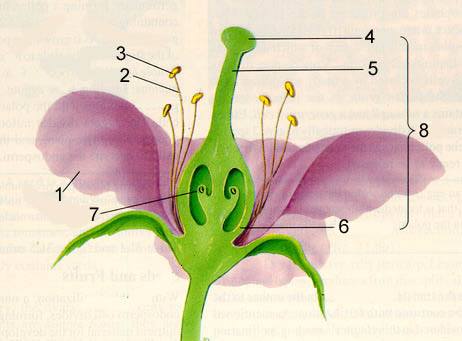
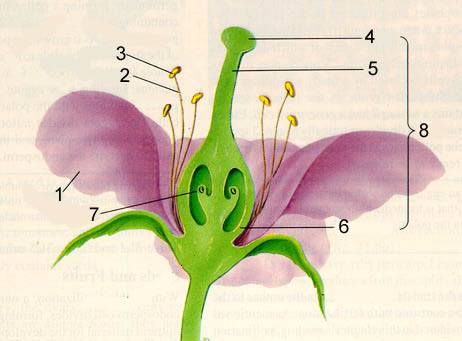
What is #2 pointing to?
a)
anther
b)
filament
c)
ovary
d)
style
24.
What is #4 pointing to?
a)
anther
b)
style
c)
stigma
d)
ovary
25.
What is #5 pointing to?
a)
anther
b)
filament
c)
stigma
d)
style
26.
Where is pollen made?
a)
ovary
b)
petal
c)
pistil
d)
anther
27.
What is the sticky part of the flower that catches pollen?
a)
style
b)
stigma
c)
ovary
d)
petal
28.
The filament___________
a)
holds up the anther
b)
protects the petal
c)
is the male part of the flower
d)
catches pollen
29.
The style____________
a)
connects the stigma to the ovary
b)
holds up the anther
c)
smells great
d)
produces pollen grains
30.
Which part attracts insects and mammals to the flower
a)
sepal
b)
petal
c)
ovaries
d)
style
31.
Tiny grains that contain sperm cells.
a)
Pollen
b)
Sepal
c)
Stamen
d)
Petal
32.
A brightly colored part of the flower that attract insects.
a)
Sepal
b)
Petal
c)
Pistil
d)
Petal
33.
A small leaf that protects the flower before it blooms.
a)
Fruit
b)
Sepal
c)
Stamen
d)
Self-pollenation
34.

A

a)

stigma

b)

anther

c)

receptacle

d)

stem

35.

B

a)

style

b)

filament

c)

sepals

d)

ovary with ovules

36.

C

a)

stem

b)

stigma

c)

sepals

d)

petal

37.

D

a)

stem

b)

stigma

c)

petal

d)

ovary with ovules

38.

E

a)

anther

b)

filament

c)

style

d)

receptacle

39.

F

a)

receptacle

b)

sepals

c)

style

d)

stigma

40.

G

a)

petal

b)

filament

c)

anther

d)

stem

41.

H

a)

petal

b)

filament

c)

ovary with ovules

d)

receptacle

42.

I

a)

anther

b)

filament

c)

stem

d)

petal

43.

Contains the pollen.

a)

sepal

b)

filament

c)

anther

d)

stigma

44.

The stalk supporting the anther.

a)

stigma

b)

style

c)

sepal

d)

filament

45.

This will become the seed and is surrounded as it matures. In some plants, this becomes a fruit.

a)

ovary with ovules

b)

stem

c)

stigma

d)

anther

46.

The receptacle for the pollen.

a)

stigma

b)

style

c)

filament

d)

anther

47.

The stalk between the stigma and the ovary.

a)

style

b)

ovule

c)

anther

d)

filament

48.

These are modified leaves that surround the flower when it is still a bud.

a)

sepals

b)

stigma

c)

stem

d)

petal

49.

The stalk that supports the whole flower.

a)

style

b)

stigma

c)

stem

d)

sepal

50.

These are modified leaves that surround the reproductive parts. Often the are brightly colored to attract pollinating insects and animals.

a)

petal

b)

style

c)

stigma

d)

stem