wayground logo

Free Printable Worksheets

Font size

S
M
L
XL
Worksheets

2P midpartial

Total questions: 30

Worksheet time: 1hrs 8mins

Name
Class
Date
1.

The theory of Endosymbiosis explains

a)

The origin of eukaryotes

b)

How bacteria live

c)

How species develop

d)

Why cells rely on one another

2.

What are evidence to support endosymbiotic theory?

a)

Mitochondria is found outside the cells

b)

Mitochondria and chloroplast can divide independently

c)

Mitochondria and chloroplast have their own cell membrane

d)

Mitochondria and chloroplast have their own genetic material

3.

Why type of cell does not contain membrane bound organelles?

a)

Animal Cells

b)

Prokaryotic Cells

c)

Eukaryotic Cells

d)

Plant Cells

4.

Which of the following characteristics make mitochondria and chloroplasts different from other organelles?

a)

They are much bigger

b)

The are found in both prokaryotic and eukaryotic cells.

c)

They both make ATP

d)

They were once free-living prokaryotes

5.

Which of the following is evidence to support the endosymbiotic theory?

a)

Prokaryotes have the same number and types of enzymes as eukaryotes.

b)

Mitochondria and chloroplasts have their own DNA, which is similar to prokaryotic DNA.

c)

All eukaryotic cells have a double-layered membran composed of phosplipids and proteins.

d)

Fossil evidence shows that the first forms of life were prokaryotic cells.
6.

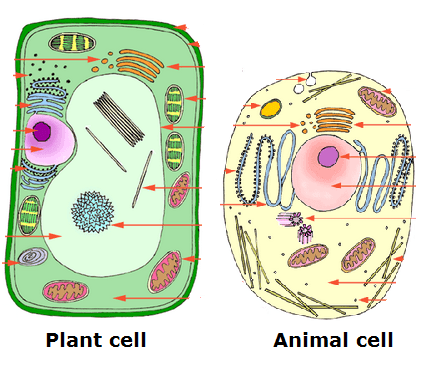
What distinguishes a plant cell from an animal cell? (How do you tell them apart) Hint: There's 3 ways (Check all 3)

a)

Central Vacuole

b)

Mitochondria

c)

Cell Wall

d)

Ribosomes

e)

Chloroplasts

7.

The 3 parts of the Cell Theory are...?

a)

All living things are composed of cells

Cells are the basic units of structure and function in living things

All cells are produced from other cells

b)

All living things are composed of cells

Cells are the basic units of dance and vibes in living things

All cells are destroyed from other aliens

c)

All living things are composed of Jell-O

Cells are the basic units of structure and function in living things

All cells are produced from factories in Canada

d)

All living things are composed of cells

Cells do karate and practice eating whole pies in their free time

All cells are produced from other cells

8.

I decide what goes in and out of the cell. I am fluid like and found in BOTH plant and animal cells. I am a...

a)

Cell Wall

b)

Cell Membrane

c)

Cytoplasm

d)

Golgi Apparatus

9.
Which of the following scientists concluded that all animals are made of cells?
a)
Rudolf Virchow
b)
Matthais Schleiden
c)
Robert Hooke
d)
Theodor Schwann
10.

This organelle digests dead cell parts and contains enzymes

a)

lysosome

b)

golgi body

c)

smooth ER

d)

Rough ER

11.
The Golgi apparatus _____.
a)
packages cell products for export
b)
eliminates waste
c)
stores DNA
d)
makes energy
12.
To convert the energy of glucose into  the  usable form of ATP is a function of _________.
a)
Cell Wall
b)
Cytoplasm
c)
Nucleus
d)
Mitochondria
13.

This image is an example of a phospholipid. Which part of a phospholipid is HYDROPHILIC?

a)

the phosphate "head"

b)

the lipid "tails"

14.

During osmosis

a)

water moves from high to low concentration

b)

large or oddly shaped molecules move across a cell membrane

c)

water moves when energy is used

d)

proteins are built

15.

Osmosis is the movement of _____ across a membrane.

a)

food

b)

energy

c)

oxygen

d)

water

16.
Ideally, your cells should be in a(n) _______ solution
a)
isotonic
b)
hypertonic
c)
hypotonic
d)
isometric
17.
What is diffusion?
a)
when molecules move 
b)
when molecules move from a high concentration to a low.
c)
no movement 
d)
molecules move everywhere
18.
When cells form a vesicle to take in materials, which form of transport is occurring? 
a)
Endocytosis
b)
Exocytosis
c)
Facilitated Diffusion
d)
Osmosis
19.
What is the difference between active and passive transport?
a)
Active does not need energy and passive uses ATP (energy)
b)
Active uses ATP (energy) and passive does not need energy
c)
Active stores transport proteins and passive releases 
d)
Active uses hormones and passive does not 
20.
Which do DNA and RNA have in common?
a)
Both are double stranded.
b)
Both contain ribose molecules.
c)
Both contain phosphate groups.
d)
Both contain uracil.
21.
If the structure of DNA were likened to a ladder, what would make up the “supporting structure” (not the “rungs”) of the ladder?
a)
amino acids and sugars
b)
nucleotide bases, including thymine
c)
nucleotide bases, including uracil
d)
sugar-phosphate molecules
22.
What is the complimentary mRNA sequence to the DNA sequence A-T-T-G-C-A.
a)
T-A-A-C-G-T
b)
U-A-A-C-G-T
c)
U-A-A-C-G-U
d)
T-A-A-G-C-U
23.
The "central dogma" states that genetic information flows from 
a)
Protein-->mRNA-->DNA
b)
Protein-->DNA-->mRNA
c)
mRNA-->DNA-->Protein
d)
DNA-->mRNA-->Protein
24.
Transcription takes place in the 
a)
cytoplasm
b)
ribosome
c)
mitochondrion
d)
nucleus
25.

brings amino acids to ribosomes, where they are joined together to form proteins

a)

transfer RNA (tRNA)

b)

Central Dogma of Molecular Biology

c)

messenger RNA (mRNA)

d)

Ribosomal RNA (rRNA)

26.

Which of the following is a difference between DNA and RNA?

a)

DNA has thymine, whereas RNA has uracil

b)

DNA is double-stranded, RNA is single-stranded

c)

DNA contains a sugar, RNA does not

d)

DNA cannot leave the nucleus, RNA can

27.
What are 3 types of active transport?
a)
Riding a bike, Running through the mountains, walking on the beach
b)
Osmosis, Diffusion, Facilitated Diffusion
c)
Sodium/potassium Pump, Endocytosis, Exocytosis
d)
Throwing a ball, Playing tennis, driving a car
28.
When cells take in a liquid through active transport, what is it called?
a)
Exocytosis
b)
Phagocytosis
c)
Pinocytosis
d)
Osmosis
29.
The sodium potassium pump usually pumps
a)
potassium out of the cell 
b)
sodium out of the cell 
c)
sodium into the cell 
d)
both potassium and sodium into the cell 
30.
Has passageways that carry proteins and other materials from one part of cell to another.
a)
Endoplasmic Reticulum
b)
Cytoplasm
c)
Ribosomes
d)
Lysosomes