
Font size
 Worksheets
036B Review for Test- Unit 1
Total questions: 76
Worksheet time: 1hrs 21mins

How could you show that Quadrilateral ABCD is congruent to Quadrilateral A'B'C'D'?
I would demonstrate how this is a rigid transformation by reflecting the figure over the y-axis and then translating it down 1 unit.
I would demonstrate how this is a rigid transformation by rotating the figure counter clockwise about the origin and then translating it right 5 and up 4.
I would demonstrate how this is a rigid transformation by reflecting over the x axis and then over the y axis.
I would demonstrate how this is a rigid transformation by translating it 6 units right, then 1 unit down

How could you show that quadrilateral ABCD is congruent to quadrilateral A'B'C'D'?
I would demonstrate how this is a rigid transformation by translating my figure 7 right and down 2.
I would demonstrate how this is a rigid transformation by rotating the figure 90° clockwise about the origin, and then translating 3 to the right.
I would demonstrate how this is a rigid transformation by reflecting over the x axis and then translating to the right 5 units.
I would demonstrate how this is a rigid transformation by rotating my figure 180° about the origin.
The mathematical term for a slide is........
translation
reflection
rotation
The mathematical term for a flip is.....?
traslation
rotation
reflection
The mathematical term for a turn is......?
translation
rotation
reflection

Which statement describes the move from frame 1 to Frame 2?
Rotate right
Translate up
Reflect vertically
Translate down

Which of these triangles are translations of Triangle A? Select ALL that apply.
B
C
D
E
F

This is an example of which transformation?
Translation
Rotation
Reflection
Dilation
What is it called when you have to make more than one transformation to move a pre-image to an image?
Sequence of Events
Sequence of Transformations
That never happens
Prime Marks

What is the transformation from frame #2 to frame #3?
Rotation 90° counterclockwise centered on a point on figure
translation down
translation up
Rotation 180° centered on left conner

What is the transformation from frame #3 to frame #4?
Rotation up
reflection up
translation up
translation down

This figure shows what transformation?
This is a 90° rotation centered on the common point.
This is a translation upwards
This is a 180° clockwise rotation
This is a 180° counterclockwise rotation

Segment AB corresponds to which segment on the right figure?
segment DF
segment FE
segment ED
segment DE

This diagram shows what transformation?
This is a reflection of "A" over line L
This is a rotation of "A" around a point on line L
This is a rotation of "A" around one of the vertices.
This is a translation to the fight and then a rotation of 90° clockwise.

What type of transformation does this figure show?
This is a reflection over the line
This is a rotation over the line
This is a translation across the line
The line segments don't match so this is not a rigid transformation.

This transformation shows what?
This is a rotation about point "B"
This is a rotation about point "D"
This could be a 180° rotation around point "B"
This is a reflection of the figure to the right.

This transformation is what?
This is a rotation.
This is a translation.
This is a reflection.
The figures are not the same shape so this is not a rigid transformation.

Select all of the translations that take Triangle T to Triangle U. There may be more than one correct answer.


where does the point (1,2) go when reflected over the
x-axis?
(1,2)
(-1,-2)
(1,-2)
(-1,2)
where does the point (1,2) go when reflected over the
y-axis?
(1,2)
(-1,-2)
(1,-2)
(-1,2)
where does the point (1,2) go when rotated 90 degrees clockwise with center (0,0)?
(2,1)
(-2,-1)
(2,-1)
(-2,1)

One of the triangles pictured is a rotation of triangle ABC and one of them is a reflection. Identify the rotation triangle and the center of rotation.
PQR with center at the origin (0,0)
XYZ with center at the origin (0,0)
PQR with center at the vertices "A"
XYZ with center at the vertices "B"
One of the triangles pictured is a rotation of triangle ABC and one of them is a reflection. Identify the reflection triangle and the line of reflection.
PQR is ABC reflected over the x axis
XYZ is ABC reflected over the x axis
PQR is ABC reflected over the y axis
XYZ is ABC reflected over the y axis

Here is a grid showing triangle ABC and two other triangles. You can use a rigid transformation to take triangle ABC to one of the other triangles. Which one? How?
Triangle EBD - ABC is reflected on a line at point "B"
Triangle CFG - Translate triangle ABC 7 units right so that "B" matches up with "F". Then rotate 90 degrees clockwise around "F".
Triangle CFG - Rotate triangle ABC 90 degrees counterclockwise around point "C", then rotate 180 degrees around the midpoint of segment CG.
Triangle EBD - Translate triangle ABC up two units.

Here are two line segments. Is it possible to rotate one line segment to the other? If so, find the center of such a rotation.
Yes, it is possible to rotate one of these line segments to the other. This can be done by rotating 180° around a point midway between the two lines.
No, is not possible to rotate because the only way to get one line to the other is by a translation up 5 units and then right two units.

Lin says that she can map Polygon A to Polygon B using only reflections. Do you agree with Lin? If so, then how might it be done?
Yes I agree with Lin. Simply reflect "A" over an line between "A" and "B"
Yes I agree with Lin. First Polygon A is reflected over a vertical line that passes the right edge of "A" and the left edge of "B". Then that image is reflected over a horizontal line that passes the through the bottom of "A" and the top of "B". This will give the image of "B".
I do not agree with Lin. These are different sized images and so "A" cannot map to "B".

describe a translation, rotation, or reflection that takes line L to line L'. Select all correct answers.
Translation down 3 units.
Translation right 7 1/2 units.
Reflection over a line parallel to L halfway between L and L'
Rotation using a point halfway between L and L' as the center of rotation and an angle of 180°

Points A',B' , and C' are the images of 180-degree rotations of A, B, and C, respectively, around point O. Name a segment whose length is the same as segment AO.
CO
BO
A'O
C'O
Points A',B' , and C' are the images of 180-degree rotations of A, B, and C, respectively, around point O. What is the measure of angle A' O B'?
79°
35°
180 - 79 = 101°
180 - 35 = 145°

Describe a SINGLE rigid transformation that takes Triangle 1 to Triangle 2.
a 180-degree clockwise rotation using the midpoint of side AC as center
a 180-degree counterclockwise rotation using the midpoint of side AC as center
a 90-degree clockwise rotation around point "A".

What is the measurement of ∠ HEF
115°
110°
117°
120°

Lines AC and DF are parallel. What is the measure of ∠ ABH ?
34°
146°
45°
33°

Name the interior angles in this figure or give the angle measurement.
angles a, b, c and d
angles c, d, e, 60 degrees
angles a, b, f, g
angles e, f, g, 60 degrees

Name all the alternate interior angles in this figure.
angles "d" and "b" also angles "a" and "g"
angles "d" and "a" also angles "b" and "g"
angles "e" and "g" also angles "d" and "f"

What is the measure of ∠ DBA +b + ∠ CBE
180°
45°
90°

What is measure of the missing angle at point "L" ?
85°
88°
90°

Parallelogram ABCD was translated to parallelogram A'B'C'D'.
How many units and in which direction were the x-coordinates of parallelogram ABCD moved?
3 units to the right
3 units to the left
7 units to the right
7 units to the left

a translation across the x-axis
a rotation
a reflection across the x-axis
a dilation

Which type of transformation is represented by the figures in the graph?
reflection and translation
reflection
rotation
dilation and rotation

Which transformation maps the solid figure A onto the dashed figure B?
Rotation 180o about the origin
Translation to the right and down
Reflection across the x-axis
Reflection across the y-axis

This figure depicts the image of rectangle PQRS after a transformation. Which transformation produced the image P'Q'R'S'?
a 1800 counterclockwise rotation about the point (0,0)
a translation of four units to the right
a 900 counterclockwise rotation about the point (0,0)
a reflection over the y-axis

Which of the following describes the transformation from figure A to figure B on the grid?
reflection across the x-axis
reflection across the y-axis
rotation about point (0,0)
translation 6 units right

Karin used a single transformation of trapezoid P to create the image Q on the coordinate plane shown. Which of these describe the transformation that Karin used?
reflection over the x-axis
reflection over the y-axis
translation down
translation up

Lainey drew figure P on a coordinate grid. Then she did a one-step transformation of figure P to draw figure Q as shown. Which of the following one-step transformations of figure P could Lainey have done to draw figure Q?
reflection over the x-axis
reflection over the y-axis
rotation 1800 clockwise
translation to the right


What it the measurement for angle 9?
140o
180o
40o
160o
What it the measurement for angle 12?
140o
180o
40o
160o

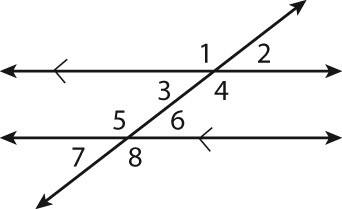


In the diagram, which of the following statements are true? Select all that apply.
∠1 and ∠4 are vertical angles
∠4 and ∠5 are alternate interior angles
∠1 and ∠8 are alternate interior angles
∠2 and ∠6 are alternate interior angles


Are two rectangles with the same side lengths always congruent?
No, if I traced with patty paper, they would not be the same.
No, just because the side lengths are the same doesn't mean that the angles are the same.
Yes, all rectangles have 90° angles. So, if I know that the side lengths and angles are the same, then they must be congruent.
No, if it's turned differently, then they can't be congruent.


What is a Parallel Line?
Lines that Cross
Lines that do not cross
Lines that cross at a 90 degree angle

Which two lines are parallel?
g and h
f and g
j and k

What is the angle measure of AED?
50
100
130
189



