wayground logo

Free Printable Worksheets

NEW

Font size

S
M
L
XL
Worksheets

CIA#1 Review

Total questions: 25

Worksheet time: 54mins

Name
Class
Date
1.
Isotopes are atoms of the same element that have the same number of __________ but different number of __________ . Therefore, isotopes of the same element have different masses. 
a)
protons, neutrons
b)
protons, electrons
c)
neutrons, protons
d)
electrons, protons
2.
A carbon isotope consists of 6 protons, 6 electrons and 8 neutrons.  What is the mass number for this isotope?
a)
12
b)
14
c)
6
d)
8
3.

Atoms of elements that are in the same group have the same number of

a)

protons.

b)

neutrons.

c)

valence electrons.

d)

protons and neutrons.

4.

The elements argon, krypton, and xenon are all non-metals. What property would these elements have in common?

a)

Good conductor of thermal energy

b)

brittle and poor conductor of electricity

c)

Shiny, lustrous surface

d)

Soft and malleable

5.
When a metal loses electrons, it becomes this type of ion.
a)
anion
b)
cation
6.
How many neutrons would Fe-56 have?
a)
56
b)
26
c)
30
d)
33
7.
Elements on the LEFT side of the periodic table will most likely form:
a)
Positive ions
b)
Negative ions
c)
Neutral Ions
d)
None of these
8.
What is the name of this element?
a)
Beryllium
b)
Boron
c)
Barium
d)
Bromine
9.

What role does the proton play regarding the atom?

a)

it is involved in bonding

b)

it is involved in the stability of the atom

c)

it gives the atom its identity

d)

it does not play a role

10.

Nuclear fusion releases energy when:

a)

heavy ions fuse together

b)

very light nuclei come together

c)

uranium splits into two fragments

d)

uranium emits a neutron

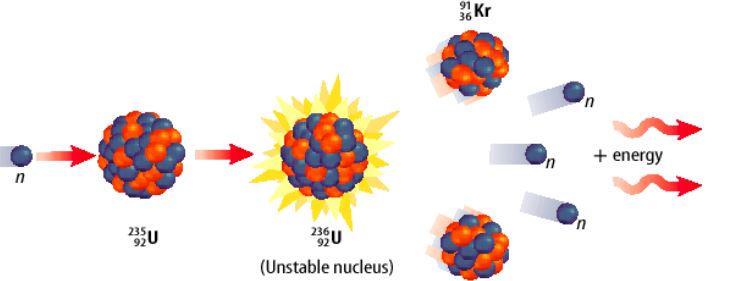
11.
This is an example of...
a)
Fission  reaction
b)
Fusion reaction
c)
Decomposition reaction
d)
Decay
12.
Solve this equation for alpha decay.
85209At = ___ + 24He
a)
83205Bi
b)
86209Rn
c)
81207Tl
d)
85208At
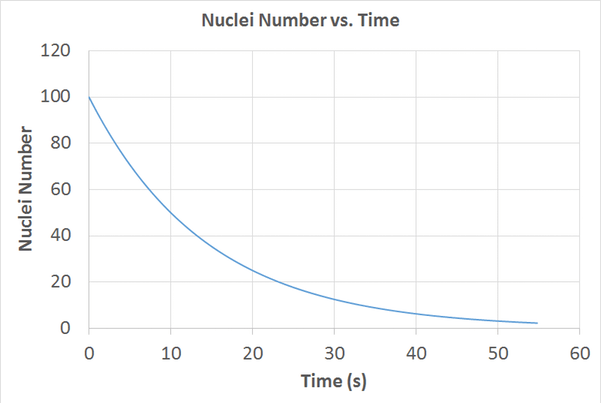
13.

What is the Half life of this isotope?

a)

5 seconds

b)

10 seconds

c)

15 seconds

d)

20 seconds

14.
You have 100 grams of radioactive C-14. The half life of C-14 is 5730 years. 
How many grams are left after 1 half life? 
a)
100 grams
b)
25 grams
c)
2 grams
d)
50 grams
15.
146C has a half life of 5730 years, how many years would it take the 4.0 g sample to decay to 0.25 g?
a)
4 years
b)
5730 years
c)
22,920 years
d)
28,650 years
16.
What are oxidation numbers?
a)
Number of electrons in the outer most energy level
b)
Number of protons
c)
Electrons gained or lost in chemical bonding
d)
Number of neutrons gained or lost
17.
What is the correct formula for the compound, lithium oxide?
a)
LiO
b)
Li2O
c)
LiO2
d)
Li2O2
18.

LiBr is called

a)

lithium bromine

b)

lithium (I) bromine

c)

lithium bromide

d)

lithuim (I) bromide

19.
What would be the proper chemical formula for combining Al3+ and Cl- :
a)
AlCl3
b)
Al3Cl
c)
AlCl
d)
Al3Cl3
20.
The following statements are true for ionic bonding EXCEPT
a)
bonding between metal and non metal
b)
electrostatic forces between opposite charges
c)
transferring of electrons
d)
sharing of electrons
21.

Oxygen is in group 16 of the periodic table. Which element would it most likely bond with?

a)

H

b)

Be

c)

F

d)

Ne

22.

What is the name of N2O3?

a)

Nitrogen trioxide

b)

Dinitrogen oxide

c)

Dinitrogen trioxide

d)

Nitrogen oxide

23.

What is the charge on the ion that oxygen forms?

a)

1-

b)

2+

c)

3+

d)

2-

24.

USE THE PERIODIC TABLE

How many valence electrons does carbon have?

a)

4

b)

12

c)

6

d)

14

25.

What period is Beryllium in?

a)

1

b)

2

c)

3

d)

4