wayground logo

Free Printable Worksheets

Font size

S
M
L
XL
Worksheets

AP Calc HW #43 (4.1 Review)

Total questions: 40

Worksheet time: 2hrs 15mins

Name
Class
Date
1.

What are the intervals of the graph increasing for f(x) = 2x4- 4x2 + 1

a)

(-1,0)

b)

(0,1)

c)

(-∞,-1) and (1,∞)

d)

(-1,0) and (1,∞)

2.
If given f'(x) how would you find the intervals which the graph f(x) has a positive slope?
a)
f'(x) < 0 (negative)
b)
f'(x) > 0 (positive)
c)
f'(x) is increasing
d)
Can't be determined
3.
Let f be the function with derivative given by f'(x) = sin(x2 + 1).  How many relative extrema does f have on the interval 2 < x < 4?
a)
Two
b)
Three
c)
Four
d)
Five
4.
Let f be the function with derivative given by f'(x) = x2 - 2/x.  On which of the following intervals is f decreasing?  (No Calculator)
a)
(-∞, 0]
b)
(-1, 0]
c)
(0, ∛2]
d)
(∛2, ∞)
5.
Given a function, f(x), if f'(x)<0 over a certain interval, then f(x) is ____________ over that interval.
a)
decreasing
b)
increasing
c)
concave up
d)
concave down
6.
For a function g(x), g'(-2)=0 indicates that x=-2 is ________________.
a)
an inflection point
b)
a critical point
c)
a relative maximum
d)
a relative minimum
7.
For a function f(x), f'(-3) = 5 indicates f(x) is ___________ at x=-3.
a)
increasing
b)
decreasing
c)
concave up
d)
concave down
8.
Select the correct derivative of f(x).  
a)
A.
b)
B.
c)
C.
d)
D.
9.
Find the fourth derivative.
y = x-1 + x2
a)
2x-3 + 2
b)
-6x-4
c)
24x-5
d)
x-1 + x2
10.
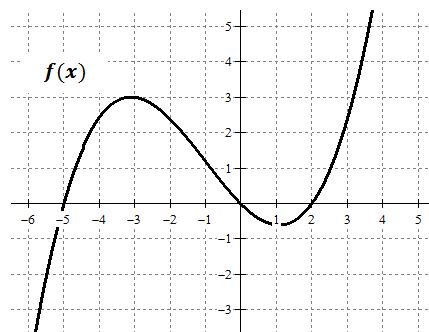
Over what interval(s) is f(x) increasing?
a)
(-∞, -3) ∪ (1, ∞)
b)
(-3, 1)
c)
(-5, 0) ∪ (2, ∞)
d)
(-5, ∞)
11.
Over what interval(s) is f(x) decreasing?
a)
(-3, 1)
b)
(-∞, -5) ∪ (0, 2)
c)
(-∞, -3) ∪ (1, ∞)
d)
(-5, 0) ∪ (2, ∞)
12.
Use the sign chart for f'(x).  There is(are) ...
a)
a local maximum at x = -2.
b)
a local minimum at
x = -2 and a local maximum at x = 4.
c)
a local maximum at
x = -2 and a local minimum at x = 4.
d)
no extrema.
13.
At what x-value(s) does f(x) have a minimum?
a)
x = -3
b)
x = 1
c)
x = 5
d)
x = -3 and x = 5
14.

Which of the following could be the graph of f ' , the derivative of f ?

a)
b)
c)
d)
e)
15.
If f '(3) = 0 and f"(3) < 0, then which of the following must be true?
a)
There is a local max at x=3
b)
There is a local min at x = 3
c)
There is an inflection point at x = 3
d)
There is an x-intercept at x = 3
16.
The graph shown is the DERIVATIVE of f. From the derivative's graph, identify the interval graph where f (the original function) is concave up.
a)
(-1,1) & (3,4)
b)
(-3,-2)
c)
(-2,-1)
d)
(-3,-1) & (1,3)
17.
The concavity of a function is described by its _______________.
a)
first derivative
b)
second derivative
c)
third derivative
d)
expression
18.
For a function g(x), g''(3)=-8 indicates that g(x) is ____________ at x=3.
a)
increasing
b)
decreasing
c)
concave up
d)
concave down
19.
Find the point(s) of inflection for f(x) = 2(x)1/5 + 3
a)
None
b)
x = 0
c)
x = 0, 2
d)
x = -2, 0, 2
20.
If f''(x)>0 over the interval (-7,1), then what will be true about f'(x)?
a)
It's constant
b)
It's increasing
c)
It's decreasing
d)
Cannot be determined
21.
List all of the critical values (x-locations of the critical points) of the function whose derivative is graphed.
a)
{-3, -1, 1}
b)
{-3, -1}
c)
{-4, -2, 0}
d)
Cannot be determined
22.
List all of the x-locations of the points of inflection of the function whose derivative is graphed.
a)
{-4, -2, 0}
b)
{-2, 0}
c)
{-2, 0, 1}
d)
Cannot be determined
23.
List all of the x-locations of the minimum points of the function whose derivative is graphed.
a)
{-2, 1}
b)
{-1, 1}
c)
{-1}
d)
Cannot be determined}
24.
List all of the x-values of the points of inflection of the function whose second derivative is graphed.
a)
{-3, 1}
b)
{-3, -1, 1}
c)
{-4, 2}
d)
Cannot be determined
25.
f(x) is pictured. Inflection points are most likely at which x values?
a)
x=0 and 1.5
b)
x=2 and 2.5
c)
x=2.25
d)
x=1
26.
When f'(x) changes from positive to negative, there is(are) ...
a)
a maximum.
b)
a minimum.
c)
no extrema.
27.

If (a,b) is a local minimum, then what will be true about f''(a)?

a)

It's postive

b)

It's negative

c)

It's zero

d)

Cannot be determined

28.

What is a horizontal tangent?

a)

Has a positive slope.

b)

Has a negative slope.

c)

Has a slope of zero.

d)

Has an undefined slope.

29.
How many extrema are in the picture?
a)
2
b)
3
c)
4
d)
5
30.
Find the second derivative of
f(x) = x+ e - cosx
a)
f"(x) = 2 + ex + cosx
b)
f"(x) = 2x + ex + cosx
c)
f"(x) = 2x + xex - cosx
d)
f"(x) = 2x + ex + sinx
31.

On which of the following intervals is f increasing?

a)
b)
c)
d)
e)
32.

For which value of x is f ' positive and increasing?

a)

a

b)

b

c)

c

d)

d

e)

e

33.

Which of the following statements must be true?

I. f has a relative Min at x=-3.

II. The graph of f has a point of inflection at x=2.

III. The graph of f is concave down for 0 < x < 4.

a)

I only

b)

II only

c)

III only

d)

I and II only

e)

I and III only

34.

The function f has a local Max at x = ?

a)

-3

b)

-1

c)

1

d)

3

e)

4

35.

What are the x-coordinates of the Points of Inflection of the graph of f ?

a)

0 only

b)

3 only

c)

0 and 6 only

d)

3 and 6 only

e)

0, 3, and 6

36.
Over what intervals is f(x) decreasing?
a)
(-∞, -1) ∪ (1, ∞)
b)
(-∞, -√3) ∪ (0, √3)
c)
(-1, 1)
d)
(-√3, 0) ∪ (√3, ∞)
37.
Find the second derivative of the function:
f (x) =  2x - 5x6
a)
f ''(x)= 2 - 30x
b)
f ''(x) =  2-30x5
c)
f ''(x) = -30x5
d)
f ''(x) = -150x4
38.
Identify the critical points of the following function:
g(x)=2x3-3x2
a)
x=-1,1
b)
x=0,0
c)
x=0,-1
d)
x=0,1
39.
On what interval(s) is the function
y = x^3 + 6x^2
concave up?
a)
(-∞,∞)
b)
(-∞,-2)
c)
(-2,∞)
d)
(0,∞)
40.

On what interval is f decreasing ?

a)
b)
c)
d)
e)

There is no such interval.