
NEW
Font size
S
M
L
XL
 Worksheets
Water Cycle and Clouds
Total questions: 25
Worksheet time: 13mins
Name
Class
Date
1.
These clouds can produce severe thunderstorms.
a)
Altocumulus
b)
Cirrostratus
c)
Nimbostratus
d)
Cumulonimbus
2.
Which clouds can signal nice weather is on the way?
a)
Nimbus, stratus
b)
Cumulus, cirrus
c)
Cirrus, stratus
d)
Alto, cumulus
3.
Which cloud type forms higher than the others, and can indicate a coming warm front?
a)
cirrus
b)
cumulus
c)
nimbus
d)
stratus
4.
Which clouds spread over a large area, are layered and can produce days of light precipitation?
a)
cumulus
b)
nimbus
c)
cirrus
d)
stratus
5.
When water vapor at the surface changes from gas directly to ice crystals, what forms?
a)
dew
b)
fog
c)
frost
d)
rain
6.
What energy causes water to evaporate or transpire?
a)
Chemical
b)
Thermal
c)
Mechanical
d)
Potential
7.
When temperatures are below freezing, water vapor will condense directly from gas to ice crystals. What is this called?
a)
precipitation
b)
crystallization
c)
transpiration
d)
collection
8.
Rain, snow, sleet, and hail are all examples of-
a)
precipitation
b)
condensation
c)
transpiration
d)
accumulation
9.
What water cycle process results in plants releasing water vapor from their leaves?
a)
precipitation
b)
crystallization
c)
transpiration
d)
collection
10.
When water vapor at the surface condenses and temperatures are above freezing, what forms?
a)
dew
b)
fog
c)
frost
d)
rain
11.
As water condenses, it must cling to some surface. To what does it cling when in the atmosphere?
a)
Water vapor
b)
Clouds
c)
Dust particles
d)
Ice
12.
Through which water cycle processes does water vapor enter the atmosphere?
a)
condensation, transpiration
b)
evaporation, transpiration
c)
evaporation, condensation
d)
precipitation, evaporation
13.
When liquid water gains enough heat energy it will---
a)
precipitate
b)
condense
c)
run-off
d)
evaporate
14.
Water flowing across the surface and underground is always attempting to ----
a)
Move back to sea level
b)
Move toward the nearest valley
c)
Move immediately underground
d)
Re-evaporate
15.
What determines how much precipitation will sink into the ground?
a)
How porous the ground is
b)
The air temperature
c)
The altitude of the land
d)
How long it rains
16.
What force drives water to move downhill both on the surface and underground?
a)
Magnetism
b)
Attraction
c)
Gravity
d)
Repulsion
17.

What is number 1?
a)
Precipitation
b)
Condensation
c)
Evaporation
d)
Transpiration
18.

What is number 2?
a)
Surface Run-off
b)
Condensation
c)
Transpiration
d)
Evaporation
19.

What is number 3?
a)
Transpiration
b)
Condensation
c)
Evaporation
d)
Precipitation
20.

What is number 4?
a)
Transpiration
b)
Condensation
c)
Evaporation
d)
Precipitation
21.

What is number 5?
a)
Evaporation
b)
Surface Run-off
c)
Ground water
d)
Condensation
22.
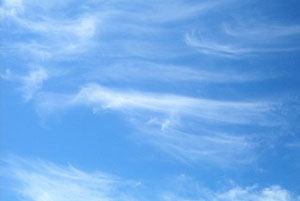
This type of cloud is thin, wispy, and made of ice crystals
a)
cumulus cloud
b)
stratus cloud
c)
cirrus cloud
d)
cumulonimbus cloud
23.

Which type of cloud is white and puffy?
a)
cumulus
b)
cirrus
c)
stratus
d)
cumulonimbus
24.

Clouds form during the process of...
a)
evaporation
b)
condensation
c)
precipitation
d)
runoff
25.
What type of clouds are called "fair weather clouds" and look like floating cotton?
a)
Cumulus
b)
Stratus
c)
Nimbus
d)
Cumulonimbus
Reset

