wayground logo

Free Printable Worksheets

Font size

S
M
L
XL
Worksheets

GEOMETRY UNIT 6: SIMILARITY TRANSFORMATIONS

Total questions: 182

Worksheet time: 9hrs 58mins

Name
Class
Date
1.
Dilations only enlarge figures.
a)
True
b)
False
2.
A scale factor of 1/2 reduces a figure.
a)
True
b)
False
3.
A dilation creates a similar figure.
a)
True
b)
False
4.
If a line segment has a length of 12 units and after a dilation the image length is 4 units, what was the scale factor?
a)
3
b)
1/3
c)
8
5.
The "image" is the shape before the dilation.
a)
True
b)
False
6.
The __________ is the ratio of a length of the new figure to the corresponding length on the original figure.
a)
reduction
b)
enlargement
c)
scale factor
d)
center of dilation
7.
In a dilation what mathematical operation is used with the scale factor?
a)
addition 
b)
subtraction 
c)
multiplication 
d)
division 
8.
A dilation can produce a smaller figure also known as a ______
a)
reduction
b)
enlargement
c)
scale factor
d)
center of dilation
9.
 A dilation can produce a larger figure also known as a ______
a)
reduction
b)
enlargement
c)
scale factor
d)
center of dilation
10.
If a dilation produces a congruent figure, then the scale factor was equal to _____.
a)
1/2
b)
2
c)
10
d)
1
11.
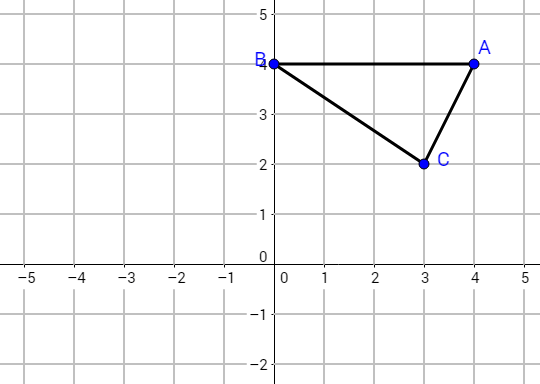
Dilate the figure by a scale factor of 3 with the origin as the center of dilation. What are the coordinates of the image?
A(3,3) B(6,6) C(9,3)
a)
A'(9,9) B'(18,18) C'(27,9)
b)
A'(6,6) B'(9,9) C'(12,6)
c)
A'(0,0) B'(3,3) C'(6,0)
d)
A'(1,1) B'(2,2) C'(3,1)
12.
Choose the correct scale factor:
a)
2
b)
3
c)
1/3
d)
1/2
13.
The point (8, 12) was dilated to become point (2, 3). What was the scale factor?
a)
½
b)
¼
c)
4
d)
2
14.
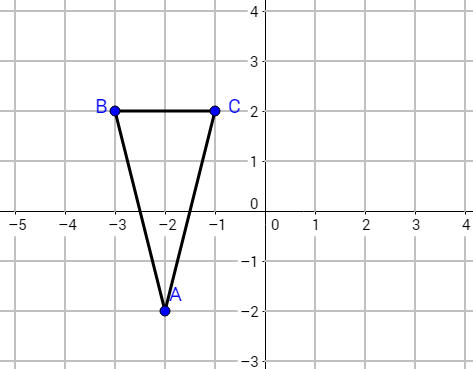
Dilate Point B by a scale factor of 1/2
a)
(1.5,-4)
b)
(-1.5,1)
c)
(-1,-1.5)
d)
(-2,-2)
15.
A dilation is which of the following: 
a)
only an enlargement
b)
only a reduction
c)
Either an enlargement or a reduction
d)
Neither an enlargement or a reduction
16.
A dilation produces a similar figure
a)
True
b)
False
17.

A dilation produces a congruent figure

a)

True

b)

False

18.
When a dilation has a scale factor greater than one, the dilation is an enlargement.
a)
True
b)
False
19.
When the scale factor of a dilation is less than one, the dilation is a reduction.
a)
True
b)
False
20.
How do you write the algebraic notation when the scale factor is 3?
a)
(x, y) goes to (1/3x, 1/3y)
b)
(x, y) goes to (-3x, -3y)
c)
(x, y) goes to (x + 3, y + 3)
d)
(x, y) goes to (3x, 3y)
21.
A dilation is which of the following: 
a)
only an enlargement
b)
only a reduction
c)
either an enlargement or a reduction
d)
neither an enlargement nor a reduction
22.
Definition: The figure after a transformation has occurred. 
a)
Pre-image
b)
Image
c)
Translation
d)
Reflection
23.
Definition: The figure before a transformation has occurred. 
a)
Pre-image
b)
Image
c)
Translation
d)
Reflection
24.
A dilation always produces a congruent figure.
a)
True
b)
False
25.
A dilation always produces a similar figure. Similar figures have the same ______ but different ______. 
a)
measure; shapes
b)
sizes; shapes
c)
value; measures
d)
shape; sizes
26.
Did the image enlarge, reduce or none of the above?
a)
Enlarge
b)
Reduce
c)
None of the above
27.
Does the image show a Dilation? If yes, did the image enlarge, reduce or none of the above?
a)
Yes, enlarge
b)
Yes, reduce
c)
No
28.
What scale factor was used to produce the image?
a)
2
b)
3
c)
1/3
d)
1/2
29.
What scale factor was used to produce the image?
a)
1
b)
7
c)
18
d)
49
30.
What scale factor was used to produce the image?
a)
2
b)
-2
c)
1/2
d)
1
31.
What scale factor was used to produce the image?
a)
2.5
b)
1.5
c)
3.5
d)
4
32.

What are the coordinates for the center of dilation?

a)

(3, 0)

b)

(0, 0)

c)

(3, 1)

d)

(3, -2)

33.

What are the coordinates for the center of dilation?

a)

(0, 0)

b)

(-3, -1)

c)

(-12, 6)

d)

(-3, -3)

34.
Find the measure of x:
a)
6
b)
24
c)
33
d)
36
35.
State the coordinate of the image of the given point B (-10,-6) under a dilation with center at the origin with the given scale factor k = 1/2.
a)
(5,3)
b)
(20,12)
c)
(-20,-12)
d)
(-5,-3)
36.
State the coordinate of the image of the given point B (4,9) under a dilation with center at the origin with the given scale factor r = 2.
a)
(2,4.5)
b)
(-8,-18)
c)
(8,18)
d)
(9,4)
37.
State the coordinates of the image of point C after a dilation with a scale factor of 1/2 and center point P.
a)
(-6, 1)
b)
(-3, -2)
c)
(1, -6)
d)
(-2, -3)
38.
State the coordinates of the image of point B after a dilation with a scale factor of 2 and centered at point A.
a)
(-4,2)
b)
(-8,4)
c)
(-4,6)
d)
(-2,-2)
39.
The red triangle has been dilated by a scale factor of 1/4 about the origin, which triangle is it's new image? 
a)
green triangle 
b)
red triangle 
c)
black triangle
d)
none of these 
40.
Under a dilation, which scale factor will result in a congruent image?
a)
-2
b)
0
c)
1
d)
1/2
41.

An image is dilated at a scale factor of 1.5. This means the dilation is an enlargement and the dilated image will be bigger.

a)

True

b)

False

42.
Dilate Point B by a scale factor of 3:
a)
(12,0)
b)
(12,12)
c)
(4,3)
d)
(0,12)
43.
Does the image show a dilation?
a)
Yes
b)
No
44.

A dilation is which of the following:

a)

an enlargement

b)

a reduction

c)

Either an enlargement or a reduction

d)

Neither an enlargement or a reduction

45.

When A(3, 6) is under a dilation of 2 what are the coordinates of A'?

a)

(3, 6)

b)

(1.5, 3)

c)

(6, 12)

d)

(12, 6)

46.
In a dilation what mathematical operation is used with the scale factor?
a)
addition 
b)
subtraction 
c)
multiplication 
d)
division 
47.
The __________ is the ratio of a length of the new figure to the corresponding length on the original figure.
a)
reduction
b)
enlargement
c)
scale factor
d)
center of dilation
48.

State the coordinate of the image of the given point G (-10,-6) under a dilation with center at the origin with the given scale factor of 1/2.

a)

G' (5,3)

b)

G' (20,12)

c)

G' (-20,-12)

d)

G' (-5,-3)

49.
What is the scale factor from ABCD to MNOP?
a)
2/3
b)
3/2
c)
2
d)
3
50.

If your SF = 0.8, what type of dilation is it?

a)

Reduction

b)

Enlargement

51.

If your SF = 2.5, what type of dilation is it?

a)

Reduction

b)

Enlargement

52.

If your SF = 6/5, what type of dilation is it?

a)

Reduction

b)

Enlargement

53.

A dilation is given by the transformation (x, y) → (3.5x, 3.5y). What is the scale factor?

a)

3/5

b)

3.5

c)

5/3

d)

1/3.5

54.

A dilation is given by the transformation (x, y) → (.75x, .75y). What type of dilation is this?

a)

enlargement

b)

it is not a dilation

c)

reduction

55.

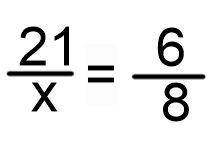
Solve for x

a)

x = 19.6

b)

x = 5/98

c)

x = 101/5

56.
Solve for x 
a)
x = 6
b)
x = 25
c)
x = 28
d)
x = 17
57.
Solve for x 
a)
x = 16
b)
x = 28
c)
x = 1/26
d)
x = 26
58.
What is a proportion?
a)
When two ratios can be simplified
b)
When two ratios are equivalent and show the same value
c)
When two ratios have the exact same numbers
d)
When two ratios can be multiplied by 2
59.
Solve the proportion.
a)
q=2
b)
q=9
c)
q=4.5
d)
q=6
60.
Solve the proportion.
a)
10.8
b)
7.5
61.
There were 5 ice cream cones for every 3 brownies sold at the ice cream shop. If there were 24 brownies sold, how many ice cream cones were sold?
a)
8
b)
15
c)
40
d)
29
62.
Solve for x 
a)
x = 1/10
b)
x = 10
c)
x = 4
d)
x = 5
63.
Solve for x 
a)
x = 15
b)
x = 11
c)
x = 1/11
d)
x = 20
64.
Are the fractions equivalent?
a)
Yes
b)
No
65.

The scale of a map says that 6 cm represents 15 km.

What distance on the map represents an actual distance of 6 kilometers?

a)

3.6

b)

2.5

c)

2.4

d)

.42

66.

The scale of a map says that 6 cm represents 15 km.

What is the actual number of kilometers that is represented by 15 cm on the map?

a)

37.5

b)

90

c)

225

d)

20

67.
The pair of figures is similar. Find the missing side.
a)
x = 20
b)
x = 12
c)
x = 5
d)
x = 4
68.
Find missing side
a)
5
b)
7
c)
9
d)
11
69.
Solve for X.
a)
2 ft
b)
3 ft
c)
4 ft
d)
6 ft
70.
A triangle has vertices with coordinates (2,0), (3, -1) and (-2,-5). If the triangle is dilated by a scale factor of 3 with the origin as the center of dilation, what are the coordinates of the vertices of the image?
a)
(5,3), (6,2), (1,-2)
b)
(6,0), (9,-3), (-6,-15)
c)
(2/3,0), (1,-1/3), (-2/3,-5/3)
d)
(-1,-3), (0,-4), (-5,-8)
71.
a)

A

b)

B

c)

C

d)

D

72.
What would be the scale factor in the dilation shown?
a)
1/1
b)
1/2
c)
4/1
d)
2/1
73.

The center of dilation is important because

a)

it's the location from which the dilation occurs.

b)

All of the corresponding points of the image and pre image are on the lines radiating from the Center of Dilation.

c)

it's a fixed point on the plane about which all points are expanded or contracted.

d)

All of the above

74.

What is the perimeter of A'B'C'D' after ABCD is dilated by a scale factor of 3?

a)

30

b)

10

c)

5

d)

15

75.
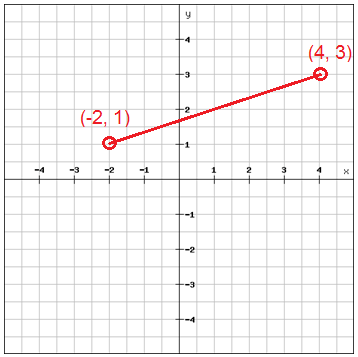
Find the distance between (-12, 1) and (12, -1).
a)
24.05
b)
24.06
c)
24.07
d)
24.08
76.
Find the distance between (-5, -8) and (-1, -16).
a)
8.9
b)
9.8
c)
10.3
d)
11
77.
Find the distance between (3, 24) and (7, 56).
a)
32.1
b)
32.2
c)
32.3
d)
32.4
78.
Find the distance between (-4, 5) and (7, 18).
a)
15.96
b)
16.08
c)
16.23
d)
17.03
79.
Find the distance.
a)
9.7
b)
10.7
c)
11.7
d)
12.7
80.
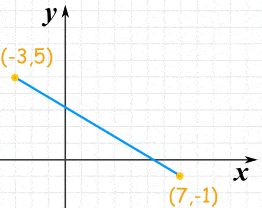
What is the distance between the two points?
a)
6.3
b)
6.5
c)
6.7
d)
16
81.

How is the distance formula correctly written:

a)

d = (y1 y2)2 (x2 x1)2 d\ =\ \sqrt{\left(y_{1\ }-\ y_2\right)^2\ -\left(x_{2\ }-\ x_1\right)^2}\

b)

d = (x2 x1)2 + (y2 y1 )2d\ =\ \sqrt{\left(x_{2\ }-\ x_1\right)^2\ +\ \left(y_{2_{\ }}-\ y_1\ \right)2}

c)

d = (y1 y 2)2 + (x2 x1)2d\ =\ \sqrt{\left(y_{1\ }-\ y\ _2\right)^2\ +\ \left(x_{2\ }-\ x_1\right)}^2

d)

d = (x)2 (y)2\sqrt{\left(x\right)^2-\ \left(y\right)^2}

82.

A(3,1) B(-2,-1) written correctly is:

a)

(23)2 + (11)2\sqrt{\left(-2-3\right)^2\ +\ \left(-1-1\right)^2}

b)

(13)2 + (12)2\sqrt{\left(1-3\right)^2\ +\ \left(-1-2\right)^2}

c)

(23)2 (11)2\sqrt{\left(-2-3\right)^2\ -\ \left(-1-1\right)^2}

d)

(23)2 (11)2\sqrt{\left(-2-3\right)^2\ -\ \left(-1-1\right)^2}

83.

A(2,0) B(-2,4) is written as

a)

d = (42)2 (02)2d\ =\ \sqrt{\left(4-2\right)^2\ -\ \left(0-2\right)^2}

b)

d = (40)2 (22)2d\ =\ \sqrt{\left(4-0\right)^2\ -\ \left(-2-2\right)^2}

c)

d = (2 +0)2 + (4+2)2d\ =\ \sqrt{\left(-2\ +0\right)^2\ +\ \left(4+2\right)^2}

d)

d = (22)2 + (40)2d\ =\ \sqrt{\left(-2-2\right)^2\ +\ \left(4-0\right)^2}

84.
What is the distance between (2,9) and (1,5)?
a)
15
b)
17
c)
4.12
d)
3.87
85.
Complete each proportion.
AB / BM  =  ? / CD
a)
BC
b)
AC
c)
MD
d)
MC
86.
Find length of segment AB.
a)
x = 810
b)
x = 21.6
c)
x = 33.75
d)
x = 67.5
87.
Solve for X
a)
7.5
b)
4.8
c)
13.33
d)
5
88.
Solve for DC
a)
1.5
b)
17.1
c)
8.4
d)
3.5
89.
Solve for x.
a)
x = 2
b)
x = -1
c)
x = 1
d)
x = 5
90.
Solve for x.
a)
3
b)
6
c)
8
d)
9
91.
Find x.
a)
54/7
b)
56/3
c)
11
d)
21/2
92.
Find the value of x.
a)
6.92
b)
18.67
c)
2.625
d)
13.71
93.
Find the length of the missing side.
a)
4
b)
6
c)
5
d)
7
94.
Find the length of the unknown segment.
a)
6
b)
3
c)
7
d)
1
95.
Find the missing length.
a)
5
b)
9
c)
7
d)
8
96.
Find the missing length.
a)
14
b)
20
c)
16
d)
10
97.
Find the missing length.
a)
8
b)
23
c)
11
d)
16
98.
Which of the following is NOT true about similar figures?
a)
A) Similar figures always have the same shape.
b)
B) Similar figures always have the same size.
c)
C) Similar figures always have corresponding angles that are equal.
d)
D) Similar figures always have corresponding sides that are proportional.
99.

ΔSQR∼ΔSPT. Which choice below lists two corresponding sides?

a)

SP and SR

b)

QS and PT

c)

PS and RS

d)

TP and RQ

100.
Why are the triangles similar?
a)
AA~
b)
SAS~
c)
SSS~
d)
AAS~
101.
Solve for x.
a)
x = 5
b)
x = 3
c)
x = 14
d)
x = 1
102.
What is the value of X?
a)
X=4
b)
X=6
c)
X=3
d)
X=2
103.
If the triangles are similar, find x
a)
90
b)
60
c)
30
d)
15
104.
A gymnasium is 96 feet long and 75 feet wide.  On a blueprint, the gymnasium is 5.5 inches long.  To the nearest tenth of an inch, what is the width of the gymnasium on the blueprint?  
a)
4.3
b)
8.6
c)
6.4
105.

Find the scale factor from the smaller triangle to the bigger.

a)

2/3

b)

1/2

c)

1.5

d)

3

106.

The Angle-Angle Similarity (AA ~) Theorem states if two angles of one triangle are _______________ to two angles of another triangle, then the triangles are ____________________.

a)

adjacent; equal

b)

complementary; scalene

c)

congruent; similar

d)

supplementary; isosceles

107.

The Side-Side-Side Similarity (SSS ~) Theorem states if the corresponding sides of two triangles are _____________________, then the triangles are _________________.

a)

proportional; similar

b)

similar, proportional

c)

congruent; congruent

d)

equal; equilateral

108.

The Side-Angle-Side Similarity (SAS ~) Theorem states that if two sides of one triangle are ________________ to two sides of another triangle and their _________________ angles are congruent, then the triangles are similar.

a)

adjacent; intersect

b)

complementary; form

c)

adjacent; create

d)

proportional; included

109.

Which is not a similar triangle theorem?

a)

ASA∼

b)

SAS∼

c)

SSS∼

d)

AA∼

110.

State the postulate that proves these triangles are similar.

a)

AA~

b)

SAS~

c)

SSS~

d)

AAS~

111.

State the postulate that proves these triangles are similar.

a)

SSS~

b)

SAS~

c)

AA~

d)

Not similar

112.

State the postulate that proves these triangles are similar.

a)

AA~

b)

SAS~

c)

SSS~

d)

Not Similar
113.

We can use dilation and ____________________ motion to establish triangle similarity theorems.

a)

symmetry

b)

rigid

c)

movement

d)

none of the above

114.

Which of the following do we consider rigid motions:

a)

translations

b)

symmetry

c)

reflections

d)

rotations

115.

State is the triangles are similar.If so, state how you know they are similar

a)

Similar by SSS similarity theorem

b)

Similar by SAS similarity theorem

c)

Similar by AA similarity theorem

d)

Not similar

116.

State is the triangles are similar.If so, state how you know they are similar.

a)

Similar by the SSS similarity theorem

b)

Similar by the SAS similarity theorem

c)

Similar by the AA similarity theorem

d)

Not Similar
117.

State is the triangles are similar.If so, state how you know they are similar.

a)

Similar by the SSS similarity theorem

b)

Similar by the SAS similarity theorem

c)

Similar by the AA similarity theorem

d)

Not Similar
118.

State is the triangles are similar.If so, state how you know they are similar.

a)

Similar by the SSS similarity theorem

b)

Similar by the SAS similarity theorem

c)

Similar by the AA similarity theorem

d)

Not similar

119.

State is the triangles are similar.If so, state how you know they are similar.

a)

Similar by the SSS similarity theorem

b)

Similar by the SAS similarity theorem

c)

Similar by the AA similarity theorem

d)

Not similar

120.

State is the triangles are similar.If so, state how you know they are similar.

a)

Similar by SSS similarity theorem

b)

Similar by SAS similarity theorem

c)

Similar by AA similarity theorem

d)

Not Similar
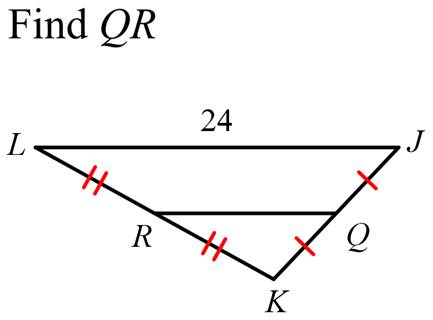
121.

State is the triangles are similar.If so, state how you know they are similar.

a)

Similar by SSS similarity theorem
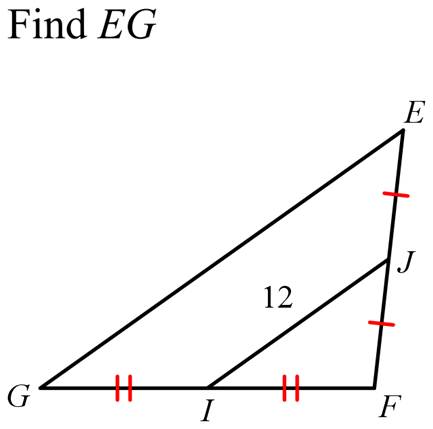
b)

Similar by SAS similarity theorem
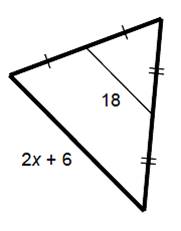
c)

Similar by AA similarity theorem

d)

Not Similar

122.

State is the triangles are similar.If so, state how you know they are similar.

a)

Similar by SSS similarity theorem

b)

Similar by SAS similarity theorem

c)

Similar by AA similarity theorem

d)

not similar

123.

State is the triangles are similar.If so, state how you know they are similar.

a)

Similar by SSS similarity theorem

b)

Similar by SAS similarity theorem

c)

Similar by AA similarity theorem

d)

Not Similar

124.

State is the triangles are similar.If so, state how you know they are similar.

a)

Similar by SSS similarity theorem

b)

Similar by SAS similarity theorem

c)

Similar by AA similarity theorem

d)

Not Similar

125.

State is the triangles are similar.If so, state how you know they are similar.

a)

Similar by SSS similarity theorem

b)

Similar by SAS similarity theorem

c)

Similar by AA similarity theorem

d)

Not Similar

126.

State is the triangles are similar.If so, state how you know they are similar.

a)

Similar by SSS similarity theorem

b)

Similar by SAS similarity theorem

c)

Similar by AA similarity theorem

d)

Not Similar

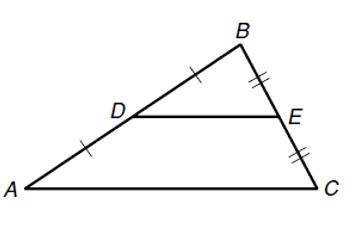
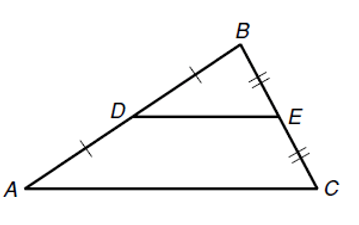
127.
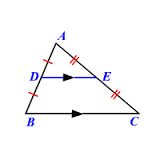
Name a midsegment of ⌂ABC
a)
segment AC
b)
segment DE
c)
segment AB
d)
segment BC
128.
Name a segment parallel to segment AC
a)
segment DE
b)
segment DB
c)
segment AC
d)
segment BC
129.
Name a segment that has the same length as segment BD
a)
segment BE
b)
segment DE
c)
segment AD
d)
segment AC
130.
name a segment that has half the length of segment AC
a)
segment AD
b)
segment BE
c)
segment DE
d)
segment BC
131.
Name a segment that has twice the length of segment EC
a)
segment BC
b)
segment BE
c)
segment AC
d)
segment BD
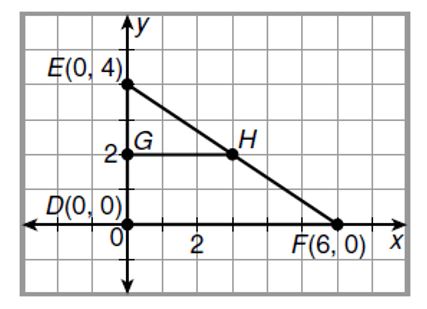
132.
Find the coordinates to G.
a)
2
b)
(2, 0)
c)
(0, 2)
d)
(0, 0)
133.
Find the coordinates to H.
a)
(3, 2)
b)
(2, 3)
c)
(3, 3)
d)
(6, 0)
134.
Find the slope of segment DF.
a)
1
b)
2
c)
0
d)
undefined
135.
Find the slope of segment GH.
a)
1
b)
2
c)
0
d)
undefined
136.
If two segments have the same slope, then they are parallel.  Are segments DF and GH parallel?
a)
yes
b)
no
137.
Find the length of segment DF.
a)
2
b)
3
c)
4
d)
6
138.
Find the length of segment GH.
a)
2
b)
3
c)
4
d)
6
139.
Does GH = 1/2DF?.
a)
no
b)
yes
140.
Find the measure of ST
a)
12
b)
11
c)
24
d)
no enough information
141.
Find the measure of QR
a)
11
b)
22
c)
24
d)
55
142.
Find the measure of PU
a)
12
b)
11
c)
24
d)
not enough information
143.
Find the measure of angle SUP
a)
55 degrees
b)
125 degrees
c)
180 degrees
d)
not enough information
144.
Find the measure of angle SUR
a)
55 degrees
b)
125 degrees
c)
180 degrees
d)
not enough information
145.
Find the measure of angle PQR
a)
55 degrees
b)
125 degrees
c)
180 degrees
d)
not enough information
146.
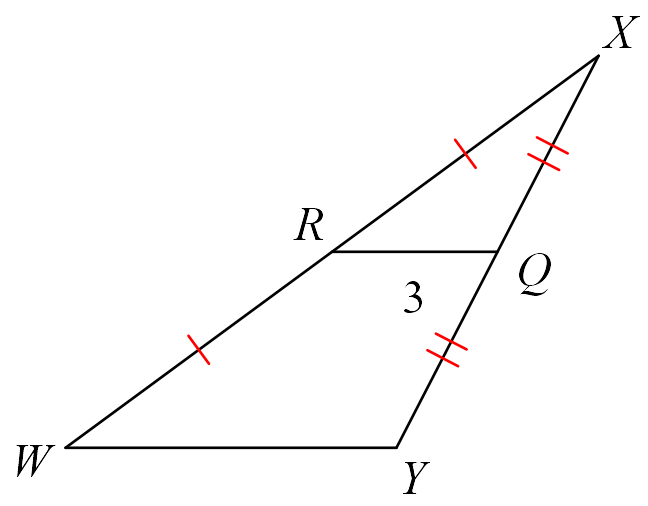
QR is a midsegment of triangle WXY. What is the length of segment WY?
a)
3
b)
6
c)
9
d)
12
147.
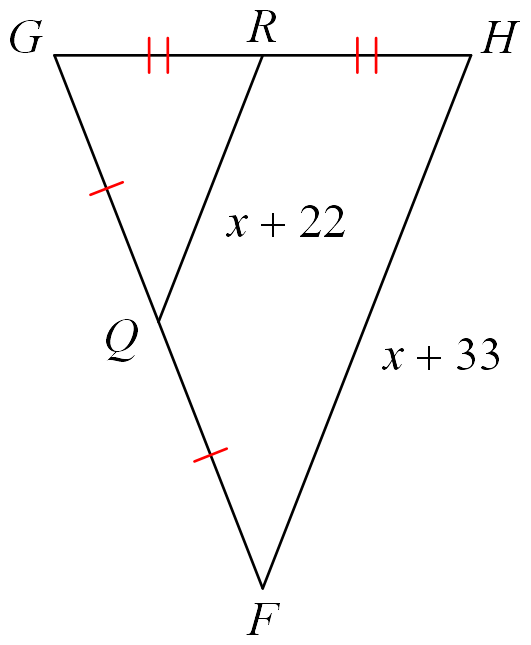
QR is a midsegment of triangle FGH. Solve for the value of x?
a)
5.5
b)
11
c)
-5.5
d)
-11
148.
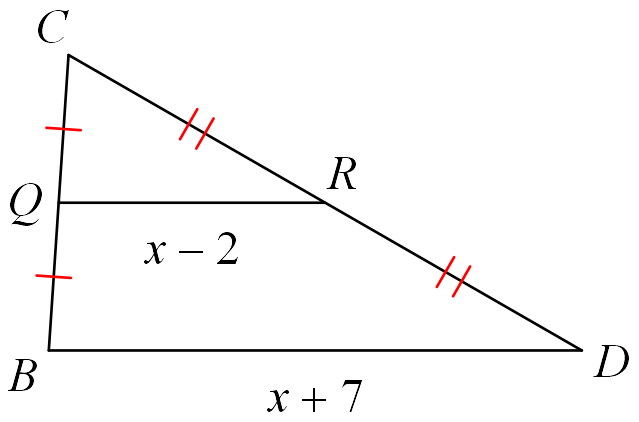
QR is a midsegment of triangle BCD. Solve for the value of x.
a)
11
b)
18
c)
9
d)
-7
149.
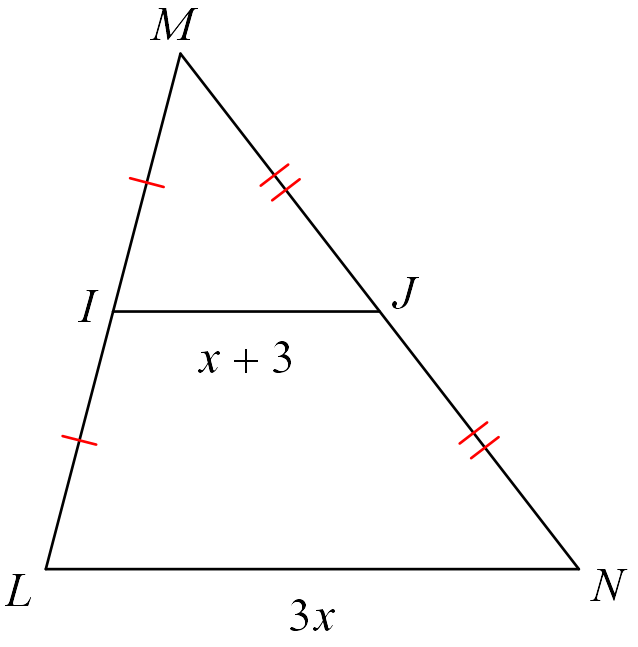
IJ is a midsegment of triangle MLN. What is the length of segment IJ?
a)
9
b)
6
c)
18
d)
0
150.
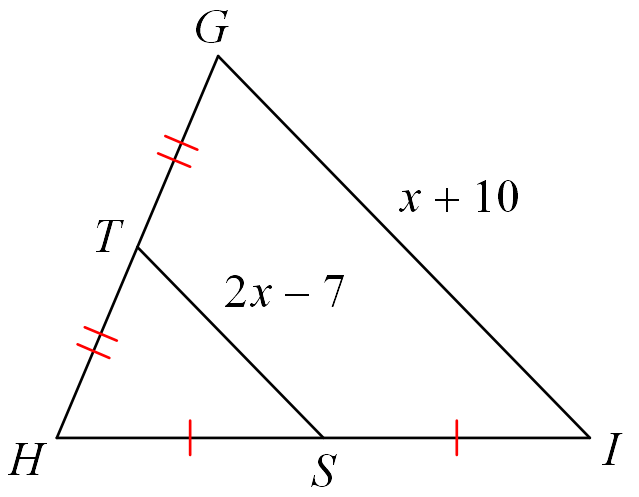
TS is a midsegment of triangle GHI. Solve for the value of x.
a)
4
b)
6
c)
8
d)
10
151.
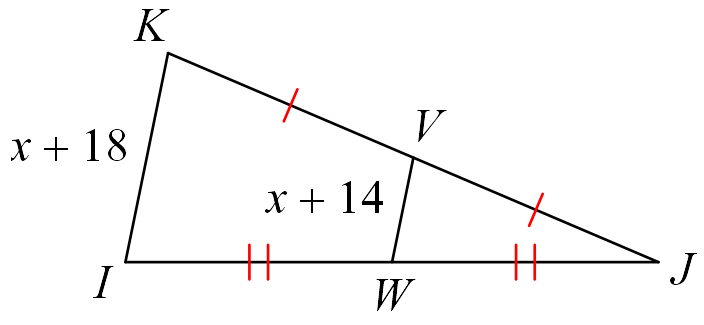
VW is a midsegment of triangle KIJ. What is the length of segment KI?
a)
-1
b)
-10
c)
18
d)
8
152.
Is DE parallel to BC?
a)
Yes
b)
No
153.
Find the length of AB
a)
6
b)
11
c)
17
d)
68
154.
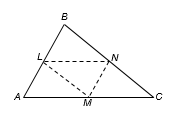
If LN = 5, then AC = ______.
a)
5
b)
10
c)
15
d)
25
155.
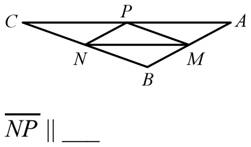
Name the parallel segment.
a)
CP
b)
CA
c)
CB
d)
AB
156.
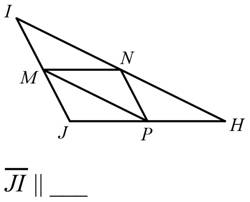
Name the parallel segment.
a)
JH
b)
PN
c)
MP
d)
MN
157.
Find the missing length.
a)
12
b)
48
c)
24
d)
18
158.
Find the missing length.
a)
12
b)
6
c)
20
d)
24
159.
Find the missing length.
a)
x = 12
b)
x = 11
c)
x = 15
d)
x = 9
160.

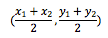
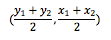
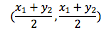
Which of the following is the correct midpoint formula given two endpoints (x1, y1) and (x2, y2)?
a)
b)
c)
d)
161.
What is the midpoint between (3, -1) and (7, -5)
a)
(5, -2)
b)
(10, -6)
c)
(5, -3)
d)
(2, -2)
162.
Find the midpoint of the segment with the endpoints:(1, 7) and (9, 0) 
a)
(4, 3.5)
b)
(3.5, 5)
c)
(3.5, 4.5)
d)
(5, 3.5)
163.
Find the midpoint of the segment with the endpoints:(-7, -8) and (4, 7) 
a)
(-5.5, -7.5)
b)
(-1.5, -0.5)
c)
(-3, -1)
d)
(0.5, 1.5)
164.
Find the midpoint of the segment with the endpoints:(4, 12) and (-6, 14)
a)
(-1, 13)
b)
(13, 1)
c)
(13, -1)
d)
(5, 13)
165.
Find the distance between the points:  (-3, -4) and (5, 5)
a)
11.8
b)
14.4
c)
12
d)
19
166.

What is the distance midpoint (-5, 3) and (4, -5)

a)

(-0.5, 2)

b)

(-0.5, -1)

c)

(-0.5, 1)

d)

(-.05, -0.5)

167.
Find the midpoint of an imaginary diagonal AC of ABCD.
a)
(1, 3)
b)
(5, 4)
c)
(6, 4)
d)
(0, 4)
168.
Find the endpoint of the segment with the endpoint of  (-4, 5) and midpoint of (7, -9) 
a)
(18, 13)
b)
(13, 18)
c)
(11,4)
d)
(1.5, -2)
169.
Point M with coordinates (3,4) is the midpoint of the line AB and A has the point (-1,6). What is the point of B?
a)
(1,5)
b)
(2,10)
c)
(7,2)
d)
(1,2)
170.
a2 + b2 = c2
a = 9 b = 40
a)
c = 41
b)
c = 65
c)
c = 25
d)
c = 5
171.
a2 + b2 = c2
b = 35 c = 37
a)
a = 12
b)
a = 11
c)
a = 18
d)
a = 14
172.
a2 + b2 = c2
b = 35 c = 37
a)
a = 12
b)
a = 11
c)
a = 18
d)
a = 14
173.
Find the missing side
a)
9
b)
41
c)
6.4
d)
3
174.
side a on a right triangle is ALWAYS the longest side
a)
true
b)
false
175.
What is the longest side of a right triangle called?
a)
Leg A
b)
Leg B
c)
Hypotenuse
d)
Pythagoras' Big Buddy
176.
Find the length of the missing side. 
a)
25 cm
b)
42 cm
c)
52 cm
d)
48 cm
177.
Find the length of the missing side. 
a)
20 in.
b)
68 in.
c)
16 in.
d)
80 in.
178.
The Pythagorean Theorem ONLY works on which triangle? 
a)
obtuse
b)
scalene
c)
isosceles
d)
right
179.
What is the opposite of squaring a number?
a)
divide
b)
multiply 
c)
fractions
d)
square root
180.
What is the side of a right triangle across from the right angle called?
a)
square
b)
arm
c)
leg
d)
hypotenuse
181.
solve for c
a)
7
b)
9
c)
4
d)
13
182.
Find the missing side
a)
48
b)
108
c)
83.6
d)
72