
NEW
Font size
 Worksheets
Earn Bonus Points for the Semester Exam
Total questions: 33
Worksheet time: 34mins
This organelle is a highly selective barrier, allowing some materials to pass through it, but not others.
cell wall
nucleus
cell membrane
chloroplast
Which of the following pairs incorrectly matches a cell structure with its function?
mitochondrion . . . cellular energy
ribosome . . . manufacture of proteins
lysosome . . . movement
central vacuole . . . storage
Which of the following structures would be present in a plant cell, but not in an animal cell?
nucleus, mitochondria, chloroplasts
cell wall, mitochondria, Golgi apparatus
central vacuole, Golgi apparatus, nucleus
chloroplasts, cell wall, central vacuole
Which statement correctly explains a difference between the cells of prokaryotes and the cells of eukaryotes?
Eukaryotic cells have a nucleus and membrane-bound organelles; prokaryotic cells lack these features.
Eukaryotic cells have fewer distinct parts than prokaryotic cells because they are less evolved.
Eukaryotic cells do not have cell walls or vacuoles; prokaryotic cells have both of these features.
Eukaryotic cells reproduce using DNA; prokaryotic cells use RNA only to reproduce.
What structures are common in all prokaryotic and eukaryotic cells?
cell wall, ribosomes and nucleus
cell membrane, nucleus, mitochondria
cell membrane, cytoplasm and ribosomes
chloroplast, cell membrane and cytoplasm
A specific type of cell is being studied by a scientist. She notices the cell contains a nucleus, lysosomes, a cell membrane and cell wall. What is the correct classification of this cell?
A prokaryotic cell
A bacterial cell
A eukaryotic animal cell
A eukaryotic plant cell
Using a microscope in the science lab, Jill observed two unknown cell: Cell 1 and Cell 2. Cell 1 she identified as a plant cell and Cell 2 as an animal cell. Her teacher told her she identified the cells correctly. What did Jill most likely observe to correctly identify the cells?
Cell 2 had a cell membrane and Cell 1 did not.
Cell 1 had a cell wall and Cell 2 did not.
Cell 2 had a chloroplast and Cell 1 did not.
Cell 1 had a nucleus and Cell 2 did not.
Cell theory was first proposed in 1838. Evidence obtained through additional scientific investigations resulted in the current cell theory. Which statement describes a component of the original cell theory that was removed because of the new scientific knowledge?
All living things are made of cells.
All cells come from other preexisting cells.
Cells form through spontaneous generation.
Cells are the basic structural and functional units of life.

Look at the cross section of a cell membrane of a eukaryotic cell. H+ ions are being pumped from a low concentration to a high concentration. How do you describe this type of transport across the cell membrane?
Active transport
Passive transport
Facilitated diffusion
Co-transport

A teacher has set up a model to represent osmosis.
The model is shown in the diagram above.
Which structure is represented by the object in the center of the beaker, labeled X?
vacuole
cell membrane
nucleus
mitochondria
Which of the following best explains the difference between passive and active transport within cell membranes?
Passive transport does not require chemical energy to occur; active transport requires energy, such as ATP.
Passive transport happens only in the presence of water, while active transport does not require water to occur.
Passive transport moves larger substances through the cell membrane; smaller molecules must move by active transport.
Passive transport allows whole particles to move through the membrane, while active transport breaks particles down before they can pass through.

The diagram below shows the general structure of an amino acid. Which type of molecule is formed from amino acids?
Lipids
Proteins
Nucleic acids
Carbohydrates

A sugar, a phosphate group, and a nitrogen base form the building blocks of which organic compound?
Carbohydrate
Lipid
Protein
Nucleic Acid
Which macromolecule stores energy, insulates us, and makes up the cell membrane?
Carbohydrates
Proteins
Lipids
Nucleic acids
Two of the four principle classes of organic compounds are proteins and nucleic acids. What is the relationship between proteins and nucleic acids?
Nucleic acids use proteins for energy
Nucleic acids are a subset of proteins
Proteins are long polymers of nucleic acids
Nucleic acids contain the information to make proteins
Which of the following structure below is the building block /monomer of a lipid?


Water is essential for life. Its special properties make water the single most important molecule in plant life. Which of the following properties of water enables it to move from the roots to the leaves of plants?
Water expands as it freezes.
Water is an excellent solvent.
Water exhibits cohesive behavior.
Water is able to moderate temperature.
Large bodies of water, such as lakes and oceans, do not quickly fluctuate in temperature. What is the reason for this phenomenon?
Water is an acid.
Water is a versatile solvent.
Water has a high heat capacity.
Water acts as a buffer.
All living things need to transport molecules from one place to another in order to carry out necessary life functions. Living things often transport these molecules by dissolving or dissociating them in water and then moving the resulting solution from place to place. What characteristic must a molecule have for it to form a solution in water?
It must be at least slightly polar to be able to react with the polar water molecules.
It must be nonpolar to be able to react with the polar water molecules.
It must be at least as small as the polar water molecules.
It must be covalently bonded in order to form new bonds with the polar water molecules.
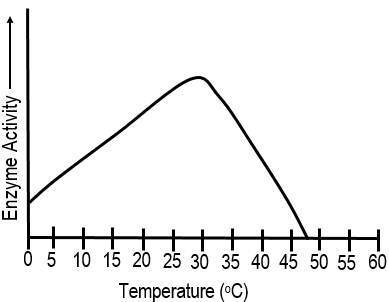
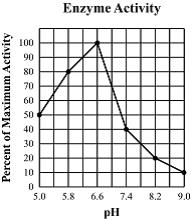

The graph shows the energy of the reactants and
products of a biochemical reaction, as well as its activation energy without an enzyme. How would an enzyme affect the reaction?
The activation energy would become lower and the reaction will speed up
The activation energy would become higher and the reaction will speed up
The energy difference between the reactants and products would decrease
The products will change into different products
Many fish and aquatic plants can survive a cold winter because the layer of ice that forms at the top of the lake insulates the water below and prevents the lake from freezing solid. What unique property of water contributes to this effect?
Water absorbs heat when it evaporates and forms a gas.
Water expands and becomes less dense when it freezes.
Water molecules completely separate into ions in solutions.
Water forms hydrogen bonds with ions and other polar substances.
Cell theory is a result of the contributions of several different scientists, and applies to all living things. Which of the following explains why cell theory will not ever become the law of cells?
Cells of different organisms are so diverse that it is impossible to come up with a law that would apply to all of them.
Because cells undergo change as mutations occur within them, developing anything beyond a cell theory would be impractical.
Scientific theories are well-tested explanations, while laws are well-tested descriptions of natural phenomena; one cannot become the other.
Scientific theories can only become laws if all possible cases can be tested; it would be impossible to test all living things to see if they have cells.

Louis Pasteur experiment was used to disprove spontaneous generation, the idea that living things came from nonliving. A scientist did a controlled experiment similar to Pasteur’s experiment, using broth. In the experiment, he filled two open flasks, as shown in the figure below, with broth and boiled the broth until it became clear. He then left the flasks open for several days. Which results showed that spontaneous generation did NOT occur?
The broth in Flask A remained clear and the broth in Flask B became cloudy.
The broth in Flask A became cloudy, and the broth in Flask B remained clear.
The broth in both Flask A and Flask B became cloudy.
The broth in both Flasks A and Flask B remained clear.
In which way are photosynthesis and cellular
respiration different?
Cellular respiration produces ATP for cell function while photosynthesis stores energy.
Cellular respiration produces oxygen, while photosynthesis uses oxygen.
Photosynthesis and cellular respiration both use carbon dioxide.
Photosynthesis releases energy while cellular
respiration stores energy.

Which statement describes the relationship
between photosynthesis and cellular respiration?
The reactants of photosynthesis are the reactants of cellular respiration.
The reactants of photosynthesis are the products of cellular respiration and vice versa.
The products of photosynthesis and cellular respiration are the same.
The products of photosynthesis are the products of cellular respiration.
Two different species of bacteria are examined. Scientists find that Species X always produces CO2 and H2O during cellular respiration. Species Y always produces ethyl alcohol and CO2 when making ATP. Which conclusion can be made from these observations?
Only Species Y is aerobic.
Only Species Y is anaerobic.
Both Species X and Species Y are aerobic.
Both Species X and Species Y are anaerobic.
Which of the following correctly compares the products of aerobic and anaerobic respiration?
Aerobic respiration produces more than 30 ATP per glucose molecule and either ethyl alcohol or lactic acid, while anaerobic respiration produces only 2 ATP per glucose molecule.
Aerobic respiration produces more than 30 ATP per glucose molecule, while anaerobic respiration produces only 2 ATP per
glucose molecule and either ethyl alcohol or lactic acid.
Anaerobic respiration produces more than 30 ATP per glucose molecule and either ethyl alcohol or lactic acid, while aerobic respiration produces only 2 ATP per glucose molecule.
Anaerobic respiration produces more than 30 ATP per glucose molecule, while aerobic respiration produces only 2 ATP per
glucose molecule and either ethyl alcohol or lactic acid.
Photosynthesis and cellular respiration both involve the use and release of gases. Which statement correctly identifies the role of gases in the two processes?
Photosynthesis and cellular respiration both use carbon dioxide and release oxygen.
Photosynthesis and cellular respiration both use oxygen and release carbon dioxide.
Cellular respiration uses oxygen and releases carbon dioxide, while photosynthesis uses carbon dioxide and releases oxygen.
Cellular respiration uses carbon dioxide and releases oxygen, while photosynthesis uses oxygen and releases carbon dioxide.
Which of these statements best explains the process of energy conversion that takes place in the mitochondria?
Energy is required for carbon dioxide molecules to form six-carbon sugar molecules
Water molecules and radiant energy are necessary for anaerobic respiration to take place.
Oxygen molecules release energy in the form of heat during combustion reactions.
The energy in glucose molecules is transferred to the phosphate in ATP.

