Font size
 Worksheets
Waves
Total questions: 21
Worksheet time: 10mins

Which type of wave is illustrated in the diagram?
Longitudinal
Slinky
Transverse
Water

Which of the following are examples of transverse waves?
Gamma waves
Ultrasonic waves
Ultraviolet waves
Sound waves
Visible light

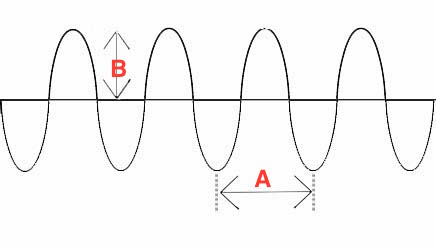
Which letter(s) represents the wavelength of the wave?
a
b
c
d
e

What is the amplitude of this wave?
0.20 m
0.40 m
2.0 s
4.0 s
What is the frequency of this wave?
0.25 Hz
0.50 Hz
2.0 s
4.0 s

Which of the following is the wave equation used to find wave speed?
T = 1/f
f = 1/T
v = f/λ
V = f x λ

The time period of this wave is 2 seconds. What is the wave speed?
1.0 m/s
2.0 m/s
4.0 m/s
8.0 m/s

A gamma ray has a frequency of 1.0 x 10 20 Hz and travels at 3.0 x 10 8 m/s. What is it’s wavelength?
3.3 x 10 -13 m
3.0 x 10 -12 m
3.3 x 10 11 m
3.0 x 10 12 m

Max is sitting in his boat observing water waves enter the harbour. He counts 20 waves passing into the harbour in one minute. What is the frequency?
0.33 Hz
3.0 Hz
20 Hz
1200 Hz

All waves transfer energy?
True
False

Which of the following is the correct order for the electromagnetic spectrum shown above?
Gamma, X-ray, UV, Visible, IR, Microwave, Radio
Radio, IR, Microwave, Visible, UV, X-ray, Gamma
Gamma, UV, X-ray, Visible, IR, Microwave, Radio
Radio, Microwave, IR, Visible, UV, X-ray, Gamma

Which of the following types of electromagnetic radiation has the longest wavelength?
Gamma
X-ray
Radio
Microwave

Which of the following types of electromagnetic radiation has the largest frequency?
Gamma
X-ray
Radio
Microwave

Which of the following do all regions of the electromagnetic spectrum have in common?
Travel at the speed of light (3.0 x 10 8 m/s)
Cannot travel in a vacuum
Can be reflected, refracted and polarised
Need a medium to travel in

Other than cooking food, which of the following is a use of microwave radiation?
Night vision equipment
Destroying bacteria in water chillers
Satellite communication
Location of tumours

Which of the following is a danger of IR radiation?
Causes burns
Causes hearing damage
Easily absorbed by water in the body’s cells
Causes cancer

Which of the following are dangers of visible light?
Can cause damage to the retina
Easily absorbed by water in the cells of the body
Causes cancer
Can burn corneas
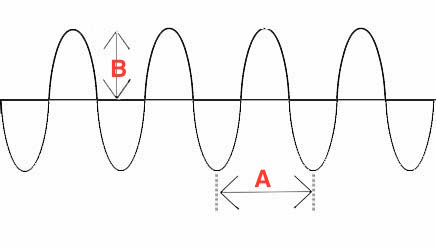
What property of this wave is represented by the letter "A"
amplitude
crest
trough
wavelength