Wayground logo

Free Printable Worksheets

Font size

S
M
L
XL
Worksheets

Focus #15

Total questions: 20

Worksheet time: 17mins

Name
Class
Date
1.
Which represents the distribution of water on Earth?
a)
3% freshwater, 97% salt water
b)
97% freshwater, 3% salt water
c)
71% freshwater, 29% salt water
d)
29% freshwater, 71% salt water
2.
What is the water that fills the cracks and spaces in underground soil and rock layers called?
a)
Groundwater
b)
Water Table
c)
Precipitation
d)
Snow
3.
When water leaves plants in the form of water vapor it is known as
a)
Evaporation
b)
Condensation
c)
Transpiration
d)
Precipitation
4.
Water returns back to the Earth in this stage of the water cycle.
a)
Evaporation
b)
Condensation
c)
Precipitation
d)
Transpiration
5.
When water evaporates it eventually cools and forms a cloud.  This is known as
a)
Evaporation
b)
Condensation
c)
Precipitation
d)
Transpiration
6.
The term used to describe water leaving Earth's surface is
a)
Evaporation
b)
Condensation
c)
Precipitation
d)
Accumulation
7.
Most of Earth's fresh water is found
a)
Frozen in glaciers
b)
Underground
c)
In the Great Lakes
d)
In Oceans
8.
What percentage of water on Earth is salt water?
a)
55
b)
71
c)
84
d)
97
9.
A large body of salt water is called a(n)
a)
estuary
b)
lake
c)
ocean
d)
pond
10.
Layers of rock or soil that allow water to flow through are called...
a)
aquifers
b)
lakes
c)
reservoirs
d)
watersheds
11.
Which stage does ground water try to return to the ocean or soak into the ground?
a)
condensation
b)
evaporation
c)
precipitation
d)
run off
12.
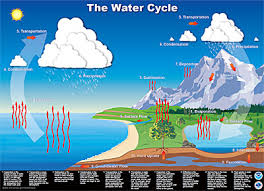
What is A?
a)
Evaporation
b)
Condensation
c)
Precipitation
d)
Runoff
13.
What is B?
a)
Evaporation
b)
Condensation
c)
Precipitation
d)
Runoff
14.
What is C?
a)
Evaporation
b)
Condensation
c)
Precipitation
d)
Runoff
15.
What is D?
a)
Evaporation
b)
Condensation
c)
Precipitation
d)
Runoff
16.

When changing from a liquid to a gas, the water molecules are ____________________________.

a)

freezing and moving away from each other.

b)

evaporating and moving away from each other

c)

condensing and moving closer to each other

d)

evaporating and moving closer to each other

17.

When changing from a liquid to a solid, the water molecules are ____________________________.

a)

freezing and moving away from each other.

b)

evaporating and moving away from each other

c)

condensing and moving closer to each other

d)

freezing and moving closer to each other

18.

When changing from a gas to a liquid, the water molecules are ____________________________.

a)

condensing and moving away from each other.

b)

evaporating and moving away from each other

c)

condensing and moving closer to each other

d)

freezing and moving closer to each other

19.

When changing from a solid to a liquid, the water molecules are ____________________________.

a)

melting and moving away from each other.

b)

evaporating and moving away from each other

c)

melting and moving closer to each other

d)

freezing and moving closer to each other

20.

This provides the power to keep the water cycle running.

a)

The Sun

b)

The Earth

c)

The wind

d)

living things