Worksheets
Continental drift and Plate Tectonics
Total questions: 52
Worksheet time: 36mins
What is the Theory of Continental Drift?
New continents are continually being created
and destroyed.
The layout of the continents is the same today
as it has always been
The continents have always been separate but
may one day drift together to form a single
continent
All the continents were once one continent that
broke up and drifted apart over hundreds of
millions of years
When crust is neither created nor destroyed, what boundary is it formed along?
convergent
divergent
collisional
transform
What type of tectonic plate boundary involves a collision of plates?
transform
divergent
convergent
obstructive
Where do most volcanoes occur?
convergent boundaries
in deserts
on coastal plains
divergent boundaries
What is responsible for the volcanoes and mountain ranges?
Weathering
Super-nocturnal tides
Hurricanes
Plate Tectonics
Continents to continent plate boundaries produce what feature when they collide?
Rift Valleys
Mid-ocean ridges
Tall mountain ranges
Deep-sea trenches
What type of boundary exists when 2 plates are pulling apart?
Convergent
Transform
Obtrusive
Divergent
Where do volcanoes and earthquakes occur?
Under the flat surface of plates
Above the flat surface of the plates
Along plate boundaries
At the center of plate
The cause of earthquakes and how they are formed is the
Greenhouse Effect in the Ozone
melting of glacial ice in global warming
movement of continental plates
meteors that hit earth's surface from space
What is the most likely reason the bones of the reptiles were found on more than one continent?
Location geographically
Flooding
Plate Tectonics
Hurricane displacement
Rift Valley is a feature of what plate boundary?
Obtrusive
Divergent
Transform
Convergent
Why does the Ring of Fire around the Pacific Ocean have the most volcanoes?
boundary plates
divergent plate
convergent plates
transform plates
The theory of continental drift states that all the continents were once part of one big landmass called Pangaea. Who was the scientist that came up with this theory?
Harry Hess
Bill Nye
Alfred Wegener
Albert Einstein
Tectonic plates float on top of the
crust
asthenosphere
lower mantle
outer core

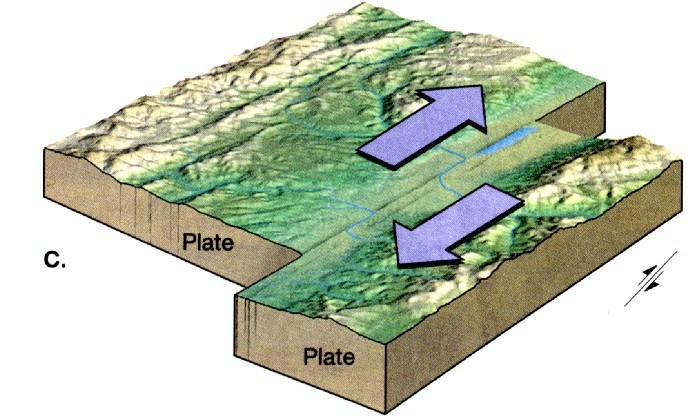
The San Andres Fault is an example of a
convergent boundary
divergent boundary
transform boundary
subduction zone

What type of plate boundary is shown in this picture
a convergent oceanic-oceanic boundary
a divergent oceanic-oceanic boundary
a convergent oceanic-continental boundary
a divergent oceanic-continental boundary
What was the name of the super continent that existed 250 million years ago?
Pangea
Eurasia
Wegenerland
Disneyland
What would you likely find at a convergent boundary between two pieces of continental crust?
volcano
mountains
rift
ridge

Most geologists think that the movement of Earth’s plates is caused by _______
convection.
continental drift.
subduction.
conduction.
any natural feature of the earth's surface
Landforms
Rivers
Sand Dune-
a vent in the crust of the earth from which usually molten or hot rock and steam is released
Mountain
Delta
Volcano
Study of plates, their movement, and Earth’s features that they affect
Plate boundaries
Plate Tectonics
Major mountains
the region where two lithospheric plates meet
Continental Drift
Plate tectonics
Plate Boundaries
The idea that continents were once part of a single landmass that broke apart and
moved
Continental Drift
Tectonic Plates
Transform
Boundary between two plates where the plates are sliding past each other
Divergent-
Convergent-
Transform-
Forms where plates are moving away from each other
Divergent-
Convergent-
Transform-
Formed where two sections of Earth’s crust are colliding
Divergent-
Convergent-
Transform-
Who is the person credited with developing the theory of continental drift?
Harry Hess
Alfred Wegener
Galileo

What is this a picture of?
Pangaea
Plate tectonics
Glaciers
What do you call the evidence of Wegener's Theory that tells about the remains of an organism that lived long time ago?
Ashes
Bones
Fossils
What two specific continents fit together most noticeably?
Africa and North America
South America and Africa
Antarctica and Africa
Where the plates touch is called the ____________.
Fault
Continental Drift
Volcano
The movement of tectonic plates is caused by
earth's rotation
movement in the mantle
gravity

New oceanic crust (sea floor) is created at this boundary.
Divergent Oceanic
Divergent Continental
Convergent Oceanic
Transform

Oceanic crust (sea floor) is destroyed at this boundary.
Convergent Oceanic
Divergent Oceanic
Convergent Continental-Continental
Divergent Continental

The process where oceanic crust slides under another plate and is melted is called ___________.
seafloor spreading
subduction
continental drift
recycling

What two crustal features occur near every subduction zone?
Volcanoes and Trenches
Rift Valleys and Mid Ocean Ridges
Volcanoes and Rift Valleys
Mid Ocean Ridges and Trenches
A divergent boundary on land creates what feature?
Mid Ocean Ridge
Rift Valley
Subduction Zone
Deep Ocean Trench
A divergent boundary in the ocean creates what feature?
Mid Ocean Ridge
Rift Valley
Deep Ocean Trench
Subduction Zone
When two continental plates converge (collide) what type of crustal feature is formed?
Mid Ocean Ridge
Subduction Zone
Rift Valley
Folded Mountains
The process that occurs at a divergent oceanic boundary that creates new crust (sea floor) is called?
Subduction
Seafloor Spreading
Continental Drift
Volcanism
What is the 'magic' that is happening in the mantle that helps move the 'lithospheric plates'?
Convection
Subduction
Seafloor Spreading
If an earthquake occurs at the bottom of the ocean floor what could form as result?
Volcano
Tsumani
Tidal Wave
Hurricane
Aside from Earthquakes, what is the only thing you will find at transform boundaries?
Volcanoes
Subduction Zones
Folded Mountains
Fault lines
What is the only event associated with ALL plate boundaries?
Volcanoes
Earthquakes
Subduction
Deep Trenches
The only type of crust that will subduct if two plates converge is...
Oceanic
Continental
Tsunamis are formed from what two types of convergent boundaries?
Continental-Continental
Oceanic-Continental
Oceanic-Oceanic