
 Worksheets
Space Review (5th)
Total questions: 51
Worksheet time: 40mins

On a field trip to a science museum, Lee saw photographs of asteroids and comets that astronomers took using telescopes. What could Lee look for in the photographs to tell a comet from an asteroid?
a long tail
a small size
a rocky surface
an irregular shape

Jacob is doing a report on the galaxy in which Earth is found. Which of the following is the galaxy that Jacob should research for his report?
Andromeda
Milky Way
Maffei 1
Ursa Minor

All visible stars in the night sky are many times larger than Earth. Why do they look like tiny points of light?
They are moving very fast.
The atmosphere blocks most of their light.
The stars visible at night are located very far from Earth.
Most of the light from stars is absorbed by galaxies, so it does not reach Earth.

Earth and Saturn are both planets orbiting the sun. Which of these other features do the two planets have in common?
They have a thin atmosphere.
They rotate about an axis.
Their orbits are the same length.
They have about the same mass.

Earth orbits the sun. Yet the sun appears to move through the sky. For example, the sun always appears to rise in the east and set in the west. What is responsible for this apparent motion of the sun?
Earth's size
Earth's orbit
Earth's rotation
Earth's revolution

If you look up at the night sky long enough, the stars will appear to move across the sky. What is responsible for making the stars appear to move across the sky at night?
Earth's revolution
Earth’s rotation on its axis
Earth’s position in its orbit
Earth’s distance from the sun

Earth revolves around the sun. Look closely at the illustration below, which shows Earth revolving around the sun. How long would it take for Earth to travel between points 4 and 2?
one week
one month
six months
twelve months

What is the definition of tilt?
Thick layer of gases that cover Earth
not straight
People from Earth
the top layer of something

What is the definition of atmosphere?
Thick layer of gases that cover Earth
not straight
People from Earth
the top layer of something

What is the definition of surface?
Thick layer of gases that cover Earth
not straight
People from Earth
the top layer of something

What is the definition of rotate?
To move around an axis. Earth does it every 24 hours
To move around the sun in a circle. Earth does it every 365 days
To move around the earth.
To spin the planets around a moon

What is the definition of revolve?
To move around an axis. Earth does it every 24 hours
To move around the sun in a circle. Earth does it every 365 days
To spin around in place
To move sideways

The Earth revolves every 24 hours
TRUE
FALSE

The Earth revolves around the sun.
TRUE
FALSE

Which sentence is true?
Venus is the hottest planet in our solar system.
Pluto is a planet
Mars is the 5th planet from the sun.
Neptune is the biggest planet in our solar system.

Which sentence is true?
Jupiter is the 7th planet from the sun.
Mars is the color blue
Earth is the 2nd planet from the sun
Saturn has rings around it

Which sentence is true?
Jupiter is a gas giant
Mars is the coldest planet
Mercury has 3 moons
Uranus is the smallest planet

Our sun is a medium-sized star compared to other stars.
True
False

What causes our seasons here on Earth?
Stars in our universe
Our revolution around the moon
Earth's tilted axis and our rotation
The revolution of Earth around the sun and Earth's tilted axis

This is the first planet from the Sun; it is very hot in the day and very cold in the night.
Mercury
Neptune
Earth
Jupiter

What are large, irregular chunks of rocks and metal in space?
Earth
comet
asteroids
gibbous

The fourth planet from the Sun; also known as the "red planet."
Neptune
Mercury
Earth
Mars

The sixth planet from the Sun; known for its large rings.
Saturn
Mercury
Earth
Mars

The fifth planet from the Sun; this is the LARGEST planet in the Solar System.
Jupiter
Mercury
Earth
Neptune

This is the eighth (last) planet from the Sun; it is deep dark blue in color.
Earth
Neptune
Mercury
Jupiter

These are the 4 planets closest to the sun (Mercury, Venus, Earth, Mars).
inner planets
outer planets
dwarf planets
solar planets

This is the nearest star to Earth.
the moon
the planet of Mars
the asteroid belt
the sun

These are the four planets FARTHEST from the Sun; Jupiter, Saturn, Uranus, and Neptune.
inner planets
outer planets
solar planets
the best planets

Where is the Asteroid Belt located in the Solar System?
near Neptune
between Mercury and Venus
between Mars and Jupiter
around the Sun

What is similar about all of the inner planets?
rocky
gasses
many moons
takes a long time to revolve around the sun

What is similar about all of the Outer Planets?
small
large
few moons
takes a short amount of time to go around the sun

Between which two planets is the asteroid belt located?
Mercury & Venus
Mars & Jupiter
Uranus & Neptune
Neptune & Pluto

Which planet takes the least time to go around the sun?
Mercury
Earth
Mars
Jupiter

Which planet is red because of iron oxide or rust?
Venus
Mars
Jupiter
Saturn

The "Great Red Spot" is a storm on which planet?
Earth
Mars
Jupiter
Saturn

Which planet has the greatest range in daytime and night time temperatures?
Mercury
Earth
Jupieter
Neptune
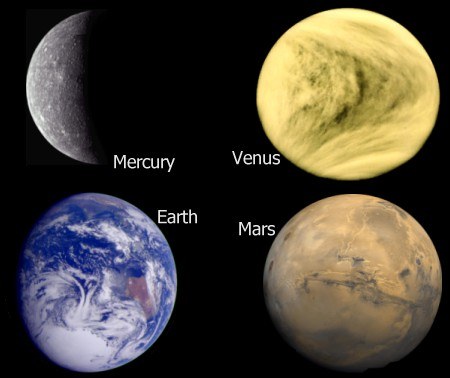


One of the main differences between the outer and inner planets is __________.
The inner planets all have water
the inner planets are much bigger than the outer planets
the outer planets are gas planets
the outer planets have rings, and the inner planets don't

Select the order from smallest to largest.
Sun, Milky Way, solar system, universe
Sun, Milky Way, universe, solar system
Sun, solar system, Milky Way, universe
Sun, solar system, universe, Milky Way

Which factor makes Earth different from all the other planets in the solar system in its ability to support life?
The Earth is exposed to rays from the sun.
The Earth has only one moon that orbits around it.
The Earth rotates in an elliptical orbit around the sun.
The Earth has a breathable atmosphere.

A spiral galaxy of stars that contains our Sun
Planisphere
Intensity
Star
Milky Way

What is the definition of orbit?
the spinning of the earth on its axis
when the lit part of the moon increases
all of the planets, moon, and other space objects going around the sun
the imaginary line that goes through the north and south poles that the earth spins on

What is the center of our solar system?
moon
earth
sun
Jupiter

There are _________ planets in our solar system.
6
7
8
9


What is the composition of an asteroid?
Ice, dust, rock, frozen gases
Rock, ice, salt, carbon
Metals and rocky material
Rock, ice, magma, frozen gases


