
 Worksheets
Newton's Laws Review
Total questions: 30
Worksheet time: 30mins
If Earth's mass was cut in half, what would happen to your mass?
increase because gravitational force increases
decrease because gravitational force decreases
decrease because gravitational force increases
nothing, mass is not affected by gravitational force

If Earth's mass was cut in half, what would happen to your weight?
Increase because gravitational force increases
decrease because gravitational force decreases
decrease because gravitational force increases
nothing, weight is not affected by gravitational force

Two asteroids exert a gravitational force, F, on each other. Some time later, the asteroids are now three times as far from each other as before. Which of the following represents the gravitational force at this distance?
⅓ x F
3 x F
9 x F
9 1x F

Two masses m1 and m2 are separated by a distance d and gravitational force between them is F. If the distance d is reduced to ½ of its previous value (d/2) the force will now be
8F (8 times greater)
2F (2 times greater)
F/4 (¼ as much force)
F/2 (½ half as much force)
4F (4 times more force)

On Earth 1 kg weighs about 10 Newtons. So how much would a 50 kg object weigh on Earth?
5 kg
5 N
50 N
500 N
On Earth 1 kg weighs about 10 Newtons. So what is the mass of an object that weighs 600 N on Earth?
6 kg
60 kg
600 kg
6000 kg

An object in motion will stay in what kind of motion as long as the net forces acting on it are zero?
slowing motion in a straight line
accelerating motion in a straight line
constant speed in a straight line
constant speed in an unpredictable direction

What can be stated about a car when it is moving at a constant speed in a straight line?
Forces are balanced
Forces are unbalanced
The net force on the is zero.
The acceleration of the car is zero.
The net force acting on the car is greater than zero.

Moe Fysics is not paying attention while skateboarding at 6 m/s hits a curb. The skateboard stops...Moe doesn't, because
the skateboard applies a force on Moe, pushing him forward.
the curb applies a force on the skateboard, not on Moe.
the velocity of the skateboard is less than 10 m/s.
the curb also applies a force on Moe, accelerating him forward.

Pushing a 30 kg child on a swing is easier than pushing a 70 kg adult on the same swing, because
the child has less inertia than the adult.
the child has more mass than the adult.
the child has more inertia than the adult.
the adult has less kinetic energy.

True or False. The acceleration of an object is inversely proportional to its mass.
True
False
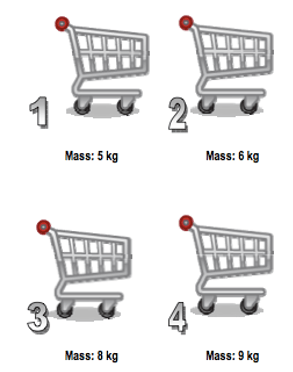
A force of 90N is applied to each cart below, which one will have the greatest acceleration?
Cart 1
Cart 2
Cart 3
Cart 4
All will have the same acceleration.

An unbalanced force is applied to a cart and it accelerates. If the net force on the cart triples, what happens to the cart's acceleration?
It doubles (2 x greater)
It triples (3 x greater)
It's 6 times greater
It's one-third as much (⅓ as much)
An unbalanced force is applied to a cart and it accelerates. If the mass of the cart doubles, what happens to the cart's acceleration if the same force is applied?
It doubles (2 x greater)
It quadruples (4 x greater)
It halves (½ as much)
It quarters (¼ as much)
A 2000-kg car has a net force of a force of 4000 N. Which of the following correctly show the work to determine the acceleration of the car?
a=mFnet=40002000=0.5 s2m
a=mFnet=20004000=2 s2m
F = ma = 2000×4000= 8000N
a= mFnet= 20004000=0.5 N
A 20 kg bike accelerates at 2 m/s/s. What is the correct calculation for determining the net force applied to the bike?
Fnet =ma=20×2=40 s2m
Fnet=ma =20×2=40 N
a= mFnet=2040=2 N
a= mFnet=2040=0.5 s2m

Two trains (Q, P) with the same mass have a net force applied to them. Their resulting motion is depicted in the v-t graph. Which train has the greater force applied to it?
Q because it has more acceleration.
Q because it has less acceleration.
P because it has more acceleration.
P because it has less acceleration.

Two trains (A and B) with the same mass have a net force applied to them. Their resulting motion is depicted in the v-t graph. Which train has the greater force applied to it?
A because it is moving faster.
A because it has more acceleration.
B because it has more acceleration.
B because it is moving slower.

Two trains (A and B) have the same net force applied to them and their resulting motion is depicted in the v-t graph. Which train has more mass?
A because it has less acceleration.
A because it is moving faster.
B because it has more acceleration.
B because it is moving slower.

Which d-t graph(s) depict objects that have a net force greater than zero applied to them?
(a)
(b)
(c)
all of the above
none of the above

The v-t graph depicts the motion of an object. When did the object have an unbalanced force applied to it? Check all that apply.
A
B
C
D
nowhere

A bowling ball and a feather are dropped at the same time from the same height in a vacuum (so no air resistance). Which object will hit the ground first? Explain.
The bowling ball because its heavier so there is a greater force of gravity acting on the bowling ball so it will have a greater acceleration.
The feather because it has less mass so less inertia so it has less resistance to the force applied to it which makes it accelerate more.
They will hit at the same time because the ratio of weight to mass is the same for both objects so they will have the same acceleration. a = F/M = f/m
They will hit the ground at the same time because it's a magic trick.

If the person is pushing backwards with the paddle, why do they move forward?
The person will actually move backwards, they need to paddle the other way
The water pushes back with an equal and opposite force
The person is pushing harder than the water
The water pushes back with a greater force than the person

A baseball bat hits a baseball with a force of 100 Newtons. What is the force and its direction exerted by the ball on the bat?
100 Newtons, same direction
100 Newtons, opposite direction
200 Newtons, opposite direction
200 Newtons, same direction

A cannon fires a 20 kg cannonball. If the action is the cannon applies a 800 N force to the right on the cannonball, what is the reaction force?
The cannon moving forward
The cannonball applies an 800 N force on the cannon to the left.
The cannonball applies a 40 N force on the cannon to the left.
The cannonball moving forward

What exerts a force on a rocket at take-off that enables it to travel upwards?
The downward force of the rocket on the rocket fuel.
The ground pushes up on the rocket.
Gravity.
The upward force of the rocket fuel on the rocket.

A bus hits a bug and the bug splatters on the windshield, which applies a greater force on the other?
The bus.
The bug
They apply an equal amount of force on the other.
Not enough information to tell.

A bus hits a bug and the bug splatters on the windshield, which undergoes a greater acceleration (deceleration)?
The bus.
The bug.
Their accelerations are equal.
Not enough information to tell.

