Wayground logo

Free Printable Worksheets

Font size

S
M
L
XL
Worksheets

EM waves

Total questions: 15

Worksheet time: 12mins

Name
Class
Date
1.
Wave with the longest wavelength
a)
microwave
b)
radio
c)
gamma
d)
visible light
2.
The EM wave with frequency higher than infrared and lower than UV.
a)
radio
b)
visible light
c)
xray
d)
gamma
3.

When the wavelength increases the frequency will

a)

increase

b)

decrease

c)

remain same

d)

none of these

4.
EM waves  
a)
Must travel through a vacuum
b)
Can travel through a medium or a vacuum
c)
Are the same type of wave as mechanical waves
d)
Can only travel through a vacuum
5.
Visible light is 
a)
radiation
b)
light
c)
a way to transfer energy
d)
all of these
6.

Which of these lists the EM waves from Highest to lowest frequency?

a)

Radio - Micro - Gamma - Visible light - UV - Xrays - Infrared - Xrays

b)

Radio - Micro - Infrared - Visible light - UV - X - Gamma waves

c)

Gamma - Xray - UV - Visible light - Infrared - Micro - radio

d)

none

7.
Which section of the spectrum is the ONLY one we can see?
a)
X-rays
b)
Visible Light
c)
Gamma Rays
d)
Ultraviolet Rays
8.

Which type of electromagnetic radiation is used extensively in communications?

a)

radio waves

b)

gamma rays

c)

infrared rays

d)

X-rays

9.

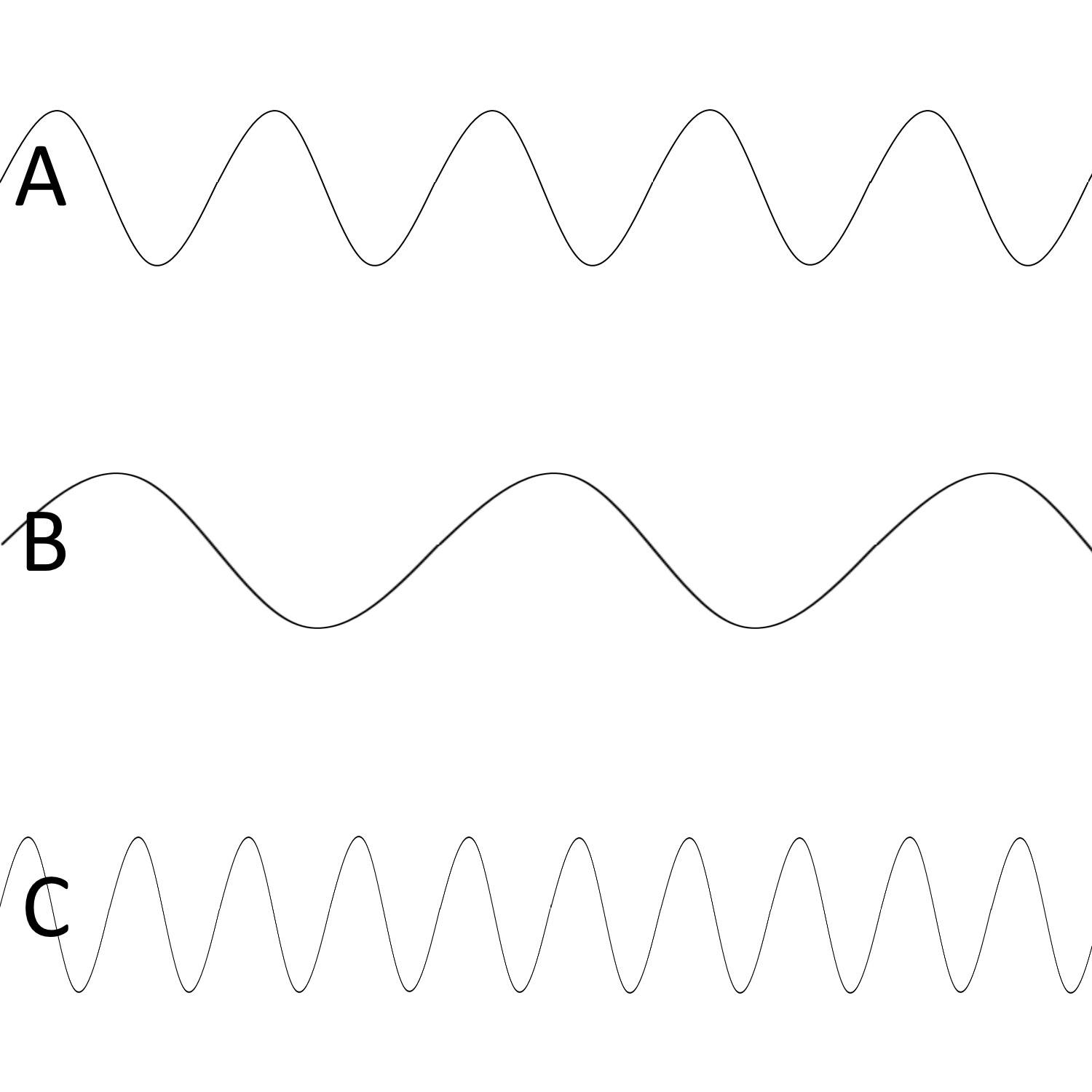
Which wave has the largest wavelength?

a)

A

b)

B

c)

C

d)

None (same wavelength)

10.

Which property determines the amount of energy for an ELECTROMAGNETIC wave?

a)

amplitude

b)

frequency

c)

particle size

d)

medium

11.
Wave with shortest wavelength
a)
UV
b)
radio waves
c)
gamma
d)
visible
12.

The complete range of electromagnetic waves placed in order of increasing is called the ______________.

a)

radar spectrum

b)

mechanical spectrum

c)

electromagnetic spectrum

d)

gamma spectrum

13.
Which type of light has the highest energy of this group?
a)
red
b)
yellow
c)
green
d)
blue
14.
The higher the frequency the ______ the energy. 
a)
higher
b)
lower
c)
neither, stays the same
15.
What do you have at 10^-8?
Wavelength Not Frequency
a)
Ultra Violet
b)
Visible
c)
Gamma Rays
d)
X-Ray