Font size
 Worksheets
Revision
Total questions: 53
Worksheet time: 32mins
Software is divided into two categories,________ and _______.
input and output
application and system
online and offline
Which of the following is NOT an example of Application software.


A computer keyboard is an example of system software.
True
False
Application software is commonly called "apps".
True
False
A person that is working on a computer is called the _______.
staff
user
player
Choose the 2 examples of Word Processing software.
MS Word
Google Chrome
Notepad
MS Excel
Choose 2 examples of Spreadsheet Software.
MS PowerPoint
MS Excel
Edge
Apple Numbers
Which is NOT an example of System software?
Games
Device drivers
Utilities
Operating Systems
Which of these are REGISTERS in the CPU? (Tick ALL that are correct)
Accumulator
ALU
Program Counter
Memory Address Register
Control Bus Register
Tick all options that happen in the FETCH CYCLE?
PC is incremented
The Instruction at the MAR address is read from RAM
The PC value is copied to the MAR
The instruction in the MAR is decoded
The value in the MDR is written to the address in the MAR.
Tick all options that happen in the DECODE CYCLE?
PC is incremented
The Instruction at the MAR address is read from RAM
The PC value is copied to the MAR
The instruction in the MAR is decoded by the CU
The value in the MDR is written to the address in the MAR.
Tick all options that happen in the EXECUTE CYCLE?
PC is incremented
The data at the MAR address is read from RAM
The ALU performs any calculations required on the ACC
The instruction in the MAR is decoded by the CU
The value in the MDR is written to the address in the MAR.
Accumulator
Stores the address of the next instruction in memory
Stores the address of where the next item will be fetched from
Stores data fetched from memory, or waiting to be stored in memory
Stores the result of arithmetic calculations
The Control Unit
Controls the flow of data around the CPU and also decodes instructions
Only controls the flow of data around the CPU
Only decodes instructions
Controls how much power is directed to all components within the computer
The Arithmetic Logic Unit (ALU)
Carries out numerical calculations and logical decisions
Calculates the different items of number data stored within the Accumulator and converts them into logical decisions
Calculates graphic data as they are only found within GPU units.
Calculates the flow of execution in a program and decodes instructions into small steps to be carried out by the program counter.
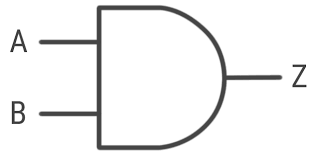
Which logic gate does this symbol represent?
AND
OR
NOT
IF
ELSE
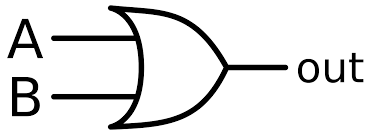
Which logic gate does this symbol represent?
AND
OR
NOT
IF
ELSE
What is the function of a NOT gate?
Inverts its input
Outputs 1 if both inputs are 1
Prevents errors
Outputs 0 if both inputs are 0
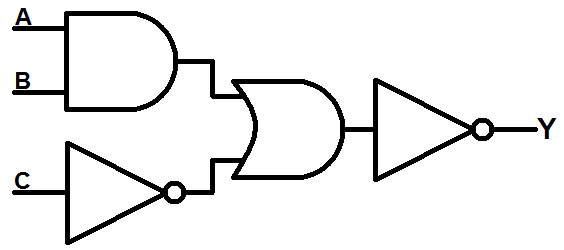
What is the output Y of this logic cricuit if A = 1, B = 1, and C = 1
0
1
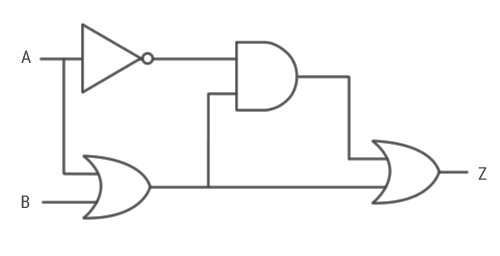
What is the output Z of this logic cricuit if A = 1 and B = 1
0
1


Assembly is a...
high level programming language
low level programming language
Most programming languages are...
High-level languages
Low-level languages
Machine code is a...
high level programming language
low level programming language
High level languages feature...
English-like keywords
Named subroutines
No variables names
Abbreviated command names
Machine code is written using...
Binary/hexadecimal
English-like key words
Plain English
Abbreviated mnemonic keywords
Assembly langauge is written using...
Binary/hexadecimal
English-like key words
Plain English
Abbreviated mnemonic keywords
Advantages of low-level languages include...
Direct access to the CPU
Programs written will often be more efficient than high-level programs
Easy to remember programming commands
Can use subroutines and advanced data structures
Assembly language is better than machine code because...
it is easier for humans to read
it is easier to remember the instructions
a person is less likely to make mistakes in assembly language
it is written using English-like keywords
Which of these are high-level languages?
Java
Assembly
Machine code
VB.NET
Python
What is a Data Flow Diagram (DFD)?
A DFD is a graphical representation of how data flows through a business information system
A DFD is a flow chart that represent how data flows in a system
A DFD is is a way to structure an organization using different levels of authority and a vertical link, or chain of command, between superior and subordinate levels of the organization
A DFD is a chart showing how data is handled
A DFD is a graphical representation of how data flows through a business information system

What is the data store symbol used to represent
The storage of data
The storage of processes
The storage of customers details
Manual or computer storage of data

The process symbol is used to represent
Customers queries in process
Shipping of goods in process
Manual or computer process that changes data
Sales negotiation in process

Which symbol is used to represent a process
First symbol shown
Second symbol shown
Both symbols can be used to represent a process
Both symbols can be used to represent a process
Both symbols can be used to represent a process

What is the external entity used for?
To show all the external works taking place outside the organisation
To represent source or destination of data that is external to the system
To represent all employees who work out on the field
To represent private event held
Does 'sink' means an external entity that takes information from the system?
Yes
No