
Font size
 Worksheets
Oceans and World Geography
Total questions: 57
Worksheet time: 2hrs 42mins

Almost three fourths of the Earth's surface is covered with ________?
continents
trees and living organisms
rivers and lakes
oceans

Which letter represents the Indian Ocean?
D
E
A
C
B

Which letter represents the Arctic Ocean?
C
A
D
B
E
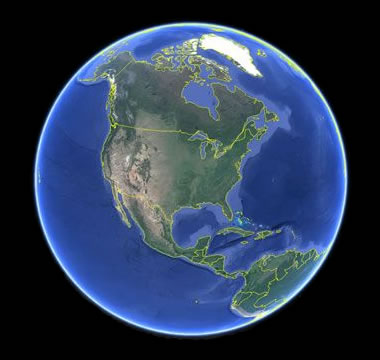
How many oceans are there on the Earth?
4
2
7
5
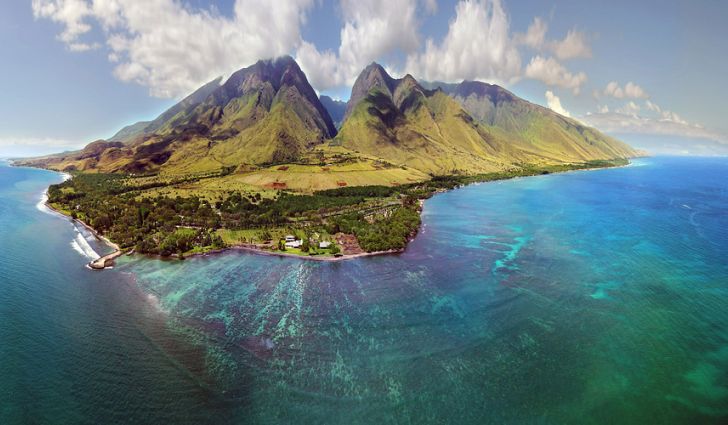
What is the largest ocean?
Pacific
Atlantic
Indian
Arctic
What are the oceans from biggest to smallest in size?
Atlantic, Pacific, Indian, Southern, Artic
Artic, Southern, Atlantic, Pacific, Indian
Pacific, Atlantic, Indian, Southern, Artic
Pacific, Atlantic, Southern, Indian, Artic

What ocean on average has the warmest temperature of all of the oceans on Earth?
Pacific
Atlantic
Indian
Southern
Artic
What ocean is near Antarctica.
Pacific
Atlantic
Indian
Southern
Artic
Flat, deep, and smooth part of the ocean floor. Cold temperatures are found here.
Continental Shelf
Abyssal Plain
Continental Slope
Seamounts
Which underwater ocean floor feature can be described as a steep hill that connects the continent to the ocean floor?
Abyssal Plain
Seamounts
Grand Canyon
Continental Slope
As you go from the continental shelf down the Continental Slope and arrive at the Abyssal Plain, the water temperature will get _____________
warmer
colder
As you go deeper in the water, what happens to the water pressure?
Nothing happens to the water pressure.
Water pressure gets less or lower.
Water pressure does not change.
Water pressure gets more or higher.


What do the arrows on the map represent?
size of waves
water weight
ocean currents
time between tides
Label all parts of the ocean floor correctly.
Mid Atlantic Ridge
Seamount
Continental Rise
Trench
Continental Slope
Abyssal Plain
Continental Shelf
Label the parts of the ocean floor.
abyssal plain
continental rise
trench
continental slope
continental shelf
Label the Ocean Floor Diagram!
Label the areas of the ocean floor
Trench
Continental Self
Continental Rise
Abyssal Plain
Continental Slope
Label the diagram appropriately
Continental shelf
Continental slope
Abyssal plain
Trench
Classify each of the following organisms: Clams
plankton
nekton
benthos
decomposer
Classify each of the following organisms: Dolphins
plankton
nekton
benthos
decomposer

Organisms that float and/or are carried by currents near the surface of the water
(a)
Organisms that swim through the water at various depths, without the aid of currents
Plankton
Nekton
Benthos
Organisms that live on the bottom of the ocean
Plankton
Nekton
Benthos
Describe the difference between plankton and nekton:
Corals are types of __________________.
plants
rocks
animals
algae
Which of the following is a way to protect coral reefs?
use poison and explosives to fish
follow laws and rules to keep reefs safe
keep them safe from storms and floods
eat more fish that try to live in corals
What is it called when coral turns white?
whitening
Coral Bleaching
Coral Blizzard
Coral Color Change
When one organism benefits and one is harmed.
Symbiosis
Mutualism
Parasitism
Commensalism
When both organism’s benefit.
Mutualism
Symbiosis
Commensalism
Parasitism
One organism benefits and one is neither harmed nor benefits.
Symbiosis
Parasitism
Mutualism
Commensalism
Remora and the shark: Remora fish are small fish that make their niche by picking up the scraps that sharks leave behind while feeding. The shark makes no attempt to prey on the remora fish. Which type of symbiosis is this?
Commensalism
Mutualism
Parasitism
Bee and the flower: Bees fly from flower to flower-gathering nectar, which they make into food. When
they land in a flower, the bees get some pollen on their hairy bodies, and when they land in the next flower, some of the pollen from the first one rubs off, pollinating the plant. Which symbiotic relationship is this?
Commensalism
Mutualism
Parasitism
Dog and the tick: Ticks live on dogs and feed off the dog’s blood. They may also infect the dog with a parasite that can cause the dog to become quite sick. Dogs also are sometimes found to be very tired because a large volume of their blood has been drained. Which type of symbiotic relationships is shown?
Mutualism
Commensalism
Parasitism
Hermit crabs and snails: Hermit crabs live in shells made and abandoned by snails.
Mutualism
Commensalism
Parasitism

Which symbiotic relationship is shown in the image?
Mutualism
Commensalism
Parasitism

Mutualism
Commensalism
Parasitism

Which symbiotic relationship is shown in the image?
Mutualism
Commensalism
Parasitism
The two most biodiverse places on earth is..
Tropical rainforests and Tundras
Open oceans and coral reefs
Tropical rainforests and Deciduous forests
Coral reefs and tropical rainforests
Sea-floor spreading begins at the
Deep ocean trench
Mid-ocean ridge
Continent's edge
The youngest seafloor crust is located...
Farthest from the mid-ocean ridges
Closest to the mid ocean ridges
Nearest the continents
On the land

What is occurring at the red arrows on the image.
Uplifting
Subduction
Mountain building
Erosion
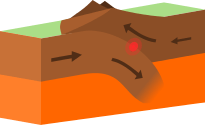

Undersea mountain chain where new ocean floor is produced at a divergent plate boundary is a ____________
seafloor spreading
deep ocean trench
Mid-ocean ridge
continental drift

Which body has the greater effect on Earth's tides?
Sun
Mars
Moon
Mercury
Tides are caused by
strong winds that blow over ocean waters.
the gravity of the moon and sun interacting with Earth.
the shifting of the tectonic plates on the ocean floor.
variations in the salinity of ocean water.

