
 Worksheets
Revision Ch 1 G 5
Total questions: 127
Worksheet time: 2hrs 42mins


Matter is anything that takes up a space and has a mass
True
False
Mass is :
amount of matter in an object
amount of space an object takes
Air is a matter
True
False
Elements are the basic ingredients that make up all other substances
True
False
Metals are shiny , reflective and have smooth surface
True
False
Non metals can conduct heat and electricity very well
True
False
Type of matter made of two or more elements
Compound
Molecule
Molecule is the smallest particle of a compound and still has the properties of a compound
True
False
Example of a compound :
Carbon
Oxygen
Carbon Dioxide
Example of an element :
Sodium chloride
Iron
Carbon Dioxide


which is not a metal
oxygen
aluminium
calcium
mercury
aluminium is commonly used in many industries because?
strong and heavy
strong and light
shiny and heavy
cheap and ligh
mercury is a liquid,,,,,,,,,,,,,,,,,,,,,
metal
non metal
compound
semi metal
The ....................determines what the element will be
electron
nucleus
nuetron
proton
which of the following is a compound?
water
oxygen
hydrogen
carbon
what are parts of atom
electron
neutron
proton
all of the above
The amount of matter in a solid, liquid, or gas
mass
volume
color
The .................. properties of a material can be observed, described, and measured without changing the material.
chemical
physical
mass
Mass can be measured by using a balance, often using units of .........
kilograms
milliliter
litter
grams
Volume can be measured by using a balance, often using units of .........
kilograms
milliliter
litter
grams
Mass can be measured by using units of .........
kilograms
milliliter
litter
grams
You can use a ............ to find the volume of a liquid.
a thermometer
a balance
a graduated cylinder
The temperature can be measured by ......
kilogram
milliliters
celcius
fahrenheit
________ the amount of space an object takes up
mass
volume
temperature
________ the amount of matter in a solid, liquid, or gas.
mass
volume
temperature
________ the measure of how fast the particles in an object are moving.
mass
volume
temperature
What do you use a balance and gram cubes to measure?
temperature
weight
mass
texture
Liquid in a graduated cylinder has a volume of 70 mL. You put a small solid ball into the cylinder, and the height of the liquid moves up to 80 mL. What is the volume of the ball?
10 ml
75 ml
80 ml
150 ml
You measure the temperature of water. One hour later you measure the temperature again, and the temperature is higher. What do you know about the particles in the water?
The number of particles has increased.
The number of particles has decreased.
The particles are moving slower.
The particles are moving faster.
The amount of matter in a solid, liquid, or gas
mass
volume
color
Does the mass of an object change when the object is moved to a different position?
(a)
How do you show that air has volume?
(a)
Why is it useful to have the right temperature in your freezer?
(a)
How would the texture of the stone change if it were cracked and scratched in several places?
(a)
Why might scientist measure the mass of an object rather than the weight of an object.
(a)
What do you know for certain about particles that make up a very hot liquid?
(a)

Molecules in a __________ have very little movement and the object keeps its shape and volume.
solid
liquid
gas
Does liquid have one solid shape
no
yes
maybe

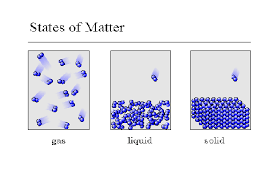
What happens when the speed of particles decreases?
Their temperature decreases
Their temperature increases
Their mass decreases
Their mass increases
Condensation involves a change of state from ___ to ___
Liquid to Solid
Liquid to Gaseous
Solid to Liquid
Gaseous to Liquid
Boiling involves a change of state from ___ to ___.
Solid to Liquid
Liquid to Gaseous
Gaseous to Liquid
Liquid to Solid
What factors affect the rate of evaporation?
Temperature only
Temperature and Wind only
Temperature, Wind and Exposed Surface Area
None of the above
Melting involves a change of state from ___ to ___
Gaseous to Liquid
Solid to Liquid
Liquid to Gaseous
Liquid to Solid
What type of matter has NO definite Shape and NO Definite Volume
Gas
Liquid
Solid
What type of matter has Definite SHAPE,a definite VOLUME, and the molecules are very close together?
Gas
Liquid
Solid
What type of matter has NO definite shape, has a definite VOLUME, and the molecules slide past each other as it flows?
Gas
Liquid
Solid
What do we call the change from a gas to a liquid? Think water vapor hitting a cold glass.
condensation
evaporation
melting
deposition
The opposite phase of melting is????
freezing
sublimation
condensation
deposition

Which state of matter has molecules that slide past each other but stay close together? They do not form a regular pattern.
solid
liquid
gas
The phase change from water vapor to liquid water is known as... (Think cold glass in summer)
evaporation
precipitation
condensation
sublimation
Condensation occurs when water vapor....
loses heat
gains heat
Boiling occurs when water ...
loses heat
gains heat

Steam rising from wet clothes while ironing them. This is an example of__________.
Evaporation
Condensation

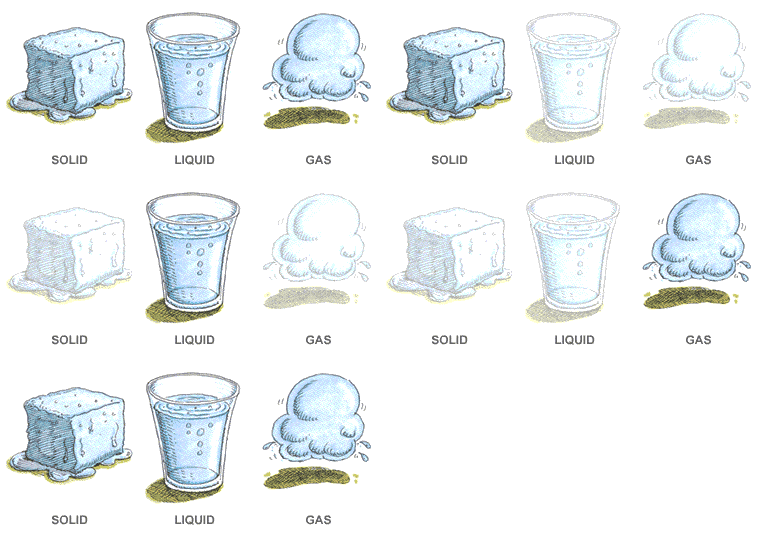
What happens when water mixes with sugar?
the appearance of sugar changes
the shape of water changes
the taste of sugar changes
the state of water changes
What are mixtures?
different materials placed together but keeping their own properties
a mixture in which substances spread out evenly and will not settle
the degree to which a material will dissolve in another substance
the substance in a solution that has the greatest amount
the substance in a solution that has the least amount
What is a solution?
different materials placed together but keeping their own properties
a mixture in which substances spread out evenly and will not settle
the degree to which a material will dissolve in another substance
the substance in a solution that has the greatest amount
the substance in a solution that has the least amount
What is solubility?
different materials placed together but keeping their own properties
a mixture in which substances spread out evenly and will not settle
the degree to which a material will dissolve in another substance
the substance in a solution that has the greatest amount
the substance in a solution that has the least amount
What is a solvent?
different materials placed together but keeping their own properties
a mixture in which substances spread out evenly and will not settle
the degree to which a material will dissolve in another substance
the substance in a solution that has the greatest amount
the substance in a solution that has the least amount
What is a solute?
different materials placed together but keeping their own properties
a mixture in which substances spread out evenly and will not settle
the degree to which a material will dissolve in another substance
the substance in a solution that has the greatest amount
the substance in a solution that has the least amount
Which process would you use to separate magnetic material from a mixture of other substances?
Chromatography
Magnetic Attraction
Filtration
Floatation
Sifting
Which process would you use to separate a solid that has dissolved in a liquid solution. The solution is heated or left uncovered until the liquid turns to gas and leave the solid behind.
Evaporation
Magnetic Attraction
Filtration
Floatation
Sifting
Which is an example of a mixture?
a salad
an orange
sand
nuts
Which is an example of a solution?
trail mix
cereal with milk and banannas
a bag of candy
tea
Which one of the following would you use to separate sand from iron filings?
a bar magnet
filter paper
hot plate
strainer
A Mixture is a combination of substances where the original substances keep their original properties
True
False
A solution is a special mixture formed when one substance is _____________evenly throughout the other.
Dissolved
Disappearing
Spread Out
Put
A tablespoon of a substance is added to warm water and stirred. The result was that the substance could no longer
be seen.
We can conclude from the results that the substance –
is less dense that water
heated the water
flavored the water
dissolved in water
Which physical property of salt would stay the same in a mixture of salt particles and water?
color
shape
size
taste

