
 Worksheets
Chapter 7 MUTATION
Total questions: 55
Worksheet time: 55mins
Mutation can ONLY be caused spontaneously.
True
Wrong
What is the term used to group X-rays, UV rays, colchicine and ethidium bromide?
(a)
Tick ALL examples of physical mutagens
X-ray
Gamma-ray
UV rays
Colchicine
Gene mutation usually occurs during:
DNA repair
DNA replication
Cell division
DNA transcription
A mutation in which only one nucleotide is altered is called a:
Frameshift Mutation
Deletion Mutation
Point Mutation
Insertion Mutation
When do random, or spontaneous, mutations happen?
During cell division
When cells are exposed to hazardous chemicals
When cells are exposed to certain viruses
When cells are exposed to radiation
Which effect of mutation occurs when there is an addition or removal of a base?
missense mutation
nonsense mutation
frameshift mutation
point mutation

What type of mutation is shown in the diagram?
Point mutation - missense
Frameshift Mutation - deletion
Frameshift Mutation - addition
Point mutation - nonsense
A type of mutation that affect every codon beyond the point of mutation.
Point Mutation
Silent Mutation
Nonsense Mutation
Frameshift Mutation

What type of mutation is this?
Nonsense mutation
Missense mutation
Silent mutation
Frameshift mutation
Which mutations would likely cause the greatest impact?
Inversion mutation
Frame-shift mutation
Silent mutation
Missense mutation
The original gene is ABCDEF. The new sequence of gene is AEDCBF. What is the type of chromosomal mutation occurred?
Insertion
Inversion
Deletion
Translocation
ATTTGAGCC- Original
ATTGAGCC - Mutated
The example above is an example of a
Insertion
Point mutation
Deletion
Substitution
Identify which of the following is a genetic mutation disease..
Common head cold
Cystic fibrosis
Heart attack
Chicken pox
Which of the following is an example of a beneficial mutation?
When an organism's lifespan becomes shorter.
When an organism becomes unable to reproduce.
When an organism's body becomes deformed.
When an organism develops immunity to a disease.
What mutation has occurred here?
T-G-A-C-C-A
T-G-A-G-C-A
Substitution
Deletion
Insertion
Frameshift
DNA molecule segment is : TTACGCAAG
The mutated DNA segment is TTACGCAAC. This is an example of ___ mutation.
Substitution
Insertion
Inversion
Translocation
ATT-TGA-GCC- Original
ATT-GAG-CC - Mutated
The example above is an example of a
Insertion- Frameshift
Deletion- Substitution
Deletion -Frameshift
All of the above
What type of gene mutation has occurred here? Normal-
AGA-TTC-ATA-GCG
Mutant-
AGA-TTC-AAT-AGC-G
deletion frameshift
insertion frameshift
substitution
nonsense
Why are insertion and deletion mutations so harmful?
They change all of the codons from the mutation on down the line, which changes the amino acid sequence
They insert things that an organism doesn't need.
They often delete things that organisms need.
Insertion and deletions are not any more harmful than substitution mutations.
T-G-A-C-C-A
T-G-A-G-C-A
Identify the SUBSTITUTION mutation form the following:
normal DNA: ATG CCA AAT
ATG TCA AAT
ATG CCT AAA T
ATC CA AT
ATG CCA AAT
ATG CCA AAT

Which of these are the effect if base substitution mutation? Tick all correct answers
Missense
Silence
Nonsense
Frameshift
If a nucleotide is substituted yet the amino acid produce is the same, the effect of mutation is ___________
silence
missense
nonsense
frameshift
If a nucleotide is substituted, and it change one amino acid to to another. This effect is called
Missense
Nonsense
Silence
Frameshist
In sickle-cell anemia..
Glutamic acid is substituted with valine on Beta-polypeptide chain
Valine is substituted with glutamic acid on Beta-polypeptide chain
Glutamic acid is substituted with valine on alpha-polypeptide chain
Valine is substituted with glutamic acid on alpha-polypeptide chain
The polypeptide produced is truncated and short. The most likely type of point mutation that causes this is
Base substitution - nonsense mutation
Base substitution - missense mutation
Insertion mutation
Inversion mutation
The insertion of a base pair into the genetic code will cause frameshift mutation, unless the number of the base pairs inserted is
one
two
three
four
A nonsense mutation
Usually results in the formation of an abnormally short polypeptide
causes one amino acid to be changed to another
caused by insertion mutation
resulted from deletion of one or two bases
A ________ is one of the DNA mutation that most likely be more damaging to the protein they specifies
codon deletion
codon substitution
synonymous base substitution
base pair deletion
A mutation that occurs in the gametes of an
organism will most likely be transferred to which of
the following?
The siblings of the organism
The offspring of the organism
The other organisms living nearby
The mating partner of the organism

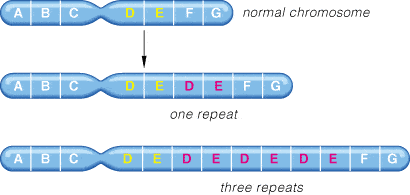

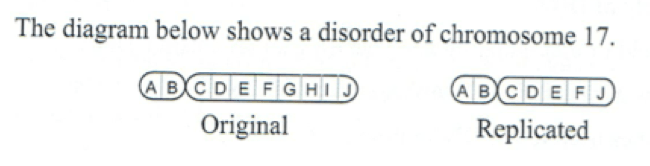
Inversion
When a segment of a chromosome breaks off.
When a segment of a chromosome breaks off, flips, and reattaches.
When a segment of a chromosome is copied or doubles.
When a segment of a chromosome breaks and attaches to a non homologous chromosome.
When entire chromosomes don't separate evenly during meiosis.
Nondisjunction
When a segment of a chromosome breaks off.
When a segment of a chromosome breaks off, flips, and reattaches.
When a segment of a chromosome is copied or doubles.
When a segment of a chromosome breaks and attaches to a non homologous chromosome.
When entire chromosomes don't separate evenly during meiosis.
Nondisjunction in Meiosis I is more deleterious than nondisjunction in Meiosis II
True
False


Trisomy 21suggests that an individual has
Three copies of chromosome 21
Twenty one copies of chromosome 3
Three pairs of chromosome 21
Two copies of chromosome 21


Why is nondisjunction in Meiosis I is more deleterious than nondisjunction in in Meiosis II?
All gametes formed are abnormal
75% of the gametes formed are abnormal
50% of the gametes formed are abnormal
25% of the gametes formed are normal
Nondisjunction of sex chromosomes may occur during meiosis I of spermatogenesis. Which of the following are the possible genotypes of the zygote if the normal ovum is fertilised by these two types of the sperms?
XXY and YO
XYY and YO
XXY and XO
XYY and XO
Which of the following is NOT an example of chromosomal mutations?
Substitution
Translocation
Inversion
Duplication
Which of the following is caused by deletion by a large part of short arm of chromosome 5?
Cri-Du-Chat
Thalassemia
Down syndrome
Sickle cell anaemia
Polyploidy refers to
Multiple ribosomes present on a single mRNA
a chromosome which has replicated but not divided
an individual with extra sets of chromosomes
extra copies of gene adjacent to each other on a chromosome
All these are TRUE about Turner syndrome, EXCEPT..
A disorder that affects female
The syndrome is known as Monosomy X
Affected individual has webbed neck
A disorder with an extra X chromosome
Which of the following statement about non-disjunction is FALSE?
May produce a polyploidy
Give rise to Turner and Klinefelter syndrome
Only happens during Anaphase I of meiosis
Give rise to abnormalities in the number of both sex chromosomes and autosomes.

