
 Worksheets
Middle Ages and Canterbury Tales
Total questions: 65
Worksheet time: 5hrs 25mins
What are the years of the Middle Ages period?
0-500 AD
449-1066 AD
1066-1485 AD
1500-present AD
The Canterbury Tales is a(n)…
extended metaphor
allegory
frame story
epic poem
What is the code of conduct where knights were virtuous Christians who fought selflessly?
Feudalism
Chivalry
Democracy
Bro Code
What is the name of the system where a king would give nobleman lands in exchange for his loyalty and service?
chivalry
feudalism
Event where knights would ride towards each other with blunted lances (long poles) in attempt to knock each other off of their horse
Joust
Chivalry
Squire
Page
Which Church official was the highest authority in the Church?
Bishop
Archbishop
Pope
Abbott

Which group was the second highest in the social hierarchy?
Knights
Serfs/Peasants
Kings/Queens
Lords/Ladies
Which group was the lowest in the social hierarchy?
Knights
Serfs/Peasants
Kings/Queens
Lords/Ladies
Who is known at the Father of English Poetry?
Beowulf
Geoffrey Chaucer
William Shakespeare
Burton Raffel
During this period of time, which type of English was spoken and written?
Early Modern English
Modern Engish
Middle English
Old English

What determined a person's power and wealth in the Middle Ages?
Gold
Land
Cash
Spices


Why might the Knight be dressed as he is?
He has just come from battle.
He's a slob.
He's poor.
He's no longer a knight and does not wear his armor anymore.
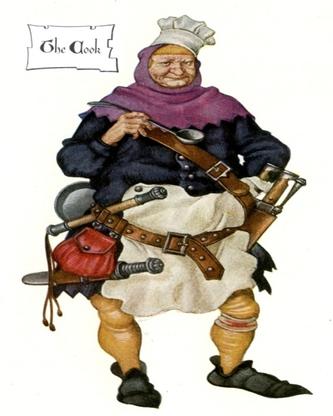
Which of the following best describes the cook?
very fancy dresser, always wanted to be first at the alter to give her offering, well-traveled, married 5 times
big, brawny, tells dirty tavern stories, he is strong and plays the bagpipes
has an oozing ulcer on his knee, questionable hygiene
very poor, ideal parish priest,well-educated

Which of the following best describes the Knight?
brave and strong
truthful
modest clothing
all of the above

Which of the following best describes the Friar?
bald and fat, has a preference for hunting and fine clothes, doesn't care for hard work
receives payment for others' confessions, marries off young women, takes money from widows
an expert woodsman, face "brown like a nut," carries peacock- feathered arrows
loud, probably less busy than he pretends to be, wise

Which of the following best describes the Merchant?
forked beard, very good at business, makes money at others' expense
loud, probably less busy than he pretends to be, wise
white beard, spends his money freely, well-liked by other pilgrims
has an oozing ulcer on his knee, questionable hygiene

Which of the following best describes the Clerk?
bald and fat, has a preference for fine clothes and luxuries, and doesn't care for hard work
very thin, only loves books, spends all his money on education
seems wise, made a lot of money as a lawyer, knew the law by rote, less busy than he seemed to be
an expert woodsman, face "brown like a nut," carries peacock- feathered arrows
In what month do the pilgrims begin their journey?
April
March
May
June

What can the reader infer about the Friar from these lines?
But anywhere a profit might accrue
Courteous he was and lowly of service too.
He helps other make money
He is humble and servile.
He has aspirations to be a merchant.
He will use people for money.
This pilgrim was an Oxford student who didn't say much, didn't have a job, and just loved learning for the sake of learning.
The Clerk
The Squire
The Franklin
The Prioress/Nun
He seemed wise. He made a lot of money. He seemed busier than he really was.
The Knight
The Squire
The Manciple
The Sergeant at the Law
He looked a little like Santa Claus. He liked to eat, drink, and be merry. He was a country gentleman with a dagger and a silk purse.
The Yeoman
The Franklin
The Host
The Pharmacist
He was from Dartmouth, didn't ride well, and was a good navigator. He had little conscience about killing the enemy, and seemed rather like a pirate.
The Miller
The Knight
The Reeve
The Shipman
This pilgrim was large and somewhat deaf, had a red complexion, wore a wide hat and spurs and had been married several times.
The Host
The Cook
The Wife of Bath
The Shipman
This pilgrim was truly Christ-like; patient, giving, holy and virtuous, and didn't believe in pomp or glory. He practiced what he preached.
The Monk
The Friar
The Parson
The Pardoner
He was the Parson's brother. He was an honest worker who paid his taxes on time.
The Reeve
The Plowman
The Shipman
The Haberdasher
He was old, choleric, and thin. He was a good manager and a good carpenter, feared by the farm workers. He usually brought up the rear of the party, lagging behind.
The Pardoner
The Friar
The Squire
The Reeve
He had a red face full of sores. He ate onions and drank too much. He would take bribes, had a garland of flowers on his head, and held a cake like a shield.
The Summoner
The Cook
The Haberdasher
The Miller
This pilgrim sang in a strong voice, had long, yellow hair, bulging eyes, was baby-faced and carried a bunch of false relics to sell.
The Friar
The Monk
The Pardoner
The Prioress/Nun


Which of the following best describes the squire?
expert woodsman, strong, and loyal
would rather be hunting, loves the outdoors, big sparkly eyeballs
very thin, only loves books, spends all his money on education
A courteous 20-something "lover and cadet, a lad of fire" who can sing, dance, joust, draw, etc

Which of the following best describes the Yeoman?
loud, less busy than he seemed to be, well-spoken, and very wise
This "proper forester" is well-armed & "his head was like a nut, his face was brown"
very thin, only loves books, spends all his money on education
forking beard, very knowledgeable, money management is his downfall
The member of the aristocracy who is portrayed as a perfect example of chivalry. He has just returned from The Crusades and is dressed plainly.
The Pardoner
The Summoner
The Knight
The Monk
This pilgrim sells fake artifacts and makes "monkeys of the priest and congregation."
Summoner
Friar
Pardoner
Monk
In The Canterbury Tales the Skipper is the character that ...
the author considered a "proper forester" with a longbow and a face as brown as a nut
made his prisoners walk the plank on his ship
is a great hunter who used horses and greyhounds to bag his prey
is both an author and a pilgrim
The author describes the activities of the Friar with the lines, "...nothing good can come/ Of commerce with such slum-and gutter-dwellers." Which answer interprets Chaucer's feelings on the Friar's character the best?
The Friar is a really lazy guy.
The Friar is very careless.
The Friar doesn't like being dirty.
That the Friar is a snob only out for money.
Which person does the narrator seem to dislike most?
Sergeant at Law
Oxford Cleric
Knight
Monk
Who is the "best" character out of the ones listed below?
The Wife of Bath
The Summoner
The Nun
The Plowman
Who is the "worst" character out of the ones listed below?
The Squire
The Yeoman
The Franklin
The Pardoner

