
NEW
Font size
 Worksheets
5470 - Newton's Second Law
Total questions: 20
Worksheet time: 10mins

Which is the equation for net force on this box?
Fnet = (F1+F2)/a
Fnet = F1 - F2
Fnet = F1*F2
Fnet = F1 + F2

This block is started from rest. Which pair of graphs best demonstrates the motion that would result from this net force?


A shopping cart is pushed frictionlessly such that its acceleration is a. If the net force on the cart doubled, then
a would be 1/2 of its original value.
a would be equal to its original value.
a would be twice as large as its original value.
a would 22 = 4 times as large as its original value.
A shopping cart is pushed frictionlessly such that its acceleration is a. If more items were added to the cart so its mass doubled, then
a would be 1/2 of its original value.
a would be equal to its original value.
a would be twice as large as its original value.
a would 22 = 4 times as large as its original value.
A bowling ball is dropped from rest inside a vacuum chamber such that there is no air resistance. The ball falls with an acceleration of a. If the mass of the ball doubled, how would the acceleration change?
The acceleration would double to 2a.
The acceleration would stay the same a.
The acceleration would decrease to 1/2 a.
Not enough information

The net force in this case is
-2 N left
12 N right
16 N right
FN depends on the mass of the block
In order to calculate the acceleration, a, in this scenario, you would need
no other quantities - you have all the info needed to calculate a.
the mass only
the net force only
the mass and normal force
A person with a weight of 650N stands in an elevator on a scale. Calculate the approximate mass of the person.
Depends on the acceleration of the elevator.
6.5 kg
65 kg
650 kg
A person with a weight of 650N stands in an elevator on a scale. In which picture, if any, does the scale have a reading of 0 Newtons?


None, the scale always reads something because the Fg of a person is never zero near the surface of the Earth.

A student pulls a box across a table until it starts moving and then pulls at a constant velocity yielding the graph, right. Identify the kinetic friction force.
3 N
5 N
6 N
8 N
A student pulls a box across a table until it starts moving and then pulls at a constant velocity yielding the graph, right. Identify the maximum static friction force at the threshold of motion.
3 N
5 N
6 N
8 N
A student pulls a box across a table until it starts moving and then pulls at a constant velocity yielding the graph, right. If an applied force of 8N now acts on the box. What is the resultant motion?
Accelerates left
Remains stationary
Constant velocity right
Accelerates right

You're studying a skier as they slide down a slope. Which coefficient would you use?
0.05
0.14
0.15
0.30
The skier has a mass of 50kg and a coefficient of kinetic friction of 0.05. Which of the following steps would you need to take in order to calculate the friction force on the skier? Calculate the...
mass of the skier in grams
speed of the skier in m/s
weight of the skier in N
surface area of the skis in m2
A 500N skier coasts across a flat surface with a coefficient of kinetic friction of 0.05. Calculate the force of friction.
2.5 N
25 N
250 N
2,500 N
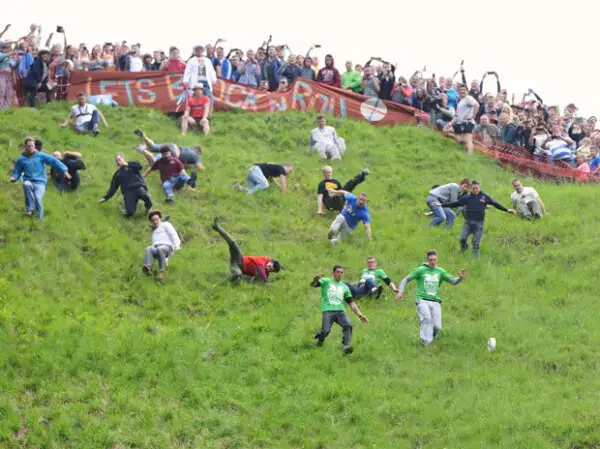
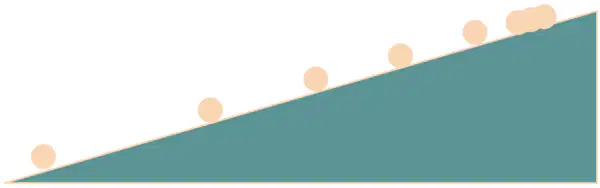
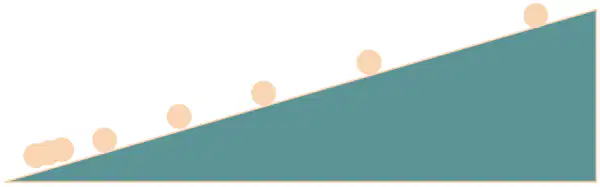
The Cooper Hill Cheese-Rolling is an event in Gloucestershire that has competitors chase a wheel of cheese down a hill. Which of the following best shows the dot diagram of a cheese on a hill starting from rest?

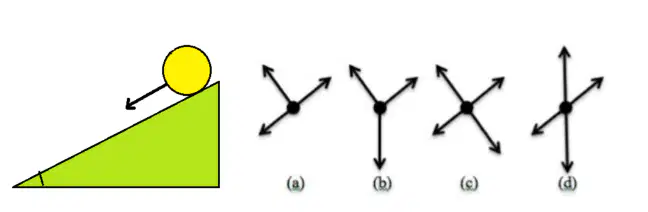
The cheese wheel has friction so that it travels at constant velocity downhill. Which free body diagram best shows the forces acting on the cheese wheel?
a
b
c
d

A cheese wheel has a mass m and is on a hill of incline angle theta. Which could be used to calculate the normal force acting on the cheese wheel?
Fg = mg
Fgx = mg sin(theta)
Fgy = mg cos(theta)
There is no normal force while the cheese rolls down hill.
If the angle of the hill were even steeper, which change would occur?
The acceleration of the cheese would decrease.
The normal force acting on the cheese would decrease.
The weight of the cheese would increase.
The mass of cheese would increase.
If the mass of the cheese doubled but the incline stayed at a fixed angle theta, would the acceleration of the cheese change?
The acceleration of the cheese would double to 2a.
The acceleration, a, of the cheese would not change.
The acceleration of the cheese would decrease to 1/2 a.

