
 Worksheets
Honors Quiz Covalents (No Network)
Total questions: 34
Worksheet time: 3hrs 50mins
What is the chemical formula for dinitrogen heptachloride?
N2Cl7
2N7Cl
2NCl7
N2Cl5
Which of these is NOT an exception to the octet rule when drawing Lewis dot structures?
stable with less than 8 electrons
odd number of electrons
expanded octet
double octet
Which of these is NOT a polar molecule?


Which of the following is the weakest bond?
Single
Double
Ionic
Triple


Which of the following is the correct LD Diagram for Hydrogen Cyanide, HCN?
A
B
C
D

Which of the following has T-shape molecular geometry?


XeF4 is a square planar. It has
4 bonding pairs
6 bonding pairs
4 bonding pairs with 2 lone pairs
5 bonding pairs with 1 lone pair
What is the hybridization of Xe in XeF4
sp
sp3d
sp
sp3d2
A double bond consists of...
1σ & 1π bonds
1π & 2σ bonds
2π bonds
2σ bonds

How many pi bonds are in the following molecule?
0
5
2
3
Give the formula: tetraphosphorus nonasulfide
P4S9
P9S4
P2S3
P4NS
When dissolved in water, the solution is a poor conductor of electricity.
ionic compounds
covalent compounds
A single covalent bond is made up of _____ electrons.
one
two
three
four
In the nitrite ion (NO2-), __________.
both bonds are single bonds
both bonds are double bonds
both bonds are the same because of resonance
there are 20 valence electrons
there is one single and one double bond
A valid Lewis structure of _______ cannot be drawn without violating the octet rule.
NF3
IF3
PF3
SbF3
SO42-
Which atom can accommodate an octet of electrons, but doesn't necessarily have to accommodate an octet?
N
C
H
O
B
As the number of covalent bonds between two atoms increases, the distance between the atoms ______ and the strength of the bond between them ______.
increases, increases
decreases, decreases
increases, decreases
decreases, increases
is unpredictable
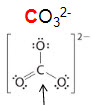
The Lewis structure of the CO32- ion is


non-polar

WHat is the shape of this molecule?
Bent
Linear
Tetrahedral
Pyramidal
Trigonal Planar
Molecules:
have covalent bonds and are always polar
have covalent bonds and are always non-polar
have covalent bonds and can be polar or non-polar
have ionic bonds and are always polar

Why do simple molecular substances have low melting and boiling points?
The intermolecular forces between simple molecules are weak.
The covalent bonds holding the atoms together in a simple molecule are strong.
A large number of covalent bonds hold the atoms together in simple molecules.
What is the difference between a polar covalent bond and a nonpolar covalent bond?
The difference between a polar covalent bond and a nonpolar covalent bond is the unequal sharing of electrons and the resulting charge separation in a polar covalent bond.
A nonpolar covalent bond occurs when electrons are completely transferred from one atom to another.
A polar covalent bond involves the sharing of electrons between two atoms of the same element.
A polar covalent bond is stronger than a nonpolar covalent bond.

