
Font size
 Worksheets
Food Chains and Food webs-Test
Total questions: 30
Worksheet time: 30mins

What would happen if there were no thrush in the model above?
there would be more insects and slugs
there would be less insects and sluga
there would be more voles
there would be more hawks
What do decomposers do in a food chain?
they are the first part of a food chain that feeds all of the other organisms
they break down all other organisms to provide nutrients for the soil to help the producers
they serve as food for the consumers

In the food web modeled above, where does the flow of energy end?
mangoes and flowers
flowers and frogs
eagle since nothing else in the web gets energy from the eagle
python and wolf
What type of ecological pyramid is never inverted?
ecological pyramid
energy pyramid
numbers pyramid
biomass pyramid
An organism that must consume other organisms for nutrients is called a(n)
(a)
A path showing the flow of energy from the Sun to a producer and through different levels of consumers is called a(n)
(a)
What is the name of the organism which eats primary consumers?
Tertiary Consumers
Secondary Consumers
Quaternary Consumers
Top Predators

An organism that transforms energy from the Sun and uses carbon dioxide and water to make food is called a(n)
(a)
An animal that eats tertiary consumers is named a(n)
(a)

Look at the blank Energy Pyramid. Which Trophic Level is where we would find the Tertiary Consumers?
The bottom level
The second from the bottom level
The top level
The second from the top level
Overlapping food chains with different pathways to show the flow of energy in an ecosystem is known as a(n)
(a)
The arrows in a food chain or web represent what?
They point to the organism that is being eaten.
It shows how sunlight flows within an ecosystem.
They show what direction the energy is flowing between organisms.
They represent how water is transferred within a habitat.
How many calories (kcal) will be passed on from 2,587 kcal to the next trophic level?
2,587.0
258.7
25.87
10%

In this food chain, what is the secondary consumer?
Plants
Freshwater Shrimp
Minnow
Perch
Pike
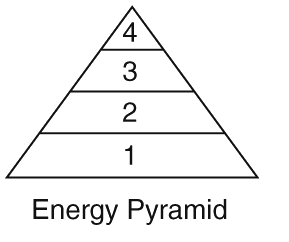
Which section of the pyramid has the least energy?
1
2
3
4
If a primary consumers have 650 kcals of energy available to them in the producers they eat, how many kcals of energy make it into the primary consumer trophic level?
6.5
65000
650
65

Which chart correctly shows three of the organisms according to their roles in cycling matter in the marine food web?


What does a Pyramid of Biomass consists of?
the amount of mass/weight of organisms at each trophic level
the amount of energy available at each trophic level
the amount of mass/weight consumed at each trophic level
the amount of individuals at each trophic level

Grizzly bears eat seeds, berries, roots, grasses, fungi, deer, elk, fish, and insects. This would make them a(n)...
Detritivore
Carnivore
Herbivore
Omnivore

Consider the following food chain in the ocean:
phytoplankton --> zooplankton --> herring --> salmon
If the phytoplankton produce 40 000 000 kJ of energy per day, how much energy is available to the salmon?
400 000 kJ
40 000 kJ
4 000 000 kJ
4 000 kJ

Which energy pyramid best represents the data in the table?


Bacteria, fungi, and earthworms are examples of:
scavengers
carnivores
decomposers
microorganisms

Vultures, which feed on the remains of dead organisms, are best described as _____________.
primary consumers
scavengers
omnivores
herbivores

TRUE or FALSE: The arrow in a food chain can point in any direction as long as it is pointing on an organism?
FALSE
TRUE

Which of these is a possible food chain for this environment?
Fruit tree→ fly → frog→ cat
frog → fly → grass → grasshopper
Sun ← fruit tree ← fly ← frog ← cat
Sun → fly → frog → snake

