wayground logo

Free Printable Worksheets

NEW

Font size

S
M
L
XL
Worksheets

Light and sound

Total questions: 33

Worksheet time: 22mins

Name
Class
Date
1.
Waves transfer
a)
water. 
b)
wind. 
c)
energy. 
d)
particles. 
2.
Sound travels as a ___________ wave. 
a)
longitudinal
b)
transverse
c)
water
d)
slinky
3.
How high or low a sound is, is that sound's
a)
wave. 
b)
pitch. 
c)
longitude. 
d)
amplitude. 
4.
If you see an object as orange,
a)
it is absorbing orange light and reflecting all other colors. 
b)
it is reflecting all colors. 
c)
it is absorbing all colors. 
d)
it is reflecting orange light and absorbing all other colors. 
5.
Sound waves are ___________ waves that can only travel through ______.
a)
transverse,   air
b)
transverse, matter
c)
longitudinal, liquids
d)
longitudinal, matter
6.
A sound wave can travel through a vacuum or empty space.
a)
True
b)
False
7.
How loud or soft people hear a sound is related to the _________ of the sound wave.
a)
amplitude
b)
longitude
c)
echo
d)
lens
8.
The distance from one point on a wave to that same point on the next wave is known as
a)
amplitude.
b)
frequency.
c)
wavelength.
d)
reflection.
9.
Wave frequency is measured in the unit of 
a)
hertz.
b)
pings.
c)
clicks.
d)
tones.
10.

Sounds are created by

a)

vibrating particles

b)

waves

c)

air

d)

electricity

11.

When light bounces off an object this is known as a

a)

Refreaction

b)

Absorption

c)

Reflection

d)

Electromagnetic Spectrum

12.

Refraction occurs in glass when

a)

Light bends towards the normal

b)

Light bends away from the normal

13.

The Compression part of a sound wave is when

a)

The particles are closer together

b)

The particles are spread apart

c)

The particles are moving faster

d)

The particles are moving slower

14.

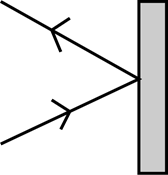
Which ray represents the angle of reflection

a)

1

b)

2

c)

3

d)

4

15.

The "Normal" is always represented on an angle of __________ to the surface of the object

a)

45

b)

90

c)

180

d)

360

16.

A sound that has more waves closer together means it has a higher

a)

Frequency

b)

Pitch

c)

Sound

d)

Amplitude

17.

When light bends this is known as

a)

Refraction

b)

Reflection

c)

Incidents

d)

Impossible to bend light

18.

Which of the following objects would transport sound the fastest

a)

Steel

b)

Wool

c)

Air

d)

Water

19.
Which way of communicating will NOT work for astronauts in outer space?
a)
ringing a bell
b)
flashing a light
c)
using a radio
d)
waving a hand
20.
Which diagram of a sound wave represents the sound with the highest pitch?
a)
A
b)
B
c)
C
d)
D
21.
What causes sound?
a)
something vibrating
b)
a part of a car
c)
an object moving through the air
d)
light energy
22.
The distance between the line of origin to the top of the wave is called
a)
amplitude
b)
wavelength
c)
frequency
d)
speed
23.
True or false: The angle of incidence equals the angle of reflection.
a)
True
b)
false
24.
What is frequency?
a)
the number of vibrations per second
b)
how high or low a sound is
c)
the loudness or softness of a sound
d)
the back and forth movement of matter
25.

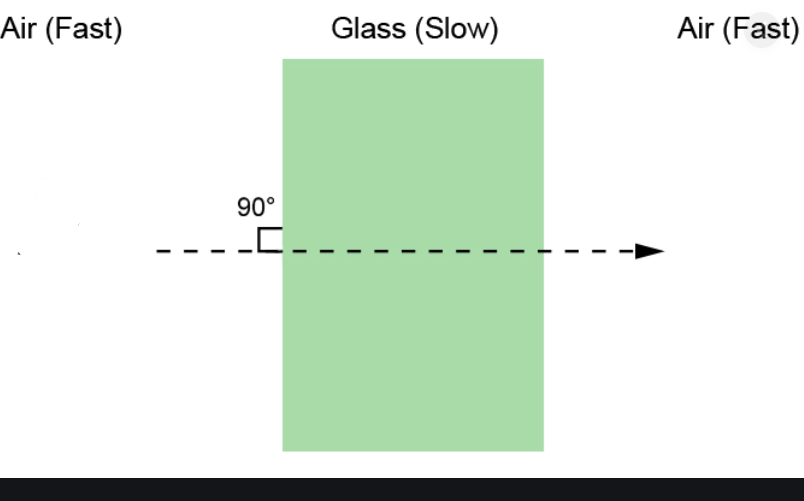
Based on the image, as light passes from medium 1 to medium 2

a)

light speeds up and bends towards the normal

b)

light speeds up and bends away from the normal

c)

light slows down and bends towards the normal

d)

light slows down and bends away from the normal

26.

What do we call a material that light can travel through?

a)

air

b)

water

c)

medium

d)

pathway

27.
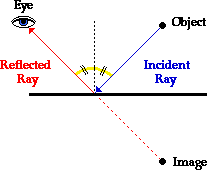
The illustration shows a light ray striking an object.
In the illustration, the light ray striking the object is-
a)
absorbed
b)
stopped
c)
reflected
d)
refracted
28.

What is the angle of reflection equal to?

a)

The angle of refraction

b)

The angle of incidence

c)

The angle of absorption

d)

The angle of light

29.

What is the angle of incidence?

a)

The angle at which light bends in water.

b)

The angle at which light hits a surface.

c)

The angle at which light is absorbed by an object.

d)

The angle at which light bounces off a surface.

30.

A beam of light bends when it passes from air into water, and more when it passes from water into glass. What can you conclude from this fact?

a)

Air is denser than glass

b)

Water is denser than glass

c)

Glass is denser than water

d)

Air is denser than water

31.

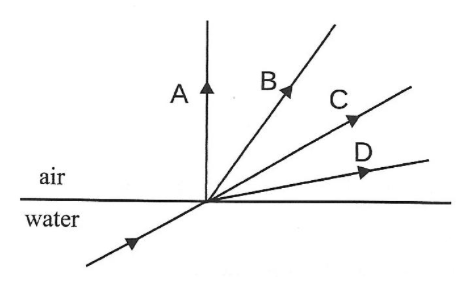
A light ray is incident from water to air. Which of the refracted rays is correct?

a)

A

b)

B

c)

C

d)

D

32.
Density is...
a)
the amount of mass in an object
b)
the amount of space an object takes up
c)
the amount of mass in a given space
d)
the weight of an object
33.

The line 90 degress through the refracting or reflecting surface is called?

a)

Medium

b)

Normal

c)

Incidence

d)

Reflection