
 Worksheets
Topic 2: 9th Grade US History- Industrial Revolution
Total questions: 55
Worksheet time: 1hrs 25mins
"Meanwhile they live in a place of infernal dins. The crash and thunder of the machinery is like the roar of an immense cataract. The room shrieks and blares and bellows. Down in the midst of it sit these tiny urchins, where they earn fifty-five cents a day each. They breathe this atmosphere until their lungs grow heavy and sick with it. But they are uncowed; they continue to swagger. And at the top of the 'breaker' laborers can always be seen dumping the roaring coal down the wide, voracious maw of the creature."—Stephen Crane, "In the Depths of a Coal Mine," 1894
Crane describes young coal miners as mistreated but nonetheless...
happy
healthy
proud
satisfied
"This, then, is held to be the duty of the man of Wealth: First, to set an example of modest, unostentatious living, shunning display or extravagance; to provide moderately for the legitimate wants of those dependent upon him; and after doing so to consider all surplus revenues which come to him simply as trust funds, which he is called upon to administer, and strictly bound as a matter of duty to administer in the manner which, in his judgment, is best calculated to produce the most beneficial result for the community—the man of wealth thus becoming the sole agent and trustee for his poorer brethren, bringing to their service his superior wisdom, experience, and ability to administer—doing for them better than they would or could do for themselves."—Andrew Carnegie, "Wealth," 1889
What is Carnegie's message in the text above?
People who are wealthy deserve the money that they have.
It is the responsibility of wealthy people to give back to society.
Regardless of social class, everyone should accept their place in society.
America is a land of opportunity, where anyone can work to make a fortune.
How did business leaders in the late nineteenth century utilize vertical integration?
They maintained control of production and distribution of their products.
They maintained control of the raw materials necessary for their products.
They allowed market forces to dictate how their products were distributed
They delegated responsibility for production and distribution to subsidiaries.
"All charges made for any service rendered or to be rendered in the transportation of passengers or property as aforesaid, or in connection therewith, or for the receiving, delivering, storage, or handling of such property, shall be reasonable and just; and every unjust and unreasonable charge for such service is prohibited and declared to be unlawful."—Interstate Commerce Act, 1887
What did the Interstate Commerce Act do?
A.It controlled the railroads' transactions.
B.It broke up all remaining railroad trusts.
C.It monitored the rates charged by railroads.
D.It regulated all railroads in the United States.
"Ten dollars a week was to him a fortune. . . . Indeed, he would have been glad, only the day before, to get a place at three dollars a week. . . . Then he was to be advanced if he deserved it. It was indeed a bright prospect for a boy who, only a year before, could neither read nor write. . . . Dick's great ambition to "grow up ‘spectable" seemed likely to be accomplished after all."—Horatio Alger, 1868
The works of Horatio Alger promoted the idea that--
A.life in the cities was preferable to rural life B.workers were being exploited by industrialists C.anyone could become successful with hard work D.children in the workforce deserved better treatment
A.life in the cities was preferable to rural life
B.workers were being exploited by industrialists
C.anyone could become successful with hard work
D.children in the workforce deserved better treatment
"[Rockefeller's company] killed its rivals, in brief, by getting the great trunk lines to refuse to give them transportation. Vanderbilt is reported to have said that there was but one man—Rockefeller—who could dictate to him."—H. D. Lloyd, The Atlantic, 1881
In this text, Lloyd describes how John D. Rockefeller built an oil-
A.cartel
B.corporation
C.monopoly
D.trust
"We recognize that peaceful industry is necessary to successful civilized life, but the right to strike and the preparation to strike is the greatest preventive to strikes. If the workmen were to make up their minds tomorrow that they would under no circumstances strike, the employers would do all the striking for them in the way of lesser wages, and longer hours of labor."—Report on the (U.S.) Industrial Commission on Capital and Labor, 1890
In this report, Samuel Gompers is explaining the need for
A.unions. B.pensions. C.wage labor. D.freedom of contract.
A.unions.
B.pensions.
C.wage labor.
D.freedom of contract.
"Go into any of the ‘respectable' tenement neighborhoods . . . you shall come away agreeing [that] . . . life there does not seem worth living. . . . [T]he airshaft. . . . seems always so busy letting out foul stenches . . . that it has no time to earn its name by bringing down fresh air. . . ."—Jacob Riis, How the Other Half Lives
In this paragraph, Riis drew attention to the
A.political conditions in large cities. B.economic conditions in large cities. C.living conditions of the urban poor. D.working conditions of urban workers.
A.political conditions in large cities.
B.economic conditions in large cities.
C.living conditions of the urban poor.
D.working conditions of urban workers.
"When Rockefeller founded Standard Oil, kerosene was 30 cents a gallon. Twenty years later, Rockefeller had almost a 90 percent market share and kerosene was only eight cents a gallon. Customers were the real winners here, because Rockefeller's size allowed him to cut costs. . . ."—Historian Burton W. Folsom, Jr.
Folsom would be most likely to call John D. Rockefeller a
A.carpetbagger. B.robber baron. C.philanthropist. D.captain of industry.
A.carpetbagger.
B.robber baron.
C.philanthropist.
D.captain of industry.
One major reason for the growth in urbanization between 1860 and 1900 was that
A.politicians in major cities demanded fair working conditions for all laborers.
B.the upper-middle class was prosperous and able to afford city dwellings.
C.many new immigrants were unable to find work on Midwestern farms.
D.many factory jobs were located in cities near transportation routes.

According to the information on this map, if a train station in Cheyenne's clock reads 10:00, it would be 12:00 at a train station in
Fargo.
Las Vegas.
Memphis.
Richmond.

Between 1861 and 1870, Scottish people accounted for approximately what percent of immigrants to the United States from the British Isles?
A.5 percent
B.10 percent
C.15 percent
D.20 percent
What was the main reason for the drop in cotton prices between 1865 and 1890?
A.Other crops became more popular in the textile industry.
B.The boll weevil decimated the southern states' cotton supply.
C.The southern states could not export as much cotton to the North.
D.Mills in Europe found cheaper sources for cotton.
What did Alexander Graham Bell's most famous invention contribute to life in the late 1800s?
A.His invention opened up a new entertainment industry.
B.His invention were among the first products advertised in catalogs.
C.His invention created a better way to communicate with transatlantic ocean liners.
D.His invention helped make communication between households and businesses more efficient.

Which point of view about business leaders is the artist most likely communicating?
A.Business leaders have too much control over their industries.
B.Business leaders are working together in suspicious ways.
C.Trusts have exploited the common people.
D.The laws governing trusts are not strict enough.

To which industry in the late 1800s does this political cartoon allude?
A. agriculture
B. journalism
C. music
D. steel
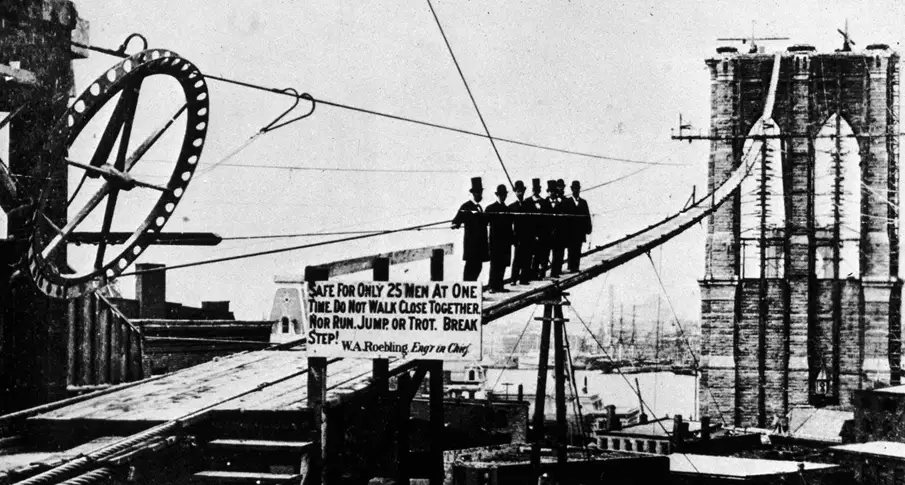
How does this photo of the Brooklyn Bridge reflect the technological innovations of the late nineteenth century?
A.Concrete was needed for the bridge's frame.
B.Steel was a necessary component for the construction.
C.Steam engines were integral to the building of the bridge.
D.Hydroelectric power helped raise heavy materials during construction
How did the Haymarket Riot hurt the labor movement?
A.Key labor leaders were injured in the riot.
B.Many Americans came to believe that union members were violent anarchists.
C.Union members became afraid to strike following the violence.
D.The fires started in the riot destroyed much of Chicago's industrial base.

In the nineteenth century, tenements such as this were examples of
A.demographic shifts from urban to rural areas.
B.how foreign policies affected economic issues in cities.
C.the social issues affecting rural development.
D.the social issues affecting urbanization.
How did the U.S. government encourage American industry in the late nineteenth century?
A.by enforcing the Fourteenth Amendment
B.by enacting protective tariffs
C.by subsidizing the steel industry
D.by passing laws to protect workers
Admittance into the United States through Ellis Island was largely dependent on
A.the validity of the immigrant's stateside sponsor.
B.the immigrant's social standing in his or her home country.
C.the applicability of vocational skills the immigrant possesses.
D.how many children for whom the immigrant was seeking citizenship.
The Knights of Labor was formed with the goal of
A.broad social reform for laborers.
B.helping immigrant workers find jobs.
C.raising money to overthrow large factories.
D.promoting capitalism among skilled workers.
Which immigrant to the United States played an influential role in labor issues in the nineteenth century?
A.Leo Baekeland
B.Mary Harris Jones
C.James Naismith
D.Nikola Tesla
What was one advantage of urbanization for poor workers who migrated to cities in the late nineteenth century?
A.They had access to sufficient healthcare. B.They had access to electricity and other technologies. C.They were better able to provide their children with educational opportunities. D.They earned wages that enabled them to have a higher standard of living.
A.They had access to sufficient healthcare.
B.They had access to electricity and other technologies.
C.They were better able to provide their children with educational opportunities.
D.They earned wages that enabled them to have a higher standard of living.
John Wanamaker changed consumer culture by
A.selling branded merchandise.
B.opening the first department store.
C.offering free delivery to rural areas.
D.buying advertisements in newspapers.
Which of the following was NOT a significant natural resource that fueled industrial growth in the United States after the Civil War?
The Civil War hindered industrial growth in the United States.
True or False: Entrepreneurs played a minor role in the industrialization of the United States.
Protective tariffs were designed to:
Protect local industries from foreign competition and encourage people to buy domestic.
Laissez-faire economic policies generally favor:
Which of the following inventions is NOT credited to Thomas Edison?
True or False: George Westinghouse's work made it possible to transmit electricity over long distances.
Mass production is best described as:
After the Civil War, the industrial growth of the South was generally:
A major challenge faced by the South in its industrial development after the Civil War was a lack of:
True or False: Corporations are a form of business ownership where a single individual holds all the responsibility and profits.
A monopoly occurs when a company has:
Complete control over a particular product or service.
Horizontal integration involves:
Combining many firms in the same business.
The Sherman Antitrust Act of 1890 aimed to:
Prevent monopolies and promote competition and outlaw trusts
Which of the following was a primary goal of early labor unions in the United States?
Which group made up many of the new immigrants who arrived in the United States in the 1870s?
Which of the following is an example of a push factor that caused people to leave their homelands?
War and persecution
What was Ellis Island primarily used for beginning in 1892?
Immigration station or processing station
Research facility for new technology from other countries
Military base for defense
Why did Congress pass the Chinese Exclusion Act of 1882?
How did immigrants contribute to American society despite facing challenges?
Immigrants contributed to American society by filling labor shortages.
What was a major reason many people moved from rural areas to cities in the late 1800s?
Farming jobs were difficault
Which invention made skyscrapers practical in American cities?
What was the main purpose of mass transit systems like streetcars and subways?
Who was hired to design New York City’s Central Park and other urban parks?
What was one major problem of tenement housing in growing cities?
What did Mark Twain mean when he described American society in the late 1800s as “gilded”?
Which development made it easier for rural Americans to shop for goods in the late 1800s?
What was one way that newspapers shaped American mass culture?
They reflected popular culture and stirred up public debate
Which type of entertainment was made up of musical drama, songs, and comedy?
Baseball
Vaudeville
Wild West Shows
Rock Concert
Which of the following sports became popular in American cities during the Gilded Age?
Baseball, Football, and boxing

