Wayground logo

Free Printable Worksheets

Font size

S
M
L
XL
Worksheets

Evidence/Speciation/Cladograms Review

Total questions: 27

Worksheet time: 21mins

Name
Class
Date
1.
What is the cause for all variation within a population?
a)
Natural Selection
b)
Adaptation
c)
Mutation
d)
Environmental Changes
2.

What type of genetic drift occurs when the population size is greatly decreased due to a random event?

a)

Founder Effect

b)

Bottleneck Effect

c)

Intrasexual Selection

d)

Intersexual Selection

3.
A horse and a donkey can successfully mate to produce offspring known as a mule.  Mules are sterile .  Would mules be classified as a species?
a)
Yes, mules have enough of their own traits to be considered a species.
b)
Yes, the fact that have different number of chromosomes makes them a different species
c)
No, mules are too similar to the parent species
d)
No, due to their inability to reproduce successfully.
4.
Mutations are important because they bring about
a)
death of the organism in which they develop
b)
genetic variation needed for a population to evolve
c)
benefits for the individual, not for the population
d)
Hardey-Weinberg equilibrium within a population
5.
When has speciation occurred?
a)
When populations no longer look the same
b)
When populations no longer have the same frequency of alleles
c)
When populations are living in different environments
d)
When populations can no longer interbreed
6.
The flowers of pink tulips open in the morning, while the flowers of lavender tulips open in the early afternoon. The bees that pollinate these tulips cannot carry pollen back & forth between the two types of tulips because of their flowers being closed at different times of day. What type of reproductive barrier is this?
a)
behavioral isolation
b)
hybrid sterility 
c)
temporal isolation
d)
mechanical isolation 
7.
The term for the formation of new and distinct species over the course of evolution is...
a)
speciation
b)
biological species concept
c)
reproductive barrier
d)
natural selection
8.
What is a species? 
a)
A group of organisms that can mate with each other and produce fertile offspring. 
b)
A group of organisms that can mate and produce offspring even if those offspring are infertile.
c)
A group of organisms that genetically are very different from each other. 
d)
Indivual organisms that live in the same environment. 
9.

What word describes a trait that helps an organism survive in its environment?

a)

natural selection

b)

mutation

c)

camouflage

d)

adaptation

10.
Which of the following must occur for speciation to happen?
a)
geographic isolation
b)
reproductive isolation
c)
temporal isolation
d)
behavioral isolation
11.

Albert’s squirrel and the Kaibab squirrel are distinct subspecies that live on opposite sides of the Grand Canyon. They were once one species, but now differ significantly, including fur coloring.

a)

Geographic isolation

b)

Behavioral isolation

c)

Temporal isolation

12.

Which of the following is an example of a vestigial structure?

a)

the wings of red-tailed hawks

b)

the hind limbs of a house cat

c)

the fins of a shark

d)

the wings of an ostrich

13.

Some organisms that share a common ancestor have features that have different functions, but similar structures. These are known as

a)

vestigial structures.

b)

analogous structures.

c)

homologous structures.

d)

fossil structures.

14.

The Galápagos Islands in the Pacific Ocean have varied habitats. Divergent evolution is occurring on these islands, meaning that the species that live there

a)

have lived unchanged through long periods of stability.

b)

are becoming more like each other in response to their habitats.

c)

change in response to changes in other species they interact with.

d)

had common ancestors but have become increasingly different.

15.

Two organisms that are closely related would have

a)

very similar DNA sequences.

b)

exactly the same DNA sequences.

c)

no proteins in common.

d)

completely different DNA sequences.

16.

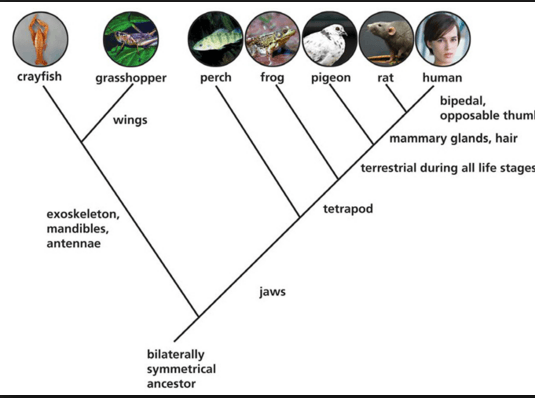
What characteristic do all organisms on this cladogram share?

a)

Loss of opposable thumb on foot

b)

Four kinds of teeth

c)

Central eye area

d)

Downward pointing nose

17.
How will this mice population most likely change in the future?
a)
The white mice will go extinct.
b)
The grey mice will go extinct.
c)
All of the mice will grow longer fur.
d)
All of the mice will grow longer claws.
18.

What term refers to body parts that perform a similar function but differ in structure?

a)

analogous structures

b)

homologous structures

c)

pharyngeal pouches

d)

vestigial pelvis

19.

The picture shown is an example of

a)

Vestigial structures

b)

Homologous structures

c)

Analogous structures

d)

Fossils

20.

Which process of evolution is demonstrated below?

a)

Comparative anatomy

b)

Homologous structures

c)

Comparative embryology

d)

Vestigial structures

21.
The picture shows the members of the Camelidae family. The physical features and the geographical origin of these animals provide evidence that - 
a)
they live in the same type of environment.
b)
have slowly evolved to become herbivores.
c)
have a common ancestor.
d)
exchanged DNA in the past.
22.

Recently, scientists have been able to use ___________to find common proteins and amino acids to determine how closely related species are.

a)

DNA

b)

Vestigial structures

c)

Fossils

d)

Homologous structures

23.

Which IS NOT used as evidence for evolution?

a)

Fossils

b)

Natural Selection

c)

Early Development/Embryos

d)

Body Structure/Anatomy

e)

DNA/Proteins

24.

Which of the following best describes the tiny legs whales have?

a)

structures that grow and improve in function as they are used

b)

structures that function at certain times of the year

c)

structures that will become adaptations when the environment changes

d)

structures that have lost all or most of their function over time
25.
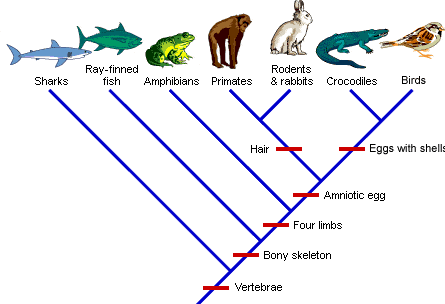
According to this cladogram, sharks are MOST closely related to which organism? 
a)
Amphibians
b)
Ray finned fish
c)
Crocodiles
d)
Birds
26.
Which trait do only humans have, according to the cladogram?
a)
jaws
b)
mammary glands & hair
c)
terrestrial during all life stages
d)
bipedal & opposable thumbs
27.

Genome maps provide the DNA sequences of chromosomes. Some scientists have compared the genome maps of a hedgehog and a sloth. What do these genome maps allow the scientists to determine?

a)

The color patterns of the offspring of each species

b)

How much the size ranges of the two species differ

c)

The methods of protein synthesis that each species uses

d)

How closely related the two species are to each other.