
 Worksheets
10th P.S Quiz-14(Refraction at curved surfaces)by PRABHAKAR
Total questions: 40
Worksheet time: 20mins

The point where the rays meet is known as....
centre of curvature
the focal point
optic centre
Plane of the lens
Which describes a convex lens?
triangular in shape
more transparent at the middle
thicker at the edges than at the middle
thicker at the middle than at the edges
Which lens represents the path of light through a diverging lens?


Equation for refraction oflight at curved surface is
n1/u - n2/v = (n2 - n1)/R
n2/u - n1/v = (n2 + n1)/R
n2/v - n1/u = (n2 - n1)/R
1/f = 1/v - 1/u
------ lens is thin at the middle and thicker at the edges.
Biconvex
plano convex
Biconcave
glass slab
Distances measured in the direction of the incident ray are taken as
positive
negative
either positive or negative
depends on lens
Any ray which is passing along principal axis of a lens is -------
passing through focus after refraction
un deviated
passing parallel to the principal axis after refracion
can't pass
Focal plane is the plane which is ..... to the principla axis -----
parallel; at focus
parallel; at optic centre
perpendicular; at focus
perpendicular; at optic centre
Focal length of a lens depends on which of the following factore?
Radii of curvature
material of the lens
medium inwhich the lens is placed
all the above
What type of image is formed when rays of light will not actually intersect?
real
virtual
projected
curved
When an object is placed between the focal point and the convex lens, the image produced is ___.
real, reduced, and inverted
real, enlarged, and inverted
virtual, enlarged, and erect
virtual, reduced, and erect

The object distance will be a _________________ value.
positive
negative
either positive or negative
can't say

The image distance for a real image will be a _________________ value
positive
negative
either positive or negative
can't say
When light travels through a lens and the image produced from the lens cannot be projected onto the screen, which type of image is produced?
real
refracted
virtual
inverted
A glass lens is immersed in water. What will be the effect on the focal length of lens?
increases
decreases
remains constant
answer does not depend upon the medium
an air bubble inside water behaves as
converging lens
Diverging lens
magnifying lens
none of the above

An equiconvex lens of focal length 12 cm is cut into two halves as shown in figure. Find the focal length of each part?
-24 cm
24 cm
12 cm
-12 cm

If the central portion of a convex lens is wrapped in black paper as shown in the figure
No image will be formed by the remaining portion of the lens
The full image will be formed but it will be less brightness
The central portion of the image will be missing
There will be two images each produced by one of the exposed
portions of the lens

The above lens is a type of ___.
concave lens
convex lens
plano concave lens
concavo convex lens

A student draws three rays of light from point P through a converging lens. Each point labelled. F is the principal focus of the lens. Which of the rays are drawn correctly?
ray Y only
ray Z only
ray X and ray Y
ray X and ray Z
Which figure represents the path of light through a converging lens?
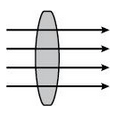
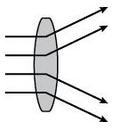
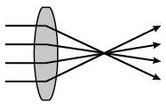
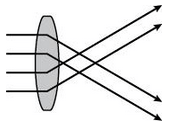
A bird is flying down vertically towards the surface of water in a pond with constant speed. There is a fish inside the water. If that fish is exactly vertically below the bird, then the bird will appear to the fish to be :
closer than its actualdistance
moving slower than its actual speed
farther away than its actual distance
fish is unable to see the bird
All the distances are measured from
principal focus
centre of curvature
optic centre
any where
------ lens is also called as converging lens
convex
concave
both concave and convex
can't say
The light ray passing through the focus will --- after refraction form a lens
pass through centre of curvature
parallel to the principal
pass through optic centre
undeviated

what type of lens is the lens given in figure
double convex
plano convex
double concave
plano concave
The ray passing through the ----- of the lens is not deviated.
Focus
optic centre
centre of curvature
none
which lens always forms virtual image
convex lens
plano convex lens
concave lens
all the above
Focal length of the plano convex lens is ----- when its radius of curvature is R and n is the refractive index of the lens.
f=R
f=R/2
F=(n−1)R
F=R(n−1)
An object is placed at a distance of 10cm from a convex lens of focal length 10 cm. The image is formed at .....
10 cm
20 cm
100 cm
infinity
The minimum distance between an object and its real image formed by a convex lens
32f
2f
25f
4f
A concave lens forms a virtual image, when the object is placed
in between F and optical centre
at F
beyond 2F
any position before it
A ray after refraction passes through focus, it passes ----- before incidence on lens
through focus
through optic centre
parallel to principal axis
through centre of curvature
A convex lens forms a diminished image, when the object is placed
at F
beyond 2F
between 2F anf F
between F and O
Height of the image is taken as negative for ----- images
erect
inverted
virtual
none of the above
Magnification produced by a convex lens is -2, then the image is
real, inverted and diminished
virtual erected and diminished
virtual, erected and magnified
real, inverted and magnified
which of the following is correct
Convex lens always forms real image
concave lens always forms magnified image
convex lens always forms diminished image
concave lens always forms virtual image

