
 Worksheets
Bonding and Nomenclature
Total questions: 30
Worksheet time: 41mins
Name
Class
Date
1.
What type of bond forms when electrons are transferred from one atom to another?
a)
ionic bond
b)
atomic bond
c)
covalent bond
d)
metallic bond
2.
The bond between Na & F. Ionic or covalent?
a)
Ionic
b)
Covalent
3.
The bond between N & H. Ionic or covalent?
a)
Ionic
b)
Covalent
4.
Which of the following gives the correct chemical formula for the compound Magnesium Phosphide?
a)
Mg2P3
b)
MgP
c)
Mg3P2
d)
MgP2
5.
What is the correct chemical name for the ionic compound: Na2O
a)
Sodium oxide
b)
Sodium (II) oxide
c)
Disodium monoxide
d)
Disodium oxide
6.
What is the correct chemical name for the ionic compound: Fe3N2
a)
Iron nitride
b)
Iron (III) nitride
c)
Iron (II) nitride
d)
TriIron dinitride
7.
What is the correct chemical name for the molecular compound: SF4
a)
Sulfur Fluoride
b)
Sulfur TetraFluoride
c)
TetraSulfide Fluoride
d)
Sulfur (IV) Fluoride
8.
What type of atoms make a covalent bond?
a)
only Nonmetals
b)
Metal and a Nonmetal
c)
only Metals
d)
only Noble Gases
9.
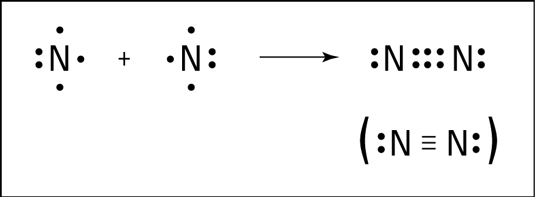
Given the picture, what type of bond is holding the atoms together in this molecule?
a)
polar covalent bond
b)
nonpolar covalent bond
c)
ionic bond
d)
metallic bond
10.
What is the chemical formula when Al+3 and PO4-3 bond?
a)
Al(PO3)4
b)
AlPO4
c)
Al(PO4)3
d)
Al3(PO4)3
11.
Co+2 combines with NO2- to form
a)
Co2(NO2)
b)
Co(NO2)2
c)
NO(Co)2
d)
Co(NO)3
12.
According to the octet rule most elements need _______ valence electrons.
a)
2
b)
8
c)
6
d)
18
13.
Hydrogen needs _____ electrons in its valence shell to be stable.
a)
4
b)
6
c)
8
d)
2
14.
Three pairs of electrons are shared in a
a)
Single bond
b)
Double bond
c)
Triple bond
15.
Which is the correct molecular structure for carbon dioxide?
a)
b)
c)
d)
16.

This is a correct dot diagram for oxygen (O)
a)
true
b)
false
17.

Which of the following is the correct Lewis dot structure for the molecule fluorine (F2)?
a)
A
b)
B
c)
C
d)
D
18.
When writing Lewis Structures, only __________ electrons are used.
a)
Inner shell
b)
Core
c)
Valence
d)
Stable
19.
A(n) _________ is an ion with a positive (+) charge.
a)
anion
b)
cation
c)
ion
d)
solute
20.
PO43-
a)
Hydrogen phosphate
b)
Phosphate
c)
Phosphide
d)
Phosphorus Tetraoxide
21.
NH4+
a)
Nitrate
b)
Nitrite
c)
Ammonium
d)
Thiocyanate
22.
CO32-
a)
Thiocyanate
b)
Carbonate
c)
Hydrogen carbonate
d)
Borate
23.
Which of the following is a characteristic property of ionic compounds?
a)
They form hard, brittle crystals with characteristic shapes
b)
They have low melting points
c)
They have low boiling points
d)
They contain no charged particles
24.
In what form can an ionic compound conduct electricity?
a)
when dissolved in water
b)
as a solid
c)
as a crystal
d)
when warmed slightly
25.
Which of the following statements is correct?
a)
Metals tend to gain electrons and become positive.
b)
Metals tend to lose electrons and become negative.
c)
Metals tend to lose electrons and become positive
d)
Metals tend to gain electrons and become negative.
26.
what is the name of CCl4?
a)
carbon tetrachloride
b)
monocarbon tetrachloride
c)
tetracarbon monochloride
d)
carbon chloride
27.
Name this formula:
KNO3
a)
Potassium Nitrogen Oxide
b)
Potassium Nitride
c)
Potassium Nitrate
d)
Potassium (I) Nitrite
28.
How many electrons are shared in a double bond?
a)
2
b)
4
c)
6
d)
8
29.
The proper formula for magnesium hydroxide:
a)
MgOH
b)
Mg2OH
c)
Mg(OH)2
d)
Mg2OH2
30.
Which type of bond creates a "sea" of delocalized, mobile electrons between atoms?
a)
Ionic Bonds
b)
Covalent Bonds
c)
Metallic Bonds
d)
Saving Bonds
100 %

